
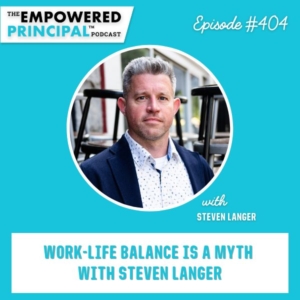
Ep #404: Work-Life Balance Is a Myth with Steven Langer
School leaders everywhere know the feeling – you’ve been pushing the boulder up the mountain since August, giving 200% to launch the school year successfully. The adrenaline that carried you through the first weeks starts to fade, and suddenly you’re wondering how you’ll sustain this pace or create any kind of work-life balance.
This conversation with Steven Langer, former principal and CEO of Well by Design, comes at the perfect time. Steven brings a refreshing perspective on sustainable leadership that challenges the traditional notion of work-life balance. His journey from walking school hallways with a clipboard (sometimes just to look busy while his mind was on overwhelm) to transforming a struggling school’s culture offers practical wisdom for every educational leader facing the intensity of a new school year.
Join us today as Steven shares how his school went from 300 suspension days to just 10 in three years, not through policy changes or disciplinary crackdowns, but through a fundamental shift in leadership mindset. You’ll discover why work-life “coherence” is more realistic and sustainable than work-life balance for school leaders, and how building capacity in others multiplies your impact far beyond what you could achieve alone. Most importantly, you’ll learn why taking care of yourself is essential modeling that gives your entire school community permission to thrive.
The Empowered Principal® Collaborative is my latest offer for aspiring and current school leaders who want to create exceptional impact and enjoy the school leadership experience. Join us today to become a member of the only certified life and leadership coaching program for school leaders in the country by clicking here.
What You’ll Learn From this Episode:
- Why work-life “coherence” is more realistic and sustainable than work-life balance for school leaders.
- How to recognize the early warning signs of burnout.
- The power of a “to-done” list versus a to-do list for managing overwhelm.
- How to triage decisions using a red-yellow-green system when everything feels urgent.
- Why transparency about taking breaks actually strengthens your leadership credibility.
- The critical role of belonging and value in transforming school culture.
- Practical strategies for building leadership capacity throughout your school community.
Listen to the Full Episode:
Featured on the Show:
- If you’re ready to start the work of transforming your mindset and start planning your next school year, the Empowered Principal® Collective is here for you. Click here to schedule a consult to learn more!
- For a free call to review your year, get in touch with me: Facebook | Instagram | LinkedIn
- Participate in The Summer of Fun by joining us in The Empowered Principal® Facebook Group, Emotional Support for School Leaders, today!
- Sign up for The Empowered Principal® Newsletter
- Podcast Quick-start Guide
- Schedule a 15-minute Q&A Call with me
- Steven Langer: LinkedIn
- Well by Design
- Stop chasing work-life balance – Steven Langer’s TEDx talk

Full Episode Transcript:

Hello, empowered principals. Welcome to episode 404.
Welcome to The Empowered Principal® Podcast, a not so typical educational resource that will teach you how to gain control of your career and get emotionally fit to lead your school and your life with joy by refining your most powerful tool, your mind. Here’s your host certified life coach Angela Kelly.
Angela Kelly: Well, hello, my empowered principals. Happy Tuesday, and welcome to the podcast. I have a very special guest for you today. This is Steven Langer, and he is the CEO of Well by Design. He and I connected online. We had a meet and greet, instant connection, and so much to offer you guys. I think this is the perfect time of year to be sharing Steven’s story and all that he offers and contributes to the field of education. And he has a TED Talk, right? So you’ll want to look that up. We’ll put that link in the show notes for you guys.
But Steven has so much to offer school leadership. We really connected talking about school leadership. He is a former school leader, which, of course, I screen because I want people to be very relevant on the podcast. And I am really looking forward to this conversation. So, Steven, welcome to The Empowered Principal® Podcast.
Steven Langer: Thank you so much, Angela. I’m really excited to be able to be a part of this. I really enjoyed connecting with you originally and looking forward to a great conversation.
Angela Kelly: Yeah, great. So I always just start off. I’m going to let you introduce yourself a little bit more. Tell the listeners who you are, your background, and how you created Well by Design.
Steven Langer: For sure. So I am a former principal, but as we always say, once an educator, lifelong educator. So that is a passion of mine. I stay very connected to the education system, though I’m up in Canada, so my education system may slightly be different than some of your listeners. And so after working as a principal, I moved into some systems work and worked on curriculum development for the K to 12 education here in Edmonton, Alberta, for the province of Alberta. Beyond that, I worked to support the entire province in the governance and assembly aspect of things working with government and did a fair bit in terms of policy development working with educators.
After that, I felt like I had done everything I could for the education system and it was the time to move. And so it was an opportunity for me to make a shift and start my own company focused on organizational wellness. We see so many educators and so many people that are pushing themselves to the absolute brink and to the limit. And burnout is a major issue, and I think that I’ve found ways that actually work to help people build a sustainable and optimal workplace culture. So that was my shift. Now I do speaking at conferences for educators as well as in the private sector. I also do work directly with schools and with organizations on helping to build those healthy workplace cultures.
Angela Kelly: Yes. So listeners, I want to highlight something. You’re hearing this at the end of September. You have been putting in 200% to kick off the school year, to onboard students, families, teachers, staff members. You’re pushing the boulder up the mountain in the fall phase of the school year. And now we’re getting into to October, and this is where the fall dip occurs. The burnout will feel real, and you’ll be thinking to yourself, oh my gosh, it’s only October. How am I going to sustain myself?
And that’s what this conversation is for. So really tune in, listen to this, replay it if you have to, if you’re listening to it in the car and you want to take notes because we want to give you tools to help you now at the beginning of the year. When you’re feeling the fatigue of the launch of the school year, but there’s so far to go and you want to gain clarity on your goals, you want to stay focused, you want to keep the priority the priority. And there is a level of fatigue, a level of overwhelm, and I would say like all of those pressing priorities where everything feels urgent, everything feels important, everything feels like it needs to be done yesterday. So Steven’s going to offer you some insights to that.
So I love that you’ve been an educator. I love that you talk about educational policy because a lot of times in education, we wait for the policy to trickle down to change our culture and change our environment versus looking at what we can do within our system in this seat on the bus. Yes, policy is important, and we need to meet policy where it’s at, but feel empowered while we’re in the seat of education, whether you’re a school leader, a district leader, an aspiring leader, or a teacher out there. What are some things that you could recommend, Steven, where yes, there are policies and procedures that we put into place, but how do we impact culture on the daily in the little things that we do in the personal power that we have as school leaders?
Steven Langer: Yeah, I think the first thing is to exhale. As you said, you’re at that point, right? At the end of September, everyone’s pushing, everyone’s been going uphill, and I know that. You got all the parents that are looking to get their kids in the right space. You got teachers trying to make sure that they’ve got everything going for the year. You’ve got your classroom assignments all ready to go. And so now is a chance to exhale because honestly, the work will never stop as an educator. There is always more. And so it’s important to take that moment to exhale.
Here in Canada, we’ve got Thanksgiving in October. And so that’s our like first marker. That’s the first long weekend where it’s like we made it. And so you’re now into it, you’re into the school year, take that moment for yourself. I think because we can push ourselves so often, it is even more important to rest. And what I mean by rest is actually not just like lay down and watch Netflix and scroll your social media, right? I think that it’s really important that we actually do things that help to renew us and help to bring us that energy.
So it may be getting out and going for the run, it may be spending time with your friends. The idea being that you do the things that you love so that it can sustain you because if we just push through, there’s research to show that when you’re just pushing through, you’re pushing through it at sometimes only 30%. And so while you think you’re working hard and going all, you know, full steam for your for your school, right, for your students, it may just be that you’re actually running on empty. And sometimes if you take that step back to rest, you come at it with a new light and a new approach because if you’re not good for yourself, you’re going you’re no good for anyone.
Angela Kelly: Yes. Yes. And your TED Talk is on kind of throwing the concept of work life balance out the window and redefining it. Can you describe that a little bit more because I think people feel like it should be this 50/50 split, whether that’s time or effort or the amount of energy exerted in your personal life and your professional life. And you’re kind of mixing that up a little bit. So I love this idea, this conversation. So tell us a little bit more, your insights on work life balance and redefining that for the school leader.
Steven Langer: Yeah, absolutely. That’s a big push for me because honestly, life is too complex to have your work and your life fit together on a scale and to be able to balance it at 50/50 with so much that we have going on. And I think when we do that, we also forget about our health, which is the third component within that. And so often we put so much on our work and so much on our home that we forget about our health, and then we crash and burn. And it’s like it’s so indicative of teachers and educators because every major break is crash time as opposed to enjoy your holiday time, right?
And so for me, work life balance, in my mind, is something that we’re pushing for that doesn’t exist. I think the mentality needs to shift towards work life coherence. And what I mean by that is coherence by definition means that it fits together and it makes sense. And so rather than it being 50/50, there are going to be seasons where we’re investing more, and there are going to be seasons where we’re able to use more time for ourselves to renew and recharge. And that can be depending on the stage within the school year, that can also be depending on the stage that you have in your life, whether you have family commitments or health commitments, caring for loved ones at home, whatever it may be.
But the reality is that we need to allow ourselves that monkey off our back where when it’s not 50/50, we start to feel guilty. We start to feel stressed, we start to feel frustrated. And instead, as we shift towards work life coherence, it allows us to do it with intention rather than just by default. And that’s the biggest piece to it is that when we move with intention, we’re deciding how we’re going to allow the flow within our work and our home to make sense for the stage that we’re at as opposed to just constantly feeling like there’s always more.
Angela Kelly: Yes. Ooh, I love this. I love this. I was just teaching a mastery, a planning mastery course, and one of the things that I talk about is there are seasons in the school year. I teach a three month plan, so we plan the fall season, winter season, spring season, summer season. And in fall, there needs to be an acceptance that I am going to invest more than 50% of my time in the beginning. But, and I should say, and if we believe that we should be investing 200% in July and August and September and October and November and December, and then again in January, then that is where you start to feel like overwhelmed, you feel fatigue, you feel burnout.
But it’s also discouraging because it there’s no space for anything else, your personal life, right? And so there is that intention that you mentioned where you’re going to intentionally overwork in probably August and September. Now we’re getting into October, 2 months of hard work being intentional in October. And it’s beautiful for Canadians that they’ve got that built-in break for Thanksgiving in October. I we had some friends. I had a colleague of mine, her name was Sharon, and she was from Canada, so she would take off days to celebrate Canadian Thanksgiving. And then here in the states, it is in November.
So people here in the states are holding their breath from August all the way until the end of November. So October feels like, oh my gosh, I’m running a marathon that’s never going to end. And I invite you to like give yourself permission to with guilt free, no shame, no guilt, take some time for yourself and build back in October, the month of some rest and some recovery and some fun, knowing that you’ve put in two full months of really hard work.
I think this is what you’re saying, Steven, where it’s like, it isn’t 50/50 every week of the month or every month of the year. It’s there’s this ebb and flow to life, there’s this cohesion where there’s a dance of more and less and more and less, but the collective, like in the long, like the long game of this all, there is a cohesion that you feel complete, you feel fulfilled, right?
Steven Langer: You’re bang on right. The only thing I’m going to add to that is that you said we can start to take rest because it’s in October. I think that in order for us to be sustained, we need to do that in August and September too. If we’re going only work in August and September, we’re not going to be at our best. And so as leaders, your goal is to be empowering. Your goal is to be innovative and to have insight into things.
In order to do that, you need to be able to pull back and you need to be able to think about things, reflect on things, remove yourself from the situation. And so, especially at the beginning of a school year, when something doesn’t quite fit right and you’re trying to find the solution that’s going to work best for your educators, for your students, for your family, your community, you’ve got to be able to remove yourself and be able to see that. And sometimes you get that in those moments when you’re not head down into your work.
And so, yes, commit yourself fully because that start of a school year is always going to be a sprint. But at the same time, I think it’s important that we make sure we take time for ourselves. And it’s not, you know, it can be simple moments where, you know what, lunch is going to be outside every day. You’re going to go outside and you’re going to get your fresh air and your sunshine just to get a moment away from it all. You know, whatever it is, you know, making sure that dinner at the table every night so that you could connect with those you care about. That’s simple things that provide you that moment of rest so that you can recalibrate.
Angela Kelly: Yes. No, absolutely agree. And I believe the key to this is knowing the beginning of the year, it might be a 70/30, you know, balance, right? That might be what balance looks like for the first couple of months. But there’s still 30%. So we’re not saying 100 don’t eat, don’t sleep, you know, no self-care. But being okay with making peace with there will be a bigger push and this actually leads me to my next question. There will be this push, but if you always have your foot on the gas and you’re always expecting yourself to give 100% here and get the rest and get the play, that’s when it feels like there’s too much to do and not enough time and overwhelm sets in and then frustration will set in and it will be this loop you feel like you have a hard time getting out of because I hear, I can hear listeners right now saying, yes, Steve, we hear you, we agree with you and it doesn’t feel like I can take the time. I don’t have the time. Like I don’t know how to fit that in.
So do you have – I actually have two questions. My first question that came to mind was, what are some signals, like internal or external signals to a person that can help them create awareness like, oh, I’m leaning down the path of burnout, but I’m getting some early signals, indicators that I’m on this path to like overworking or I’m on the path to not giving myself that, you know, that opportunity to breathe and exhale and think. So what are some signals there?
And then two, when the brain is offering to all of us like, but there is so much to do, it does have to get done. I don’t literally see mathematically how I can take time to fit in an outdoor lunch or a walk or a, you know, a me time, right? As people would say, like, if I do that, one, that’s going to be perceived that I’m not doing my job, or two, I’m not getting done the things I need to get done. So if someone’s in resistance to they can see it intellectually, but they’re in resistance to like what that reality might look like, what might you say to them?
Steven Langer: Those are like very deep questions that are so that are so at the heart of what we’re doing. I love it because it’s at the heart of every, like I can picture myself in my school. I used to walk around with a clipboard sometimes just to appear like I was doing something because my mind was just on overwhelm. I was like, I got nothing. So I’m just going to walk around, chat with some kids, and make it look like I’m doing something because otherwise my mind’s going to melt. And I bet that there are a lot of educators that are in that space, principals, leaders that are in that space.
So the first thing, those signals that you’re talking about, I’ll give you two. The first one is this brain fog that you end up getting, right, where it’s all of a sudden like, what was I doing again? Hang on a minute. And you know, you start to disconnect and you start to not be as sharp as you regularly are. And it follows up with the idea of decision fatigue where you’re feeling like I can’t make any more decisions. No more, right? Because this idea that you’re constantly getting asked things and then next thing you know, even the smallest decision seems massive and you know, when you’re like, I can’t even respond to another email.
When you get into that phase and you start to feel that brain fog, you’re well down the path towards burnout already. And it’s really time to recalibrate. Listen, we’re all we all have a bandwidth. And so if we’re like, well, I’ll just push through again, yeah, okay, and the myth around this with burnout is that at first, it can almost seem positive. We can almost have a spike in our performance because the adrenaline, the cortisols are kicking in and we’re in game mode and we’re like, yeah, I can push through. I even get more done when I push through.
Fair. I’ve been there. And you’re like, I’m crushing it. And there’s no problem. But the reality is that’s you’re in game mode, right? And that’s fight, flight, freeze mode. You can only do that for so long before all of a sudden that brain fog kicks in, decision fatigue kicks in, and then it’s a quick drop. And so those are the two things around signals. If you start to notice that, it’s really time to build in rest.
And the best ways to build in rest is outdoors. And so getting to your when you do have so much on the go and people are you thinking, well, what if people think I’m not doing anything? They’re working hard and I’m doing nothing. That’s where transparency comes in. And so at the beginning of the year with my staff, when I was in schools, I would meet with them and say, look, you can have my job tomorrow if you want it. The reality is that yeah, sometimes it looks like I’m not doing a lot because I’m walking around the school outside or I’m taking a moment. That’s probably when I’m thinking about the biggest decision I have to make that day, and I need clarity. I can’t be in the noise.
And so just trust that we’re all doing our job. I’m trusting that you’re doing your job. And if I’m taking a moment, it’s because I need it, right? It’s because I need to let my brain come down from what I was previously doing or gear into what I am doing. And so when you’re transparent about that, you don’t have to apologize for it anymore. You know, the idea that it’s like, well, I can outwork you because I’m the leader and I have to always be on. That’s false, right? We’re all human and we’re all are giving our best. Let’s just trust that and let’s assume the best in each other, right?
So to the things that when I got into that tough mode where there was nothing left, the first was to do a to-done list because it’s so easy to look at that to-do list and get so overwhelmed. There’s always more. But when you actually have a list that is on the side where it’s like, this is what I’ve done, check, check, check, that’s the dopamine hit that you need to be able to be like, oh, I’m actually making really good progress today, even though it doesn’t seem like it because my list is longer than when I started. But you’re like, it actually allows you to see progress and it allows you to see the way towards the end. So taking a look at the to-done list and allowing yourself to see, okay, I’m making headway. We’re going forward.
The other piece is to triage that workload, just like in first responders. When you’re so busy, it seems like everybody’s situation is urgent and I got to deal with it right now, especially when an educator comes in and says, I have a big problem. Well, yeah, guess what? It might be a big problem to you, but right now you’re going to have to deal with that because I have other problems. And so I’ll get to it, but you know, so when you’re triaging, it’s basically saying, okay, these are the red, the yellow, and the green problems. The red problems, these are the red decisions that you need to make in a day that are like, this is big. You know, this is I have to decide this today or else this is going to go sideways. Yellow are, you know, more urgent, but they can wait. And green are these are things that, yeah, they have to happen, but they’re not more important than my red. And so if someone comes into you with what they think is a red and it’s a green on your scale, you need to tell them that. Yes. And so, you know, hey, I’m happy to have this conversation with you. We’re going to have it at the end of the day.
So those are two strategies. The other piece, and this really gets to the core of leadership is you’re one human being. You can only do so much. And the best way to build capacity within your school is to build capacity within your team. Let go of decisions that you don’t have to make and trust your team to make the right decisions.
Angela Kelly: Yeah, this is brilliant. And what’s so refreshing about this approach is the transparency piece. It’s not about what it looks like, what leadership looks like. We’re no longer trying to portray leadership or like role play being a leader. And I know sometimes in the beginning, your first year, sometimes you feel like you have to fake it until you make it, as I was told, or like just you have to just kind of pretend you’re being the principal until you figure out what you’re doing. And then you realize you’re really never know what you’re doing. You’re just doing the best you can with what you know and your experiences and all of that.
But the transparency is the freshness because when you were saying, if I’m out on campus and someone’s, what are you doing? Or what’s coming up or whatever and they ask you kind of or call you out, to say the truth. Like I’m having a moment, I’m taking a minute for myself. Number one, you’re modeling what it means to be a human in education. We all need a minute. We all need a moment. Number two, you’re not trying to create a facade of leadership. You’re modeling what it actually looks like, what it is to be a leader. And what it is to be a leader is you have moments of fatigue and overwhelm, and grounding yourself by getting out into the sunshine or taking a walk or being if you have an indoor campus, whatever that looks like for you, being honest and transparent about that, I think is the culture shift that is what allows us to be humans as the adults on campus.
I love the transparency piece because I think it models, it reflects what it actually the job actually is and what it means to be a human in education and it gives the adults on campus permission to also take a breath, take a minute, go grab lunch off campus if they have a break or they’re allowed to do that. Whatever that looks like for them, whatever feels good and grounding for them, giving ourselves permission as adults, not judging it, expecting the best, like that positive presumption that you’re doing your job, I’m doing mine. I’m taking care of my needs right now on this little walk I’m having with my clipboard, right? I’m taking care of me because I trust that you’re taking care of you, right? That’s just it’s a different energy, it’s a different vibe. It’s more truthful of the experience of educators.
Steven Langer: Yeah. Yeah, and I think you hit on something really big around the idea of like the impression of leadership and the role of a leader. And you know, as I mentioned, there’s only one of you. And so the most impactful thing that you can do as a leader in your building is empower others to lead. And so because that’s where you see that magnification of the things that you can do. The capacity grows so much further when you don’t feel like it has to go through yourself.
And that’s not like you don’t have to feel like you’re making yourself redundant in that. It takes courage as a leader, and people will see you as a stronger leader when you let go of power. And I actually say like, no, I trust you. Let’s do this. But you need to build your team towards that so that they understand that they have capacity to make decisions, that you trust them and they’re empowered. You know, this is the empowered principle. The whole idea is that the empowered principle empowers their team to lead so that they can lead effectively.
Now, can I go down the rabbit hole of a of a fun story? Because you know, I think we’ve chatted about this one anyway. And so, you know, because, yeah, great, Steve, sounds good, but I’ve got a team that. And so, hey, I was a principal, and I walked into the new school that I was at, and on the first day of that school year, the principal and I were both vice principal, we’re both brand new. We go outside at recess on the first day, and there are kids kicking soccer balls up onto the roof so that the caretaker has to get them down. There were kids that were linking arm in arm across the highway to block traffic so that the traffic couldn’t get by because they thought it was funny.
So this was what we witnessed on our first day. Now, to be fair, you know, we looked at each other like, what did we get into? But at the same time, we were, you know, the previous administration had done an incredible job working with the staff in terms of policy and process. The lesson plans were tight, they knew exactly what the rules were, they had policies and strategic plans ready to go. So this was a staff that was almost like, you know, the potential energy, they were like shot back in a in a slingshot, ready to be released. The problem is that the they hadn’t gotten that far yet to be released. And so there were a lot of discipline issues in the school. There were over 300 suspension days in the first year that I was there. Like it was a lot to try and shift like it was a lot. But the staff were so good, and you could tell that the kids were just misaligned. You know, they didn’t have value within the school. They didn’t believe that they were cared for within the school. And so it took this, not because of the teachers, it was just this culture shift.
And so we really embarked on this idea of empowering your staff. And so one of the first things that we did is we needed to change our mindset and change our view within the community. It was a small community, so the school was really the culture hub, and they were seen as a problem. So we needed to shift that. We also needed to give kids ownership of the school because it’s their school, right? And so that’s where they go to learn. And then the last thing was to shift it for the teachers to make sure that they knew that they had capacity to be leaders.
And so we’ve embarked on this process where in the community, every home room classroom had a service project that they had to do for the community. And so it was to help build culture, build community within the broader town. So it might be shoveling walkways because up in Canada it snows a lot, so maybe we’re doing that for the for the seniors in our community. We did have a seniors complex, so we had a bunch of kids go and play with like games and build relationships with the seniors. We had some that were doing some painting and community projects. We hosted evening events within our school for community members. Everybody had a role so that they could help shift the narrative around the culture within the community.
Then the students each had a role within the school where they were a leader. For some, it was like a one day thing. And for others, you know, for our kids who are more prone to vandalize furniture and stuff, they became the ones that were building the furniture because then they protected it. You know, problem solved, right? But everybody had a role. So we built an indoor learning garden, totally shifted a common area so that people could gather and have like multiple seating areas and like, let’s gather together, let’s learn together, let’s turn it into a community.
And so some kids were responsible for the learning garden, some were responsible for the tech. It didn’t matter what they did, but they had a role so they belonged. And that was key because as soon as students feel like they belong, they have a place to go and they’re needed. Now I got to get up and go to school.
And then from there, the educators, we started shifting the programming to offer more flexible programming for our options that were more catered to what the staff were enjoying. We started to give them opportunities to lead in different capacities as well. And what we saw was that as people felt like they were valued and they belonged, the culture shifted, the mindset shifted, and behavior problems went away. And in the 3rd year that we were there as an administrative team, we had only 10 suspension days, not 300, and all of the indicators of achievement had shifted from struggling to thriving.
We actually had educators and administrators from across the province coming to look at some of the great programming that our staff were doing, right? And it wasn’t just me walking them around. It was like, come and see what our staff are doing. And the biggest indicator of that was about 5 years later, I’m speaking at an education conference, and there were more than 10 of the staff that I had worked with in that school who were at this leadership conference because they had branched themselves to be leaders, whether it be district leaders or principals or other roles of leadership. And that to me was like, okay, as a leader, are you building other leaders? So it was it was really cool. It was a really cool experience to see that major shift.
And so back to your original question of like, where does policy meet day to day? Sometimes policy changes when the day to day reflects the need for it. And so as we showed that you can shift an entire culture by building capacity and by building belonging and value and being creative in your programming, all of a sudden now other schools are like, let’s get this learning commons going. Let’s get this other programming going. And it started to shift the policies within your division as well.
Angela Kelly: Yes. Oh, that is a magical story and let me just say this because we talk truth and transparency here, this feels like a huge jump. If your school is struggling and you’ve got kids kicking balls on the roof and blocking traffic, if you’re at that point and then you’re hearing all of these statistics where the attendance came up and the behavior referrals went down and the test scores went up and it sounds like it’s too good to be true, it’s number one, it’s possible. This is a true story. And number two, it’s not that it happened overnight.
And I think as leaders, here’s what can change overnight is our perception of what leadership is, what it looks like, what it sounds like, what it feels like, its intention, its purpose. Leadership isn’t ego driven. It’s not me fixing problems. It’s not me having to know the knowledge and the wisdom and then imparting it on people and then marching people down the street and do as I say and do as I do and that’s not leadership. Leadership’s actually the opposite of that where when you’re leading people, they are choosing to follow. They are inspired, they’re listening, and we create that climate when our mindset shifts from it is my job to be the leader and look like a leader and be perceived as a leader versus let me show people what leadership looks like internal leadership from an internal space.
And that’s what you did was you said, hey, kids, you have value. This is your home, your school, your campus, your environment. This is you have ownership in this, what it looks like, what it feels like. Teachers, you too. And this isn’t a me building, this isn’t for me to just, you know, be the king or be the empress right here. It’s about we are in this together as a team for us, for them, for the greater good, as I always say. And when we shift from what do I look like as a leader to what is my intention as a leader? It’s an energy thing. It’s almost not a skill thing. It’s not so much what you’re doing, it’s who you’re being when you’re doing it and the energy that’s fueling the actions and decisions that you take. Would you agree with that?
Steven Langer: Yeah. Yeah, and I really think that if you’re trying as the leader to be the gatekeeper or to make all the decisions or to try and say like, no, as the principal or the leader, it’s got to go through me. You’re going to be limited in your capacity. And so the two major shifts that allowed us, and I say us because my assistant principal in that school was a dynamite. He was one of my mentors. He was an incredible human and he had some incredible ideas.
So the first thing is to shift your mindset because you’re right, everyone just needs to belong, feel valued, and feel like they have a role so that they actually want to commit and be aligned to that. And then the other piece is you really move forward when you allow others to make the decisions and you allow others to own certain pieces because instead of feeling like, okay, I don’t have time for that. I’ve got to go to this meeting or I’ve got to go do that. Great. They’ll go do that. They’re going to do something incredible and they’re going to tell you about it later because they know the values, they know what we’re doing. We’re aligned in what we’re trying to achieve, so you don’t have to worry that they’re going to do something off base because they’re going to do something that’s totally aligned with where you’re going and it’s probably more creative than you would have thought of anyway. You just have to allow them and empower them to do it.
Angela Kelly: Right. Right. And you have to be good with that. We all rise when we’re not afraid to let other people shine, to let somebody be better at it than us, more creative or more whatever, let their skill set rise to the top. You actually shine when your staff and your students are allowed to shine. It’s not that our light needs to be brighter than theirs, it’s that we’re shoulder to shoulder. I call it, you know, equal value but different. So it we are all of our contributions have equal value even though they look different. So custodian to the, you know, customer service in your front office, to the dean, to the maintenance people, to the bus drivers, to the teacher, to the support staff, parents.
Equal contribution in terms of value, but it looks different. And when we say, I feel like so many times everyone’s like, well, change your mindset. That’s all you got to do. And it’s like, here’s what I think Steve and I mean when we say change your mindset, expand your perspective. So you don’t have to drop what you believe is true. You simply need to ask yourself, what else is true? In addition, what else is true and expand your perspective like what else might be true? How else might I be able to trust my staff? How else might somebody else be able to take this on?
I always say, I always challenge my clients and I say like, if, you know, there’ll be a task on their calendar, we look through their calendar and I will say like, could somebody else do that? Like if somebody else can do it, then you shouldn’t be doing it. But there is a bridge that’s required when you delegate. You can’t just abdicate it. That’s different than delegating. It’s teaching and onboarding and training somebody to do it, but then releasing the reins and allowing them to do it in their own way. Let them shine, let them do it their way. And hey, this is where our work comes in. I wouldn’t have done it that way or I wanted it to look like this or we get our fingers into the how. It’s not the how, it’s done. Done is better than perfect. B+ work is okay. And sometimes what you think is going to be B+ work actually becomes gold star A+.
Steven Langer: Yeah, because it’s only your perspective when you’re thinking about this is how I would have done it. It’s like, yeah, but you know what, four other people would have rather see it this way. So, you know, maybe they actually had it right and you just let it go. You hit on a few key positions that I love talking about. So, you know, your custodian, like the role that they have within a building, I had such a great relationship with my custodian because they’re almost like the silent accepted person within the building where they’re always around, but they’re never around. And so the students say things that they probably wouldn’t have said if they knew someone was in with in earshot. And all of a sudden the custodian comes over and says, hey, this kid’s having a tough day. Now we can go deal with it or like, hey, by the way, there’s an issue happening over here. You should probably deal with.
And you’re like it’s just silent ears without even trying. But like when you think about the role that they play in terms of creating a welcoming space, you know, the first opinion that a parent has when they walk into your building is like if it’s clean and it’s ready to go and it’s shining, yeah, they’re feeling like you got things under control. If it’s a mess, then they think the whole thing’s a mess, right? And same with your bus drivers. First person that the kids sees, last person that the kids sees. And they have the ability to like start the day off right with that kid. Good morning. How are you? Good to see you. And now someone cares about you during your day. And at the end of the day, I’ll see you tomorrow. I always ask my bus drivers to say, I’ll see you tomorrow, because that like from a stance of kids that are dealing with mental health issues, that’s a really big piece because if a kid commits to seeing you tomorrow, they’re going to be there, which is good.
And the last one is my front office staff. They saved me so many times. You got a parent coming in hot, there’s an issue and they see it, they instantly cut them off and they’re like, “Hey, how are you? Great to see you. How’s your family? How’s this? It was a small town, they all knew them. And then, you know, let me get you a water. Okay, Mr. Langer, Steve’s just working with a student, he’ll come and get you right away.” I’m hiding under my desk. I don’t want to talk to that parent until they’ve cooled down a little bit. And so it’s like those kind of things where you just let go and allow someone else to take the lead allows you to do so much more within your building.
Angela Kelly: Yes. I love that story. That is so true. So hey, who really runs a school? Your custodians and your secretary, your support staff in the office. Like they’re really running the show. And I have a little story to share myself. So a couple of things, like Miguel was our primary custodian, he was our day custodian, and I would encourage him to play with the kids, to love on the kids, to like especially with lunch, like just to be lighthearted with them. He was kind of keeping to himself. And his primary language was Spanish. I said, no, talk to the kids in Spanish, speak to them in Spanish, allow there to be normal conversation, you know, and just natural and organic conversations.
And he was so loved, and they would, yes, they would share things with him or, you know, he was in earshot. It felt like he was everywhere on that campus all at the same time, and then nobody could find him at the same time. So it was funny. And then the bus drivers, I used to on hot days run out bottles of water or sodas or whatever. I knew their preferences over time, so I would like run out and, you know, thanks so much for what you’re doing. It’s, you know, the kids are coming in hot after a really warm day or something just to like or give them a cup of coffee in the morning, but really to let them know like, hey, you’re on this bus alone with 80 students.
You know, and I see you, I acknowledge you, and I thank you because I do not prefer to be driving this bus and doing your job, but I am so grateful you’re doing it, and I just thank you for that. We really want to celebrate all of the support staff. And just a shout out to all of you because this is another thing. Leaders aren’t leaders on their own. We’re not standing on a pedestal in isolation. We are founded upon the network of our community, and we are here to serve our community. We are here to serve those we lead, and we’re here to empower them and to support them and to celebrate and acknowledge them. And if you can do some of those things, which they feel like the little things that you don’t get to, but if they become the priority, you will find your job being so much easier.
Steven Langer: That’s the role of being a leader. You watch people thrive. It’s amazing.
Angela Kelly: Yeah, it’s really fun. Oh, this is inspiring. I hope this has been inspiring for you listeners. But Steve, I just I love to tap your brain, and we could talk for hours, but if I could just open it up, is there any last words of wisdom, tips, thoughts that you have as people are entering into, I know this is – we’re coming into the end of this first kind of season in school leadership. So this is dropping around the end of September, early October. What insights do you have for this point of the year?
Steven Langer: Yeah, I would say don’t wait till you’re thirsty to dig your well. And so the idea being that hey, it’s a push and it’s a long year and we want to do this for more than one year too. We don’t just want to do it for one year. We need to be well in order to do our jobs well. And if the leaders aren’t well, it resonates down to the rest. And so this idea of don’t wait till you’re thirsty to dig your well, don’t wait till you’re burnt out, stressed, tired, and exhausted to start taking care of yourself because climbing out of that well is a whole lot harder than caring for yourself along the way. And people want to see you caring for yourself because then it gives them the inherent permission to do the same. So don’t feel guilty about that. Take it and do it and lead the right way.
Angela Kelly: Yeah. Lead by example in that way. When teachers have permission to leave early, you know, or take that break or, you know, get the sleep that they need. That’s why I was asking you about kind of tips and strategies. I love the, you know, the brain fog thing because oftentimes we just think, oh, we’re just tired. But you can go home and get sleep and still come in with brain fog when you’re focused on the to-do list and not the get-done list or the to-done list like you said, but you can be physically rested but still feel burnt out, fatigued, brain fog.
So that’s an indicator that there’s another kind of fatigue happening, which might be like heart, soul, you know, your fun bucket might be empty or your what makes your heart sing might be empty and you might need to go and fill that a little bit or just again, grounding your feet, getting outside, breathing fresh air, sun on your skin, the smile of a child, you know, just the wink at a teacher like we’re in this together. Those little things can fill that back up very quickly.
Steven Langer: Yeah. Yeah, you know, you can be so easy to get caught up in the work part of things that like I got to be doing all this and this and this and this and this. But you can renew yourself by walking around your school, chatting with a student, you know, hearing about their weekend or just, you know, catching up with a kid, you know, take the time as an administrator to do that. It builds trust down the road and walk into a classroom and just celebrate your teachers. Don’t walk into, you know, with a clipboard ready to go and evaluate them. Sometimes just walk in and just enjoy what they’re doing because they’re doing great work.
Angela Kelly: Yes. Just smiling at them. Like go into a classroom and the teacher would you could see them like their body tense up and freeze and like they would start running around and like being crazy. And I would just put my hand on their shoulder or I would wink at them or I would smile at them or a thumbs up like it’s good, you’re okay.
Steven Langer: We got this. Just here enjoying the day with you. I trust you.
Angela Kelly: Yes. And then like I would like then divert my attention, not focus on the teacher, not looking at them, but talking to kids. And then the teacher can like, let that little adrenaline spike go, relax a bit and then go back into like doing what she or he does best. So, oh, this conversation is everything. I thank you for your time. Steven and I had little glitches here and there. Yeah, and this was ideal timing. I can feel it. This is going to be so powerful for our listeners out there. And if they want more information, Steve, about who you are, what you do, what you offer, can you just briefly tell us and then we’ll put all of that contact information in the show notes.
Steven Langer: Love it, for sure. Yeah, please reach out on LinkedIn at Steven Langer, as well, my website is WellByDesign.ca, not .com, so that’s a good one. And check out my TEDx. It’s just under my name at Steven Langer as well. But I love speaking at conferences, I love working with school teams, I love connecting in that way, and honestly, just reach out. I have no problem if you want to reach out and take your question or if you want some guidance on something. So please, education is my passion, so I always have time for that.
Angela Kelly: Great. Thank you so much for your time. Thank you for being here today. It’s been such an honor to get to know you and a pleasure. I look forward to collaborating in the future. I think we might be able to do some things with schools together.
Steven Langer: Oh, I love that. Yeah, it’s been a great conversation. Nice way to start the day for sure.
Angela Kelly: Yeah, awesome. Great. Thank you so much listeners. Have an amazing week, and we’ll catch you next week. See you then. Bye.
Thanks for listening to this episode of The Empowered Principal® Podcast. If you enjoyed this episode and want to learn more, please visit angelakellycoaching.com where you can sign up for weekly updates and learn more about the tools that will help you become an emotionally fit school leader.
Enjoy The Show?
- Don’t miss an episode, follow on Spotify, Apple Podcasts or RSS.
- Leave us a review in Apple Podcasts.
- Join the conversation by leaving a comment below!



Leave a Reply
Want to join the discussion?Feel free to contribute!