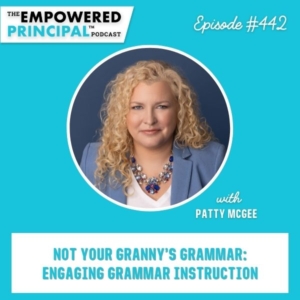
The Empowered Principal® Podcast Angela Kelly | Not Your Granny’s Grammar: Engaging Grammar Instruction with Patty McGee

Understanding how students experience and engage with language is key to creating meaningful literacy learning. Yet so often, grammar instruction is approached in a rigid, punitive, or overly prescriptive way, leaving both students and teachers frustrated.

In this episode, I talk with Patty McGee, author of Not Your Granny’s Grammar, about how she reimagines grammar instruction to make it engaging, experiential, and student-centered. We explore her philosophy for creating learning experiences in which students can experiment with language, reflect on their writing, and develop confidence, while teachers feel empowered to guide without fear of making mistakes. Patty shares practical strategies for classrooms and school leaders to make grammar interactive, joyful, and aligned with developmental learning.

Tune in this week to discover how engaging grammar instruction can transform literacy learning, help students develop confidence and agency, and support teachers in creating a classroom culture that values exploration, creativity, and reflection. You’ll walk away with actionable strategies to make grammar instruction both meaningful and memorable for students of all ages.

The Empowered Principal® Collaborative is my latest offer for aspiring and current school leaders who want to create exceptional impact and enjoy the school leadership experience. Join us today to become a member of the only certified life and leadership coaching program for school leaders in the country by clicking here.

What You’ll Learn From this Episode:

  • How to reframe grammar instruction as an engaging and playful experience.
  • Why traditional grammar worksheets may hinder deep learning and creativity.
  • Techniques for using manipulatives, sentence-building activities, and collaborative learning.
  • How to support teachers to feel confident in teaching grammar.
  • The role of reflection and curiosity in helping students internalize language concepts.
  • Approaches for integrating grammar instruction across grade levels, including elementary and high school.
  • How to build a classroom culture that values exploration, experimentation, and student expression.

Listen to the Full Episode:

Featured on the Show:

Episodes Related to Engaging Grammar Instruction:

Full Episode Transcript:

Angela Kelly: Hello, empowered principals. Welcome to episode 442. 

Welcome to The Empowered Principal® Podcast, a not so typical educational resource that will teach you how to gain control of your career and get emotionally fit to lead your school and your life with joy by refining your most powerful tool, your mind. Here’s your host, certified life coach Angela Kelly. 

Well, hello, my empowered leaders. Happy Tuesday and welcome to this episode of The Empowered Principal® Podcast. If you’re brand new to this podcast, we want to welcome you. If you’re a brand new leader out there, we are so excited for you and we hope that we get to be a part of your journey. So please tag this podcast as one of your favorites, give it five stars, and use us as a resource for you as you embark on your new journey as a school leader. So welcome to all of our new school leaders out there.

I’ve got a very special guest for you today. Her name is Patty McGee. I’m going to let her introduce herself. We just connected online, and I always, as you guys know, I always do a meet and greet because I’m looking for like the right energy, the right click. I want you guys to walk away with so much value. And Patty just, she right away was somebody that I knew you had to meet, you had to hear her story, her passion, her vision, her background, and what she’s bringing into education right now. 

And it’s interesting because I do a lot of interviews, right, Patty? And I have been talking about meeting you with my friends since we’ve had our conversation and I’m delighted to introduce you to the Empowered Principal audience. So Patty, welcome to the podcast.

Patty McGee: Oh, thank you. That warms my heart. I’ve been thinking the same thing about looking forward to this conversation with you. So thank you for having me.

Angela Kelly: Good. Very good. Well, tell us about yourself and yourself as an educator and Not Your Granny’s Grammar. We’re going to dive into that later, but I want to really let the audience know who you are personally and who you are as an educator and how you came into the work that you’re doing right now.

Patty McGee: Sure. It’s an unconventional journey. I started teaching in the mid-90s in the school that I went to as a student, and my principal was also my first-grade teacher. And so she taught me how to read and she taught me how to teach. And in that time, I really found really effective ways of employing some literacy instruction that I saw making a big difference. And that difference was just palatable. It was wonderful. I was reading books galore that were professional books.

But what was happening also was I would then teach grammar and it would be the same boring drills and things like that. I knew it was a problem with practice. And it stuck with me then as I became an instructional coach, a school librarian, actually before that, in this region where I live. I became a regional staff developer. I wrote two other books and that still, that problem of practice was still there in the back of my mind. And I would just experiment because I’m in classrooms all the time, demoing as part of the work I do as a consultant. And sometimes I just try something out with grammar.

And then I met my co-author, Tim Donahue, when I was consulting with his district. He was a supervisor at that time, and he all of a sudden taught the whole room, as we were writing grammar curriculum, how to understand grammar in a way that I had never heard before. So he had that and I had all of these ideas about how to teach grammar mulling around in my head. And back then we joked we should write a book together, and lo and behold, we did. And so that’s how we got to this place.

Angela Kelly: That is so wonderful. And just as you were telling the background story and your experience with grammar, I was having all of these images. Now, I loved school. I was that kid who loved school and I played school and I took the extra worksheets and I, you know, I was that kid. 

But even then, so I was a kid who loved school, and I was a kid who was, you know, good at school, you would say. Like I knew how to play the game and I was able to like complete my worksheets and do my homework. I just wanted to please the teacher, right? But I remember hating grammar. And then there were programs that would come in. And I’m a kid of the, like I went to elementary in the 70s, you know, upper school and graduated in 1989. So I was in the 70s and 80s, but there was a lot of like drill and kill. And it was just, it was kill, it was just grammar by death. And I really hated that.

And I can only imagine, and it breaks my heart. I was a kindergarten teacher for 15 years. So I loved it because I loved bringing the kids in and helping families. I loved it, but also it was such a primary year for grammar. And I saw the pushdown, right, as No Child Left Behind came in and then it was this crunch of then the standards came in and it was more drill and kill. And they would package it in different ways, but it was still drill and kill. 

And I am so eager to share what you’re offering because I want school leaders out there to know. And this is a perfect time. So this is going to drop in mid-June when people are thinking about their goals for the next year and their curriculum and their choices. And this, I really recommend grabbing this book and reading it and thinking about, especially if you’re teaching elementary, but even into middle and high school, and you’re going to talk about how grammar goes across. We discussed this in our meet and greet.

But let’s talk about the innovative way that you approach grammar and so it doesn’t have to be so drab and boring for both teacher and student. And we can actually make it fun, engaging, naturally engaging, and exciting for both, you know, teacher and student to participate in. So tell us a little bit more in detail about what you came across in your studies and findings.

Patty McGee: Absolutely. First, I’d like to give you just a tiny bit of background on how I’ve got here in terms of the thinking in this book, knowing that problem of practice and basically trying out lots of things that weren’t working. They were just like versions of the same thing, but maybe like cuter, like you’re mentioning, like different programs.

Angela Kelly: A little more artwork.

Patty McGee: Yeah, exactly. Exactly. I often find solutions to my problems of practice by looking at how I learn outside of school. And so that’s what I did. And I thought to myself, okay, something I’m learning right now is refinishing furniture with these special paints and waxes. And it’s very artistic. And so the first thing I do is I get curious. Like what paints and waxes might look good on this piece of furniture? And then I go to somebody who’s more expert and I ask them to show me how to do what I’m envisioning and to give me feedback on how to make it better. 

And then I go ahead and I practice, but not on the furniture yet. I practice on like cardboard or scrap wood and just to get the techniques practiced. And then I go ahead and I paint the piece. And then I pause and reflect on, what did I learn there? Like what did I learn about painting from that experience? What is it that I want to try next? What might I have done differently? I can always repaint it if I find something that I’d like to revise.

And so all of those experiences were missing from grammar instruction. They’re often found in other subjects, but they’re, I have not seen that in grammar instruction at all. And so instead, we decided to create these sorts of entry points within a grammar study, and in the true word study, the way I study painting. 

And so what we’ve created is grammar where kids can get curious, where they can seek out expert feedback and explicit instruction, where they get a chance to play. This might be my favorite part. They get a chance to play with grammatical concepts in partnerships or trios, and they pause and reflect on what is it that I’ve learned? What am I still curious about? Anything that is in our minds right now, how we might use this in the future.

So having a series of experiences within a unit on, I usually start with sentences, there’s so much research behind sentence-level construction, specifically for grades two and up. Yes, some of first, but really looking at sentence combining, sentence construction, and sentence expansion. And so starting a unit on sentences where we get to get curious, like what’s the difference between or the relationship between simple and compound sentences? And we talk about that. And it’s not lessons that we’re teaching. They’re experiences. 

And the reason I like to use the word experiences is because when we think of a lesson, we often think of a lesson plan format. And these are just quick 10-minute experiences where students in partnerships, having conversation, that oral language support, and talking and working through and co-building grammar know-how. 

And so that’s the background on kind of how we got to the point where we thought of grammar in units, learning in three phases, which is surface learning, deep learning, and transfer, which in our work we call immersion, deep learning, and transfer. And so that there’s an extended amount of time for students to wrap their heads around and likely not yet master, but start to wrap our heads around grammatical concepts.

I think of grammar as the writer’s paintbrush. And I think that that’s a big shift in thinking and one that if we make it, we start to see grammar differently rather than a rigid set of rules that one must follow. Instead, it is how we make meaning on the page for clarity and connection. And when we think of it that way, we can see greater possibilities.

Angela Kelly: Yes. Oh, so beautifully said. What really resonated with me was that you’re taking something that used to be like an intangible experience, something that was separate from us and it didn’t have meaning and purpose in its own entity because I believe that learning sticks, like you said, when we experience things through all of our senses. So much of education is through, you know, the hearing and the sight, those two senses. We don’t, we rarely use, we might use touch a little bit kinesthetically in the earliest stages. 

But, you know, getting our mind, our body, our soul, or just our heart into something that’s so intangible, you have created experiences where kids are anchoring in the learning through multiple senses and through connection, through communication. And that already just feels better and it feels more inviting because if you think about any memory that you have or anything you’ve learned, like you discussed the painting and the, and I also love the artistry.

It takes grammar from being like a skill, a hard skill that you must learn in this fashion and rules 1, 2, 3, 4, 5, into an art form. And if you think about the most majestic of written pieces, whether it’s spoken or written, they break the rules intentionally. Why? To connect, to ignite your senses, to ignite an emotion inside of you. And what you’re offering is grammar as a full-body experience, an anchoring experience that kids can actually connect to, see its purpose, see its intention, play with it like a media, an art medium, a form of painting, dancing, expression of the human experience.

I have goosebumps saying this out loud right now. Like I’m tearing up, but it really, when I think about my kinders, wow, this, this is why I was so excited to share Patty with you guys today. But when I think about grammar being painful and hard and frustrating into this lightheartedness, this fun, this dance, this playfulness, and it brings joy, it brings curiosity and exploration where there really is no one destination, there is no one right answer. There’s simply the form of expression down to the individual student level. Is that what I’m hearing from you?

Patty McGee: Yes. Yes, 100%. And wow. And I want to say that the feelings of emotion around re-envisioning what grammar can be is because many reasons, but I’d really like to point out the amount of shame that’s included in the whole concept of grammar, learning, knowledge, and instruction. It’s like the haves and have-nots. It’s saying, you speak this way, so that means that you’re not as, quote unquote, educated, or it means that if you don’t remember grammar, this is a lot with teachers on all levels of educators. They may not remember grammar very well because the methodology that was used to teach it wasn’t effective.

Angela Kelly: And off-putting. Like you, it’s almost like resistant to it. Yes.

Patty McGee: Oh, 100%. So there’s a level of like shame for those of us who are adults who don’t feel like we know grammar very well. And so there’s a great avoidance to teaching it. And we’re also surrounded still, even as adults, I mean, we have people wearing t-shirts that say, “I’m silently correcting your grammar,” or carrying mugs that say, “grammar police.” Does there need to be such a punitive type of tone around something that is art?

Angela Kelly: Yes. I guess it would be like holding a mug that says, you know, I’m judging your artwork. I’m judging your physical capacity or like something where grammar is a developmental form of expression and cultural form of expression. And I mean, that takes us down another whole other path, but the truth is that there is no one right way. There is, there are ways that we have learned culturally within our society here in the United States, but other cultures have different grammar globally. There is endless grammar. It’s a form of language. It’s a form of expression. 

And we are teaching some foundational skills for kids. I feel like more in the sense of like being able to recognize patterns, just like you would in art class, recognizing patterns, recognizing techniques, recognizing, you know, different types of expression and art forms. And you know, we do that when we get into the upper grades, might study poetry or, you know, why somebody wrote the book in the grammatical way that they did, you know, based on, you know, the historical background or the content, the messaging, the intention behind the story and the book.

So this just opens up grammar. It, I feel like it just, it’s a new paradigm of, it’s a new lens, as I call it, a new lens through which we look at grammar as more of an art form, as more of an expression. But I agree with you, Patty, it feels like people take pride in correcting. It’s funny because when you think about it in terms of the context of this conversation, what’s the point of being the grammar police or correcting it other than to make somebody feel inferior? 

Patty McGee: Or the person correcting feeling superior.

Angela Kelly: Correct. Yeah. Yes.

Patty McGee: If we could take a second just to talk about the different buckets of grammar. 

Angela Kelly: Yes, let’s do it. 

Patty McGee: You were going in that direction a little bit. So I like to think of grammar in three buckets. I know there’s more, but just generally speaking, there’s spoken grammar, and that is the grammar we use dependent upon our community, our family, our culture, whatever that grammar is. And then there’s book grammar. That’s the second bucket. And book grammar is where an author is using or, like you were saying, intentionally misusing standard grammar. And standard grammar is that third bucket.

And so what we do when we are expressing ourselves on the page is we think of our reader, we think of our audience, and we think, would my writing connect us with clarity if I used more spoken grammar? If I used a mix of spoken and standard grammar? Or is it most important to use standard grammar? And so it’s almost like code-switching.

Angela Kelly: Yes. I was just thinking that as you were describing it, I was like, this is a form of code-switching. 

Patty McGee: Yeah. Yeah. 

Angela Kelly: And when I was writing my dissertation, I had to use whatever standard book of, it was very painful, but I had to write because it was a dissertation, it was a thesis, I was expected to write in that very professional, collegiate form of writing, which I was actually pretty good at, but you had to follow like every dot, every punctuation, every space. I can’t even remember all of the terms, but like the resources and the guides that you use, like referencing people. 

And so that part of the writing for me felt so constrictive, but I also respected it because it was a form of writing based on the type of writing I was doing that to give my book the grit that it required, I needed to learn and perform that level of grammar. 

Patty McGee: Yes, because that was your audience. Your audience are academics and those who will approve your work, your dissertation. Where if you were writing the same thing but for a different audience, let’s say it’s for new teachers, you’d probably find a blend of some of that more formalized standard grammar and ways to communicate with a new generation of teachers.

Angela Kelly: Yes, definitely. So let’s talk about what this program invites teachers and students to do, how they engage with the work of grammar learning.

Patty McGee: Sure, absolutely. So before I start that, I just want to say that I have a beautiful endorsement that I would love to share. I was in a 7th-grade classroom demoing a series of experiences, and I’ll describe them to you. And we started off by saying, I’m going to teach you some grammar today, but it’s a little bit different than the old way. And when we were done and I was leaving, a 7th-grade boy stood up and said, “That was so much better than the old way.” And I was, so ringing endorsement from a 7th-grade boy and I was like, “We’re onto something here.”

Angela Kelly: Yes. And to hear that from a middle schooler, that’s pretty profound.

Patty McGee: Absolutely. Absolutely. So the way that I propose that we experience grammar instruction and grammar learning is first by taking away the expectation that when we do something with grammar, we will be able to immediately use it. That was one of the expectations with the worksheets. Like, oh, you just did a worksheet on nouns, so now you should be able to use that proficiently in your writing now and forever. Yes. And that’s just not a realistic expectation for any type of learning.

And so instead, one, say, cycle in deep learning might look like instead of studying simple sentences on their own, we might study simple and compound sentences and look at the two and in conversation hypothesize, what do I notice is the same? What do I notice is different about these two types of sentences? And they’re already identified. So identification is not the first step. I often hear, and I’ve probably said myself that, well, if they can’t identify a verb, how can they use them? They’re using verbs before they can even write words. So identification has acted as a gatekeeper to grammar learning.

So instead, I go ahead and I identify, here’s a list of simple sentences, here’s a list of compound sentences. Talk to your partners and theorize what you think the relationship is. That’s one experience, 10 minutes or less. The next experience is when I like to explicitly teach and say, “Here are a couple of theories that I overheard you talking about, and here’s a little more clarification on it.” 

And then I might teach how to take two simple sentences and turn them into a compound sentence. And I do so with a very friendly chart. For those of you listening who haven’t heard of FANBOYS, that’s just an acronym, which we have too many acronyms, but I like this one. 

It’s an acronym for the coordinating conjunctions for, and, nor, but, or, yet, so. And then I teach it step by step. You’ve got two simple sentences and you want to combine them into a compound sentence. First, you choose one of the fanboys. Then you go to your first simple sentence, change the period to a comma, put in your fanboys, and then add your second simple sentence. So it’s crystal clear. It’s not like, take a guess, what do you think I should do here? It’s a step-by-step. This is how you do it. Now, just give it a little whirl. I’ll give you two simple sentences. Try it out with your partner. And that’s it.

And then the next experience is one of play. So this one I call, well, I love grammar manipulatives, the way we use them in math to use them in grammar has been really effective. So I call this one “Presto Chango,” where we would have some sentence strips of all simple sentences. Then we would have, and they would be, you know, cut out. Then we would have the FANBOYS all cut out and a comma cut out. And in partnerships, they would create compound sentences. 

And what happens there is many things. One, they start to touch and talk about, I’d rather use this word or that word. What inevitably comes up is I’d prefer to use the word because. And I’m like, we’re going to get to that, but it wouldn’t be a compound sentence. It would be a complex sentence. Right now, we’re creating compound sentences. And so kids start to get curious instantly about that.

Sometimes they start to look at, well, I structured it correctly, but it doesn’t really make sense. It just feels awkward. And so they’re having the chance to create and compose sentences out loud without having to think about down to like the handwriting of, you know, how am I going to shape this letter? How do I spell this word? What am I even going to write down as a simple sentence? It’s a beautiful scaffold between those places. And that kind of play sometimes I will do for two different experiences on two different days just so we get some extra play. 

We then reflect, but before I go there, I just would like to say that there’s a difference between play and games. I tried the grammar games and I think it only deepened the shame because it was more public that everyone was watching, and of course, the one who knows standard grammar better is the winner. And the one who doesn’t know standard grammar as well is the loser. So I’m only building more shame on top of what already has a lot of shame around it. But with play, we don’t have a predictable outcome. There isn’t a winner or loser. We’re creating together. And what we’re creating, yes, has some guidelines, but it also has some freedom and can look different than the partnership next to me.

Angela Kelly: Yes. That is a really important distinction because we do confuse playing a game with our students versus just open exploration.

Patty McGee: Yes. Absolutely.

Angela Kelly: That’s a really, I’m glad that you said that.

Patty McGee: And then the next experience is reflection. And inevitably, I hear when they talk about their curiosities, can I put three simple sentences together? Or can I put three independent clauses together? Or when should I use these? Or even can I try these in my writing right now? So when we write down, chart out, you know, as the teacher listening into partnerships chat about what they feel they know for sure about grammar, what they’re curious about, and maybe how to use it. But the first two, what do you wonder? What do you know? Charting that out and keeping that as a little staple that we add to throughout the unit.

So the next round that looks very similar in the pattern might be on simple and complex sentences. And we would do the same thing, but I might change up the manipulatives. I might create word cards that are similar to if you’ve ever seen like magnet poetry, we had that and we’d leave each other notes in college on the fridge or on the door.

Angela Kelly: With the magnet words, yes.

Patty McGee: Yes, yes, exactly. And so having a collection of words and using every part of speech, all punctuation, multiple “the” because that’s the most commonly used word in the English language, having endings, all of that. And putting them into a baggy, making one baggy per partnership or trio, those word cards then can be used to manipulate and create complex sentences. 

And there’s two different ways to do that. So kids get a chance to play and explore. There’s a lot of words in there, so we may want to whittle them down a little bit, or we may want to just give them a day to play. And once they get familiar with the words that are in there, they’ll know them very well by the time we get through different grammar units, but it’s a great long-lasting tool.

And one little tip, before you cut out all those words and punctuation and endings, color the back of the paper so it has its own unique color. Because when, not if, one of the words falls on the floor, you can match the color on the back…

Angela Kelly: To the set. Yeah. Yep. That’s a teacher tip. That’s a pro tip right there. Yeah. I love this. It’s actually taking me back to how we were teaching just the kinesthetic of it, you know, being able to manipulate and use manipulatives. And I love that you’re actually doing it in the, I call them the upper grades, but I mean like upper elementary, middle school. Now, does this program have aspects for like the high school?

Patty McGee: Yeah. 

Angela Kelly: Okay. 

Patty McGee: Yes. 

Angela Kelly: For high school kids.

Patty McGee: Absolutely. So I have found in my work with high schools that they’re really preparing kids to take a test, like the SAT, and not necessarily preparing kids for usage of grammar. And I would say that this approach does both because if you know how to use grammar, you can see what’s going on when they’re testing you. Still, we want to look at a test, see what it’s going to ask, practice that, but that not be the only thing. 

But if we take this approach, I mean, I have two kids. One is almost 21 and one just turned 26. And I can tell you that they do not know grammar as well as, you know, you would think after being a graduate of college and now a senior in college. And that’s because grammar was taught for a test, not taught for usage. And so definitely having this type of approach in high school, I think is, I know time is limited, but that’s why this is such a good approach. 

And I like to say maybe have these grammar experiences 10 minutes, three to five times a week, and keep it simple. They’re all very low-tech or no-tech. They are, they don’t require screens. They require face-to-face conversations. They require cutting things out sometimes. It’s, or projecting something. It’s very low-prep, very high engagement. And so, yes. And in fact, seventh grade is usually the grade where the student standards are the compound-complex sentence. And most teachers I’ve met don’t know how to make those. And that means that most kids don’t know how to make them either. And so that is really important for high school as well.

Angela Kelly: This brings up a really important topic. So if we, like our generation and the generations that are teaching right now, were taught in the more traditional or more strict way of, you know, the grammar police kind of generation or era, is there a component for teachers? Because there is a lot of embarrassment and shame in the adults in the room. Like, you’re a teacher, you’re supposed to know grammar, you’re supposed to teach, especially the professional kind of, like you said, standardized grammar. You’re supposed to know that. 

And if you don’t, a lot of people will mask that and they’ll, and it’s subconscious. I remember subconsciously maybe avoiding topics I didn’t feel as competent in, or I would just do the surface level, or I would go exactly as the curriculum said because I was afraid to like expose myself or to teach it wrong, right? The worst thing you could do is teach it wrong. And so is there a component for teachers to learn this along the way with their students in a way that’s like…?

Patty McGee: Yes. Yes, 100%. So first, I want to say that in my own anecdotal research about grammar instruction, grammar learning, I talk to about 100 different teachers from all different grade levels. And the number one reason that grammar was not being taught was because the teacher didn’t feel comfortable with it. And so we are not alone. I do not want anyone to feel any sense of discomfort around not remembering grammar that was taught to us in a way that we couldn’t learn it. There are small percentage of people that did, but there’s a greater percentage of people that did not. 

And so what we have in our book, in the very back, is called Your Grammar Refresher. And Tim wrote that whole part. So Tim’s understanding of grammar and the way he teaches it makes so much sense. And so if we’re not sure about certain grammatical concepts, I’m referring to that all the time. And I wrote this book with him. So you don’t have to remember everything. You don’t have to, you know, put it all in your mind.

And there’s also to go with it, he recorded videos of him teaching particular concepts. So it’s not only written out for us, but it’s also videotaped. He got a dry erase board in his basement and his boys recorded him on their cell phones. Like it’s just, you know, simple and he just explains things so beautifully. Also to go along with that, we have provided many different resources that a teacher can use. 

So in chapter three, that’s a full unit from soup to nuts on sentences, and we have the resources for each of those things. So a teacher doesn’t have to feel confident in the grammatical concept. And in fact, I would say a beginner’s mindset is actually really helpful in this approach because we often want to tell kids what they’re doing wrong because that’s what always happened with us. 

And so there’s things like charts that we can use and print out or project from our companion site. There are different types of manipulatives that we have created. We have mentor texts and ways that we could use them. There’s just so much in there. There’s also a process for transfer and how we really get it into student writing. And really, we are not expecting perfect mastery of the entire knowledge of grammar or know-how of grammar. What we’re looking at is growth. We’re looking for is growth.

Angela Kelly: Yes, absolutely. Oh, that is wonderful to hear that there’s that component so that teachers can kind of lower that defensive shield that comes up when we feel that we’re, you know, because teachers really are under the pressure of, “You’re the educator, you should know everything, you should know exactly what you’re teaching, and you should understand it at a mastery level.” And we’re humans. And that pressure can be intense. 

So kind of lessening that affective filter and being able to lighten things up for the teachers so that it feels safe to explore that and to not know everything and I think just to say to your kids, right? Like, this is something we’re exploring even into adulthood because grammar is an art form and it can be expressed in so many different ways. So we’re all learning here together and there’s no need to feel like you have to know everything and being a little vulnerable and sharing that with your students and letting them know like, this is, you know, I had to learn it in this way and this is why I want to teach it to you in this way.

Patty McGee: Yeah, absolutely. And I was having a conversation with Whitney LaRocca and Travis Leech, who are part of the Patterns of Power group, which I think is a really sound grammatical set of resources. And we talked about this concept of being a contemporary grammarian and a contemporary grammarian is somebody who is curious about grammar, who knows that we’ll never know everything that there is to know about grammar because every style guide, no matter which one it is, revises every few years. So it’s impossible.

Angela Kelly: Because it evolves. Grammar evolves and it has evolved over the centuries.

Patty McGee: Exactly.

Angela Kelly: Because it’s a form of communication, right?

Patty McGee: Exactly. So if we think of ourselves, and maybe instead of saying we don’t know things, we can say we’re contemporary grammarians because we’re curious about grammar. 

Angela Kelly: Yes. And what it, how it exists right now. In this era, in this time, you know, timeframe of our existence. Yeah it’s, it also just gives perspective, like just almost universal perspective of the evolution of grammar. And it means like we’re just studying as it exists in this little piece of time right now. You know? That makes it kind of fun.

Patty McGee: Funny that you should say that because in chapter one of our book, we’re really trying to help us shift our minds from the way we think about grammar. And I have a chart in there where it has, here’s grammar from the 16th century. Here’s grammar from the 17th century. And just quick quotes of just by centuries of how very different grammar is now than 100 years ago. So it shows that evolution. I know it’s at a glacial pace, so we don’t really see it clearly, but it really has evolved to the point where it’s hard to read the older stuff.

Angela Kelly: Right. And it’s only in the context of the English language. Yeah. As we know it here in our own country, right? Because again, it is different. So I just am thinking about what listeners want to know. Okay, one thing I was thinking when you were speaking earlier was, for the listener out there who always wants to know this, I’m just going to ask the question for you. Let’s talk about the results, the outcomes, the impact that you have witnessed in your work with schools and districts because people want to know like, “Yeah, this sounds great, but we still need to get those test scores and we still need to, you know, we have benchmark assessments that we need to be monitoring.” So what’s the impact of this approach to grammar that you have observed?

Patty McGee: Yes. Well, obviously it’s observation, it’s anecdotal, but there’s also some studies behind components of this approach. I’ve seen in the pilot classrooms, those that I was just an email away, but I wasn’t doing all the teaching, they have reported that their test scores jumped or were significantly higher than others on the grade level. There’s one classroom in particular, it was a 4th-grade in-class support class, and the special ed teacher was like, “Sure, we’ll pilot this. It’s not going to do a thing for my kids.” But the opposite happened. 

And it’s really interesting too because when we study grammar and how sentences work and how to expand them, combine them, the pieces of them and create them ourselves, we are better then at comprehending because we can unpack the syntax of a sentence when things get tricky if we’ve been studying how to build sentences. So there’s direct research in that as well. So I think that the reason we saw these results, especially from the classrooms that really did the whole pilot unit, was because it has an effect on all things literacy.

Angela Kelly: Yes. Wonderful. That’s so inspiring and encouraging for people. And what I love most about this, and I guess we’ll close out with this, and then I’m going to have you share how people can find you and connect with you and the work that you’re doing, is this really is about making grammar feel good. And in my programs, the Empowered Principal programs, we talk about feel-good goals and we talk about goals that actually feel good to achieve. 

And there’s an intention and a purpose and we’re connected to the reason, we’re connected to the interaction with that goal. And there’s something more than just putting something down onto paper because it’s a compliance, you know, action that we’re taking and a task that we have to do because we were told to do it.

This just feels so much more like we’re making grammar feel good for students and for the teachers. It feels a little more approachable when we know that it’s so expansive that there is no need to know it all, get it right, do it this one way. And like the red ink, I think about when I was a kid, like the red ink coming out and circling where you forgot this and marking that and, oh, you would just like be allergic to the red ink. 

But this approach, like there’s no winner-loser, there’s no right-wrong, there’s no destination almost. It’s just a journey and a grammatical journey and an exploration, which just feels so much lighter and more delightful to engage with it as fun, as play, as a form of expression and artistry and connection. And I love it. I love it. I love it. I love it.

So Patty, if listeners want more, if they want to grab a copy of the book, if they want to connect with you directly, or if they want to get the, it sounds like you have resources and manipulatives that people can order for their schools to explore, where can they go for more?

Patty McGee: Yes. I just want to tell you before I say that, you use the word “delightful.” And when I share my bio, I say that I’m an advocate for delightful literacy practices.

Angela Kelly: Oh.

Patty McGee: So that was just very kismet.

Angela Kelly: Yes, good, good.

Patty McGee: So I have a website. It’s pattymcgee.org. Be sure to spell Patty with a Y because you will not find the right Patty. You’ll get Patti McGee, a famous skateboarder from the 60s.

Angela Kelly: Oh, nice.

Patty McGee: And there are free downloadables, some of them manipulatives. There are lots of different posts and resources that are on my website, and there’s also ways to contact me through there. You can voice record a message to me. You can just click contact and it will go right to my email. So I would say the best place for resources and connection is pattymcgee.org.

Angela Kelly: Great. And we’ll put that in the show notes. So the link will be available for you. Now, is the book, it’s called Not Your Granny’s Grammar. Is it on, can people just go onto Amazon or whatever their favorite bookstore is and purchase?

Patty McGee: Okay, great. Yes. So it’s Not Your Granny’s Grammar: An Innovative Approach to Meaningful and Engaging Grammar Instruction. If you go to the Corwin website, which is my publisher, and you use the code SAVE20, you’ll get 20% off and free shipping.

Angela Kelly: Excellent. Okay, so we’ll put that link in the show notes because I want people to go directly to the publisher and get that. And it’s called SAVE20?

Patty McGee: Yes.

Angela Kelly: Okay, you guys heard it right here directly from Patty herself, the author of the book, Not Your Granny’s Grammar. Thank you so much for your time. Thank you for reaching out and being on the podcast. This is why I do this work. This is why the podcast is here. It’s to connect people with alternatives to what we would consider traditional learning, teaching, and leading. And I’m just so delighted to have met you. It’s been a pleasure. And I do hope we keep in touch. Like when I meet people on the podcast, I just want to become friends with everybody and…

Patty McGee: Yes.

Angela Kelly: And I hope you guys feel that too, listeners out there. So for more, we’ll put all the links to Patty’s work in the show notes. Again, thank you for your time. To all the principals out there, congratulations. You guys are wrapping up the end of the school year. If you’re not finished yet, you’re near the finish line. Congratulations on a beautiful school year. Have a wonderful summer and we will see you next week on the podcast. Take great care, everybody. Goodbye.

Thanks for listening to this episode of The Empowered Principal® Podcast. If you enjoyed this episode and want to learn more, please visit AngelaKellyCoaching.com where you can sign up for weekly updates and learn more about the tools that will help you become an emotionally fit school leader.

Enjoy The Show?

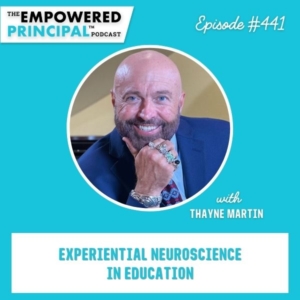
The Empowered Principal® Podcast Angela Kelly | Experiential Neuroscience in Education with Thayne Martin

Disclaimer: Please be advised that this episode contains content related to childhood trauma and a suicide attempt. If these topics are challenging for you, you may wish to skip this episode or seek support.

Understanding how students think, feel, and connect is key to creating meaningful learning experiences. Yet so often, the human side of education is overlooked in favor of purely academic outcomes.

In this episode, I talk with Thayne Martin, a leading expert in experiential neuroscience, about how understanding the brain and emotions can transform the educational experience. We dive into how gratitude, prosocial skills, and experiential learning techniques help students develop resilience, connection, and a sense of belonging. Thayne shares practical strategies for educators and school leaders to incorporate these approaches into classrooms, staff culture, and leadership practices.

Tune in this week to discover how experiential neuroscience can inform both teaching and leadership, how small intentional practices can foster emotional growth, and why connecting with students and staff on a human level can be as transformative as any curriculum. You’ll walk away with actionable insights to create an educational environment that nurtures both cognitive and emotional development.

The Empowered Principal® Collaborative is my latest offer for aspiring and current school leaders who want to create exceptional impact and enjoy the school leadership experience. Join us today to become a member of the only certified life and leadership coaching program for school leaders in the country by clicking here.

What You’ll Learn From this Episode:

  • How experiential neuroscience can guide teaching and leadership practices.
  • Techniques to help students build gratitude, empathy, and prosocial skills.
  • Why emotional and cognitive development are interconnected in education.
  • Strategies for creating classroom and school environments that foster connection and belonging.
  • How leaders can model and cultivate positive emotional experiences for staff and students.
  • Practical ways to integrate experiential learning techniques to support growth and resilience.

Listen to the Full Episode:

Featured on the Show:

Episodes Related to Experiential Neuroscience:

Full Episode Transcript:

Angela Kelly: Hey there, empowered principals. A quick heads up before we begin this podcast episode: This particular episode mentions some sensitive topics, including childhood trauma and a suicide attempt. I invite you to please listen with care.

Hello, empowered principals. Welcome to episode 441.

Welcome to The Empowered Principal® Podcast, a not so typical educational resource that will teach you how to gain control of your career and get emotionally fit to lead your school and your life with joy by refining your most powerful tool, your mind. Here’s your host, certified life coach Angela Kelly.

Hello empowered principals. Happy Tuesday and welcome to the podcast. We want to congratulate you for all of you who have finished out the school year. What a wonderful year it is, and summer break is coming along. And I hope that you are able to complete all your staffing and finalize those last little minute tasks that you need to get done so you can go off and enjoy a beautiful, beautiful summer break.

I have a special guest here with me today. His name is Thayne Martin. He is the founder and owner of It’s Pure Love. We met online and we had a meet and greet, and we just hit it off. He has some amazing stories, amazing content, and amazing resources for educators. So, Thayne, welcome to the podcast.

Thayne Martin: Thank you so much for having me. It’s a pleasure. I admire your work and the goodness that you put into the world. So thank you for being you.

Angela Kelly: I really appreciate that. For us having just met, I felt like I found a kindred spirit out there. Like we are trying to bring the humanity back into education: love, compassion, kindness, patience, understanding. And Thayne’s energy and the work that he’s doing, really, I felt very compelled to bring this to your attention as the listeners, especially this time of year because as that year is ending, we’re softening a little bit. Like we’re taking a deeper breath, we are relaxing a little bit, and Thayne’s going to tell you, he has a wife who is in education. He’s going to tell you some stories.

But this is the time of year where we’re reflecting, we’re taking a break, and this is the perfect opportunity to just really embrace what Thayne has to offer and to start practicing it when you have the time and space over the summer months and you have a little more flexibility in your day to embody this and bring this into your practice as you’re planning and preparing for next fall, which is unfortunately right around the corner, right? It happens sooner than we realize. So, Thayne, tell us a little bit about your background, your history, the work your wife is doing in the world, and then how you developed It’s Pure Love.

Thayne Martin: Yes, okay. So before I get into that, I just want to thank every teacher that’s listening. I’ve been fortunate, married to my best friend, and I’ve supported her through her teaching career. And Friday is her last day, 23 years of teaching with this particular district. I think it’s around 28, 29 total years teaching. So thank you to all you teachers for making a difference in the world and for putting the love into the children that someday will be the children that take care of each one of us. 

So I want to just first off thank each of you because I know it’s a sacrifice. I know how difficult it is to be a teacher in today’s classroom and even more so today because we live in a world where the support for education is under attack.

It’s under attack because our society is under attack and the things that matter to us, the things that matter to families, to teachers, like kindness, love, gratitude, all those prosocial emotions, that’s where I found happiness for me. And in learning how to be happy myself, I learned a particular way to find that happiness and then communicate it in a way that everybody can learn from.

So I’ll back up a little bit and tell you a little bit about my story. So I grew up here in Phoenix, Arizona, born into a beautiful family, great mother, great father, and life was normal for me as a little kid. Lower middle income, we didn’t have a lot, but we had what we needed. But my life changed for me as a child because sadly, there was a man that moved into our neighborhood that was a ugly individual that decided that his needs were more important than mine. 

And so sadly enough, he ended up robbing me of what I would say is a normal childhood development because I found myself at the hands of ugliness. So I did like most people try to do, especially men. I tried to outrun that trauma and that led to a lot of poor choices and ultimately late in life for me, being blunt, it was a suicide attempt.

And that suicide attempt was that wake-up call for everybody in my life that something had happened to this man. And not once in my life, I was in my late 30s for the first time I told one single person what ever happened to me. So my life has been about learning how to stand back up because I lived my life as a victim. I ended up going into your traditional therapy and I’m grateful for that. But in the end, it was experiential neuroscience that actually healed me because I realized that all the therapy in the world wasn’t making it stick.

Why was I spending literally decades in therapy, working with therapists and psychologists, talking about my past, talking about things that I needed to do, talking about being better when my emotional dysregulation would enter the picture. But no matter what I did, every time you get into that situation where the body responds, if you don’t have practice from that body response, ultimately, you’re not going to make the right decision. And that’s what I realized. 

So for me, it was my life experience that led me to this work of neuroscience. And interesting enough, not that enough crazy things haven’t happened to me, but it was an accidental drowning. I literally was in an accidental drowning and I lost consciousness and I died. And when I came back, I came back with knowledge and I came back with an understanding of what really matters in this life.

And so I started pouring myself into neuroscience because I realized that if I wanted to heal my brain, I also needed to heal my body because my body was operating different from what my brain was operating. And that’s when I started discovering experiential neuroscience. So that’s a little bit about my background and how I came into it. 

I started my company, It’s Pure Love, a little over a year and a half ago, and we are pioneering experiential neuroscience and actually going to be having some of our protocols studied at a university level because we’ve uncovered some pretty uncanny ways that we can help the brain learn in the classroom. So super excited about that. And anyway.

Angela Kelly: Yes.

Thayne Martin: That’s my story.

Angela Kelly: Yes. And I didn’t even know any of this story. So we always do a meet and greet, as you guys know. And Thayne and I were talking about love and, you know, just the humanity bringing it back to education. And he’s like, “Yeah, I used to have an anger management problem.” And I was like, “What? You?” I cannot even fathom that in this, you know, the version of you that I’ve met.

Thayne Martin: Because I was angry. I had never gotten help. I had never, you know, especially for men that are abused as kids, there’s not a lot of resources for us. And there’s also not a lot of people that specialize in men that were abused as children. And that’s also one of the reasons why I stand up because I’m not ashamed of what happened to me. I was ashamed most of my life and I showed up as a victim. And that’s also why I was angry. I was full of piss and vinegar. I was kind to my family and friends, but outside of that, I was full of toxic. I wasn’t kind. I would say I was a Karen.

I was a Karen, and I showed up that way. I was privileged. I was making a lot of money and I showed up that way. And I also did not like who I had become. I didn’t like being angry, but I didn’t know how to process that anger. 

I did not know how to not respond when my body escalated. I mean, it could have been road rage for me. I could have been driving down the road and the body serves up the response because somebody cut you off. Well, that response from the body is automatic and it is fast. And so immediately, somebody would cut me off and where do I go? I would go into road rage. Well, that’s not healthy either.

So I was looking at my life and I was looking at everything going on in my life, and frankly, it was a train wreck. It was a train wreck. On the outside, everything in my life was perfect. On the inside, I was completely broken and I was hiding because I’d never shared what happened to me. So for me, it was that wake-up call that made me realize that my body’s response is separate from my mind’s response. 

And until I can learn to train this body to understand what this mind is thinking and make them work together, I’m going to continue showing up in the world in a negative way. So how do I train that negative response that immediately comes out of my body when I experience anger? That’s literally what led me down the path of neuroscience. 

And then honestly, I’m a very religious person. I didn’t used to be. Before I drowned in the pool, I was an atheist, but I’m not an atheist anymore. I understand things. I understand what’s important, okay?

Angela Kelly: Yes. Can you tell us a little bit like what was the awakening? What was the clarity, the aha moment for you? Like what were the thoughts and the shifts?

Thayne Martin: Yeah, okay, great question. So when I drowned, I was very fortunate to get out of the pool alive. I know that. When I came out of the pool, my body wasn’t working. When you lose oxygen and the body goes down, when your soul comes back into your body, it doesn’t immediately engage. It’s like I wanted to swim. I wanted to swim, but I couldn’t. So I literally managed to meander my way by just moving my limbs. I was wiggling to find safety. And I found a step in my pool that I could rest on.

And the aha moment for me was laying on the side of that pool, realizing that I had escaped death and looking up into that massive beautiful sky and seeing the moon and all these stars. And what came to me was that everything up there was perfectly balanced and everything down here was not. And that included myself. So how do I, how is this maintained balance?

So ultimately, it led to this discovery. And the discovery is essentially a scientific principle. And if you understand that everything in the universe stays perfectly balanced, then you also understand that the language of the universe is actually math. So all those math teachers out there, I want to thank you because that is the language of the universe. 

And it is that understanding of math that when you apply the principles of math to physical matter, it always applies, okay? So when I started thinking about that, I started realizing that the anger that I had inside was a human emotion. And human emotion is physical energy when it leaves my body. So therefore, the principles of math that describe the universe can also support me in my life and in my emotion.

So that’s what led to this idea. And it starts with basic math. And every person that I teach, I teach and I take them back to first grade. I take them back when they learned their initial math skills: first grade, second grade. And I always ask them because the beautiful thing about the equation of life and abundant happiness is you already know the operators. Every human being knows them, and I thank every teacher for teaching them. Now I’m going to teach you a different way to apply them. All right? So it goes like this.

The first thing you learned in elementary school was addition. You learned 1+1. Well, in the equation of life and abundant happiness, addition means adding those things in life that bring forth goodness and joy. That’s addition. The next thing we learned was 1-1. That was subtraction. And subtraction in the equation of life and abundant happiness is about letting go of those things that don’t serve us, that don’t help us. 

And the one thing that I learned when I died in that pool is the importance of the present moment. That was a space that I never lived in. I was always like consumed with my past that I couldn’t fix and a future that scared the heck out of me. But what I never did was stay present in the moment.

So I learned with the equation of life and abundant happiness, the power of emotional regulation is staying aware and being in the moment. So the thing upstairs that everybody gets to define, okay? The expectation is that we as humans, we balance. So I add what I need, subtract what I don’t, and I achieve what I call neutral balance, where I’m not encumbered one way or the other. I’m perfectly balanced in this moment right where I’m at. So we have addition, subtraction. 

Then the next thing that they learned in elementary school was multiplication. And multiplication is about growth. It’s about aligning your friends, your family, your teachers, your co-workers, your fellow students, the thing upstairs, and letting the world help you grow. It’s about expansion. So you embody action and intention and you move out into the world and you create, and it grows and it gets bigger.

So now I’ve learned multiplication and I can see how I could actually apply that in my life. What did we learn next? We learned division. After we memorized those multiplication tables, we learned division. And division is about taking the expanded growth, that amazing goodness that we created, and then dividing it and putting it back into the world from where it came. So we’re supposed to work on what we call the principle of abundance. 

And that means the principle of abundance is a cost from your heart. So in the example, if I had a hundred dollars, I balance, I put action and intention, I engage my family, friends, teachers, co-workers, and I grow this to a thousand dollars. How much of that thousand do I actually need, number one, and then secondly, we understand that human beings have a desire for safety. So how much more do I need in order to feel safe? So maybe I need 600 out of that thousand and then another 200 to feel safe.

That’s my heartfelt abundance. That is the cost of that growth. So what that means is there’s two hundred dollars of extra abundance that I don’t need. Well, we’re supposed to put it back into the system. Unfortunately, mankind hasn’t figured that out and we’re holding on to money and that’s resulted in greed and excessive wealth. It bothers me that we’re going to have our world’s first trillionaire, and then we have people in third world countries that go to bed hungry every night. And yet they all sleep under the same sun. 

And that’s why me and my work is about changing that and bringing happiness and goodness back into, to life. So we add, subtract, we multiply, divide, and then we find the equal sign. The equal sign in the equation of life and abundant happiness means gratitude. It is gratitude, gratitude, gratitude.

And I would tell you that I did not know gratitude. I did not embody gratitude. And if you said gratitude to me before I drowned, I would have rolled my eyes at you because that is the same thing my grandmother used to use with me, right? When I wanted that extra thing of ice cream, my grandma would be the first one to go, “You need to be more grateful for the two scoops of ice cream that you already have before asking for the third.” And then I’d roll my eyes. So that was my relationship with gratitude.

And then I drowned, okay? And so I realized that gratitude was something that wasn’t the center in my life, not like it should. And so I decided one morning, I took a picture of a sunrise, and it was the most beautiful sunrise. And I posted on social media and I asked people, “What are you grateful for?” And you know what the most common thing that people talked about? Gratitude. Gratitude. They were thankful for gratitude and living with gratitude. And I’m like, “I don’t live gratitude. I don’t even really understand it. And it’s a word that ticks me off.”

So I decided to learn gratitude. I made a decision to get up that next morning and celebrate every sunrise for 365 days. And then somewhere along the way, I started podcasting on Instagram, sharing my journey with my family and friends. And this is where the equation of life and abundant happiness came from. And I tried learning gratitude by writing lists. That didn’t work. I tried an app to learn gratitude. That didn’t work. 

And then one day, I met a stranger. I met a stranger that completely blew me away. They did something for me in public that they didn’t have to do, and I was struggling. It was an emergency situation. And this person stepped forward and in a moment that could have gone horribly wrong, she lent an ear and kindness from her heart, and she turned what could have been a very ugly situation into a beautiful situation.

And then I did something I’ve never done before. I thanked them authentically and genuinely from my heart. And when I did that, in this one particular instance, I got something that I now call a gratitude cocktail. And it starts at the top of the head and it goes all the way down to the feet. It comes all the way back up through the body, and then you feel your vagus nerve begin to wave and oscillate. And I got tears. I started crying because it was joy that I was experiencing with this other human who is a perfect stranger. And the interesting thing, she had happy tears too.

So I left that moment and I said to myself, this is gratitude. How do I learn this? I want this feeling of an abundant happiness and joy that literally overwhelmed me. So I stepped into the world of neuroscience because I wanted to find out why did that happen that first time? So I went on along my day and I tried to create that experience with other people. And then ultimately, I couldn’t do it. And then I started studying. Why did I have this physiological experience with a stranger, but I didn’t have the same experience when I practiced gratitude with people I know?

And that led me to one of literally the most vast discoveries in neuroscience, which we’re actually now studying. And I have an amazing, she’s my vice president of neuroscience and research. She’s got 23 years clinical experience studying this. And I taught her the equation of life and abundant happiness. It changed her life, and then she said, “I want to join you. I want to study this. This is amazing what you’ve learned.”

So from that one exercise, I learned that the human being learns by experiencing, not by reading, not by doing. That’s why all those years of me sitting in seminars, right? That’s something my wife talks about all the time at the district. They bring in these people to come in and talk about teaching emotional regulation, social skills, and it’s a seminar. 

And the teachers sit through the seminar, they pay attention, and then at the end of the seminar, they roll their eyes and they say, there’s no way this is ever going to stick in the classroom because they’ve never really, at least in her district, got the kind of training in order to teach children to be emotionally intelligent in the classroom. And so that’s when I realized that I needed to create something specifically, not only for business and people, but also in education because I learned that we retain 90% when we do something. And we only retain 10% when we read about it or do traditional learning.

So experiential neuroscience is using experiences that are designed to open the heart, open the mind, and create goodness, love, connection, empathy, happiness. It’s all about training the body from a physical response to a new prosocial emotion, and they’re done through experiences. So the experiences are done with family, friends, and even with strangers. 

And you’re going to learn from your family and friends and strangers, each of these exercises, you’re going to see how you show up in life. You’re going to learn some amazing things about yourself. And you may learn some things about yourself that you want to change because you realize that that’s an old belief that came from my childhood. And I just realized in doing this experience in this deck of cards that that’s been with me since third grade. I’ll share that. Yeah.

I recently was working with a client that really struggled to be seen in public. She didn’t like to engage with people. She was afraid to talk to people. She was afraid to speak up and have a voice. And ultimately, I have an experience that I had her do where she had to be a little bit vulnerable with people in public. And ultimately, she struggled through the exercise and then she completed it. And then she recorded a video of her completing the exercise. 

And what changed in her was the abundant happiness because she realized that she could talk to people in public, have an amazing experience with them, and get out of that thought process where she was humiliated when she was a little girl at the lunch table in third grade. That one memory from third grade is what this woman has carried her whole life. And now because she experienced it in real time that she could actually work with a stranger and have love, kindness, and connection, she’s no longer afraid of that anymore. So she overcame that barrier through experiential learning. 

And that’s what experiential neuroscience is. It’s about exercises that are rooted in safety that make the person a little bit uncomfortable so that we can learn. And then while we’re in that exercise and the brain is paying attention, all of the exercises are designed to deliver a prosocial emotion experience at the end. So what it does is it’s updating the physiological response from the body real time to a new memory. And we’re literally rewriting that old story that the body continually plays. And when you rewrite that story from the body and tie it to a new memory in the mind, it remembers. That’s that 90%. So that’s in a nutshell what I do and working with people.

Angela Kelly: Yes. I can see where principals would be following along and even though like neuro, neuroscience sounds like very complicated and very complex, you have a way of breaking it down. So what leaders want to know, I think they can believe. They can feel this, they can believe it, they can see the truth in it. And then they, their brain goes, but how? 

So you and I were sharing, you were sharing some really like concrete simple examples of things that people could listen to this very podcast and turn it off and walk away and experiment with this and try it out and start to feel some changes. Do you want to share some of those?

Thayne Martin: Absolutely. Yeah. So when we work with schools, we work with principals, we work with teachers, and we work with students. So we’re going to be teaching emotional intelligence and social intelligence and metacognition, okay? We teach that as well to every layer in education because it has to be full boat. You can’t have leadership that’s emotionally intelligent, teachers that are not emotionally intelligent. Everybody’s got to be trained in the same system. All right. So let’s take a principal.

So this is a card and I’ve shared it with your team and you can edit it in. And anybody that wants copies of these cards, that information will be available on my website as well as you. So this one is called Let’s Do Lunch. And this is a card specifically from the deck of cards that’s designed to teach principals emotional intelligence and social intelligence skills, okay? So this is what Let’s Do Lunch is. 

Pick an associate you don’t know very much about and make a personal attempt to know them better by inviting them unexpectedly to your office or room for lunch. Okay. Don’t talk anything about school. This conversation is about getting to know each other as principal and teacher. Talk about your life, their life, family life, favorite movies. Be human, okay? 

So what’s the first thing that comes up to you when I ask you to play that card? Because the first thing that pops into your mind is what we call first awareness. And first awareness is usually the most accurate response because it’s coming from the subconscious and it’s not filtered by prefrontal cortex and organized thought. So I always ask people what’s the first thing that I ask when I just asked you to randomly, as a principal, go find a teacher and have lunch with them unexpectedly last minute, okay? Like that should be your first awareness.

The second thing is, what fears stop me from connecting with my co-workers and others? As a principal, what keeps me from knowing my teachers better on a personal level? Because at the end of the day, we’re all human. And when we struggle to balance our emotional energy at home, when we have fights with our spouses and we bring it to work, does that affect the classroom? Of course it does. That’s why as a principal, you know what? You’re also a counselor to your teachers. We’re all in this together. 

So part of this is about building empathy and leadership and remembering the importance of putting love even at work, right? That’s the fun thing. Itspurelove.com. My company teaches love. We teach it to businesses, we teach it to schools, we teach it to people because love is the most powerful teacher of all. It really is.

So imagine in this example how that teacher is going to feel when you the principal, pull that person in and you pour your life and you pour your thanks and your gratitude. Hey, you know, Mrs. Smith, you’ve been working for me. I noticed you’ve been here for over 10 years and I can’t think of one time when you and I sat down and had lunch together. So I brought you in today because I want you to know how much I appreciate you and how much you matter, not only to me as the principal of the school, but to the students and the parents. I am constantly reminded of the amazing work that you do. 

And time after time, I hear other teachers always telling me about you picking up the extra slack. You know, there’s always that teacher that sometimes struggles to get out there and get duty done. And yet sometimes you substitute and you work to help that person. Not everybody does that, but you do. So Mrs. Smith, as your principal, I just brought you in here today to let you know how much I appreciate you, how much I care about you, and I just want to get to know you a little bit better. So let’s have lunch today. Tell me about your life. Where are you from? What’s going on in your home life? 

Just have a conversation as two humans and watch what happens because you’re going to build an amazing relationship with that teacher and she will not forget this lunch meeting. And then she’s going to go into that lunch room and she’s going to tell everybody there that she just had the most amazing meeting with the principal and that that principal thanked her and made her feel special. She was seen. And that’s something that every employee wants. They just want to be seen. 

And I would tell you that in my wife’s career, I can’t think of that many times where she actually felt seen. And that’s a reflection on leadership. So that’s an exercise that any principal can do. That’s just one example of 101 exercises I’ve designed for a principal to learn about themselves and how they’re showing up in leadership. So that’s an example of a principal. Does that make sense?

Angela Kelly: Yep. That totally makes sense. No, that’s great. Let’s talk about what it would look like in the classroom. So with teachers, students, how can we start to, we don’t need to understand maybe all of the depths of the neuroscience behind it, but we want to understand enough so that we see the value in it and we see the benefit of it because once we understand it and we feel it, then we’re inclined to want to engage with it and embody it. So what would that look like in a classroom with teachers and students?

Thayne Martin: Yes. So the first thing we’re going to do is we’re going to come in and we’re going to train all the teachers. All the leaders are going to get trained in emotional intelligence. So you would actually go through our course and we would teach you emotional intelligence skills through experiential learning. So an example for a teacher learning to embody goodness and all the things that teachers, I’m going to say automatically do. Most teachers really do. But the cards are designed to, you know, also open up the teacher’s heart and see how they’re showing up. And it’s about creating community inside of the school, right? And it’s, it’s every layer. It’s leadership, it’s the staff, and it’s the students.

So at the staff level, we’re going to be teaching you about emotional regulation. We’re going to teach you how to add, subtract, multiply, divide, equals. You will learn the equation of life and abundant happiness, and you’ll use it in a way to teach children how to ultimately manage their own emotions because the biggest problem my wife has had is she’s never been trained in emotional intelligence in order to teach those children. 

And it used to be that parents were the people that taught emotional intelligence. But today, those parents are running two jobs, working three jobs to make ends meet, which means that the emotional intelligence skills and the social intelligence skills aren’t being taught at home. That has put extra demands on the teachers. That’s something that my wife has faced because she has found more and more being piled on to her as the educator that used to be done at home.

So my wife’s biggest complaint being a teacher of almost 30 years was that there was never any education to teach her to teach emotional intelligence to children. There wasn’t a program that was easily identified that the kids could learn prosocial emotion. Okay. 

So let’s use one as an example. So I created one. This is one that’s also available. And this exercise is called Magic Lunchbox. And with Magic Lunchbox, the teacher is going to have not only a deck that they’re going to teach emotional regulation using mathematical skills. So there will be some teaching curriculum available to teach in the classroom, but the real teacher is actually the experiences themselves.

So here’s a perfect example. This is called Magic Lunchbox. So the teacher allows students to draw numbers from a magic lunchbox. The students then have 10 minutes to find their match and spend their lunchtime today with a new lunch buddy. For added fun, the students are not allowed to speak to find their match. They must communicate through gestures and non-verbal clues. Odd number, teacher is the match. So you as the teacher might be a match for that one kid if you have an odd number of kids in your classroom. Okay. 

So now imagine those children and the excitement they have going in and pulling that number and their magic lunchbox and imagine the prosocial skills and the fun that they’re going to have trying to find their match in the classroom to be their lunch buddy that day. But the fun is that they’re not able to speak. They have to use different forms of communication. So that means the kids get to get creative. Maybe they get a piece of paper and they write a story and they walk around with their story until they find the person that has their number. You want to promote creativity and you want to make it fun.

So then once those kids have found their match, then that day they are to have lunch in the lunchroom with that new buddy. So that’s a great exercise that you could do say at the beginning of the year to start promoting prosocial emotion and emotional intelligence when the children and creating connection. So that’s just an example of one exercise that you could do with children in the classroom. The deck itself has 100 cards and every one of them is designed specifically to meet the needs of the students, right? 

There’s also a deck of 101 cards to design to teach the teachers emotional intelligence. So as your students are going through the course, so are you the teacher. What’s great about that is as you learn, you will embody the emotional intelligence and the social intelligence skills from completing the exercises, and then you’re going to be an even better teacher to teach those kids emotional intelligence and social intelligence as they work similar exercises, but they’re designed for kids, right?

So like an example for a teacher, this is one my wife loves. And by the way, my wife is actively engaged in creating them. When she retires, she’s going to be onboarding and taking ELAHcation, that’s the name of our program, and running it into the districts and helping us create more exercises because nobody knows the classroom like a teacher. I’m a neuroscientist, I’m a business guy. I don’t know the classroom like my wife does. So she’s actually helped me tremendously bring content that teachers care about and principals and students.

So when I was designing an exercise to share with your audience today, we created one called Duty Break, okay? And I know when I say duty my wife just kind of goes, she rolls her eyes, right? Like every teacher does, okay? So this card, Duty Break is a fun card that you as a teacher would experience in school, okay? 

So this is the mission for Duty Break. We all know duty isn’t always bliss. Today, take a look at the playground, letting your heart direct you, find a teacher currently assigned to duty, and relieve them of command. No questions asked. Let them know how much you appreciate them and how they show up at school. Smile and take over their duty responsibilities. 

Now, imagine the goodness that you just created with that co-worker by not only seeing them and recognizing them for their contributions to the school, but to give them that kindness and love randomly, unexpected. Trust me, that teacher will remember that, right? And so will you. And you’re going to have this amazing experience that I just experienced from that other teacher. 

And now that teacher is somebody that I didn’t know before because they’re in the fifth grade and I’m in first grade and we don’t always, we’re in different lunchrooms and different lunch hours, but now I have a relationship with this teacher because I relieved her of duty. And someday, maybe she relieves me of my duty when she sees I’m at the end of my rope. Okay. That’s the beauty of this. So everything is about creating prosocial emotions: love, kindness, gratitude, empathy, forgiveness, all the things that children need and adults need and leaders need to be effective in the world today. So that’s kind of in a nutshell what we do and how we teach in the classroom. Does that, hopefully, does that make sense?

Angela Kelly: Yeah, that’s wonderful. No, thank you so much for that. Yeah, it makes total sense. Thank you so much for sharing your beauty, your presence, your gratitude, and the work that you’re doing with this company. I see the value in it. I see the benefit, and I, what I really appreciate most is like your science and math brain coming together with the artistry and, you know, skill set of your wife’s number of years in the classroom and her skill set there. Like that combination is so beautiful. And I look forward to seeing your work throughout schools that I work with as well. So it’s a nice little compliment. Yes, absolutely.

Thayne Martin: Yes. Thank you so much.

Angela Kelly: Yeah. Well, thank you for your time today. Thank you for your presence. Thank you for, you know, reaching out and wanting to share this with the listeners of The Empowered Principal® Podcast. It’s, it’s a gift and we need as much as we can.

Thayne Martin: I am grateful for you teachers. I really am. You know, I have three daughters that are very powerful, loving, kind women today. And I know that they have many teachers along the way. I don’t want to get emotional, but there’s certain teachers that stepped up for my girls at certain parts of their life when I wasn’t always being the gentleman that I am today. There were teachers that stepped in and helped my kids. 

So thank you to all you teachers because I know it’s a sacrifice and I know oftentimes you’re not seen, but I want you to know that this man sees you. I see the issues that we’re dealing with and we’re going to fix all of that. We’re going to fix the world, we’re going to fix the classroom, and we’re going to do it with love.

Angela Kelly: Yes. Thank you so much once again. That is it, empowered principals. May you use this as an opportunity to explore gratitude, authentic gratitude, authentic appreciation for all of the gifts and blessings in your life, in your professional life, your personal life. And may this bring you so much joy. 

And for more information, all of the information we talked about today and resources will be in the show notes. So you can access all of that there. Thayne has provided some free resources for you to check out and there’ll be links for more information for you to explore and access that. So again, thank you all. Have a beautiful week. Take good care and we will talk to you next week. Bye.

Thanks for listening to this episode of The Empowered Principal® Podcast. If you enjoyed this episode and want to learn more, please visit AngelaKellyCoaching.com where you can sign up for weekly updates and learn more about the tools that will help you become an emotionally fit school leader.

Enjoy The Show?

The Empowered Principal® Podcast Angela Kelly | Rewriting Your Empowerment Story

The stories we tell ourselves shape the way we lead, the way we see ourselves, and the way we experience the world around us.

In this episode, I explore the disempowering narratives so many school leaders carry about their identity, capability, belonging, and worth. I discuss how comparison, self-doubt, and the belief that we are not enough can quietly influence the decisions we make, the support we accept, and the opportunities we allow ourselves to pursue. I also unpack the difference between truly belonging versus simply trying to fit in by pleasing others or hiding parts of ourselves.

Tune in this week to discover how to begin rewriting your empowerment story and creating a new narrative rooted in self-trust, authenticity, and possibility. I share why receiving support is a critical part of empowerment, how to recognize the stories that are holding you back, and why celebrating your wins and reconnecting to joy can help you move forward with greater confidence and momentum.

The Empowered Principal® Collaborative is my latest offer for aspiring and current school leaders who want to create exceptional impact and enjoy the school leadership experience. Join us today to become a member of the only certified life and leadership coaching program for school leaders in the country by clicking here.

What You’ll Learn From this Episode:

  • How the stories you tell yourself shape your leadership identity and confidence.
  • The difference between truly belonging and trying to fit in.
  • Why comparison and self-doubt can create disempowering narratives.
  • How to recognize the beliefs and stories that may be holding you back.
  • Why receiving support is an important part of empowerment and leadership growth.
  • The importance of celebrating your accomplishments and collecting evidence of your success.
  • How reconnecting to joy, authenticity, and self-trust can help you rewrite your empowerment story.

Listen to the Full Episode:

Featured on the Show:

Episodes Related to Rewriting Your Empowerment Story:

Full Episode Transcript:

Hello, empowered principals. Welcome to episode 440.

Welcome to The Empowered Principal® Podcast, a not so typical educational resource that will teach you how to gain control of your career and get emotionally fit to lead your school and your life with joy by refining your most powerful tool, your mind. Here’s your host, certified life coach Angela Kelly.

Well hello, my empowered principals. Happy Tuesday. Welcome to the podcast. It’s good to have you here. Listen up. I want to talk about story time. We’re going to talk about storytelling, but not in the classroom, not the stories we tell in class, the stories that we tell ourselves. Because look, I’ve been coaching myself, I’ve been coaching your fellow principals on the stories, the narratives that we tell ourselves. Unfortunately, there are stories that we tell ourselves that disempower us.

They are stories about ourselves, our identity, our capacity, our ability. We don’t believe we’re good enough for this. We don’t have enough of that trait. We’re not cut out to be a leader. We’re not good enough, strong enough, smart enough, decisive enough, skilled enough. Something is wrong with us. We have stories about who we are and who we are not. Now, where do these stories come from? Who writes the story about who we are?

Do our parents write that story? Do our siblings write that story? Do our mentors, coaches, teachers, advisors write those stories? Do our friends write those stories? Who is in charge of writing the story? Do our teachers write those stories? Do our bosses write the story of who we are and what we are capable of and what we are not? Who has the pen?

It is us. We are telling the story. This is who I am. This is who I’m not. This is what I’m capable of. This is what I’m not capable of. I don’t understand how to do this. For me, I had a story about my capacity to understand technology platforms, how to create my website, how to create audio clips, how to create video clips, how to do a Facebook Live, how to create the podcast, how to write the book. All the things that I have now accomplished, I had a story about myself beforehand. And even when I did overcome some of those challenges, I still told myself, but I’m still not good at technology.

I’m still not that skilled. Like I’m not really good on social media. Like I feel too old. I don’t feel competent. I don’t want to learn that. I don’t like it. Well, I was holding the pen to that story. But what I was doing was not only a disservice to myself but a disservice to everyone I serve, to every school leader who wants to be in the Empowered Principal Collaborative, who wants to listen to this podcast every single week. I’m doing a disservice to the service that I want to be providing in the world. Think about the story you have about yourself.

Think about the stories we have about others, comparing and despairing ourselves with other people. They have that trait and I don’t. They have it easier than me. They’re more liked. They have better connections. They have better schooling. There’s something about them that makes principalship, school leadership, being a superintendent easier for them than for me. How we compare and despair, or we think someone has it a certain way. We don’t really know that, but we write a story. We create a narrative that has us not feeling empowered.

So we have stories about ourselves that feel very disempowering. We have stories about other people that disempower us simply because we’re comparing what we think about that person and then telling ourselves we don’t have that, or that they have it easier. We also have stories around why not me? The question, why not me? What’s wrong with me? Why didn’t I get chosen? Why didn’t I get selected? Why wasn’t I good enough to make the team?

I remember trying out for cheerleading. Didn’t make the team. What did I make that mean about me when I was 14 years old? And am I still carrying that story now, that I don’t belong and I don’t fit in? Let’s talk about stories about not belonging. This has come up over and over again. There are stories that we create about ourself that are very disempowering. We want to belong. We are wired as human beings. One of our universal desires and needs is to feel significant, to belong, to be loved, to be appreciated, to fit in.

And there’s a difference between belonging and fitting in. Belonging is just being you authentically, and people cherishing your existence in the world. People loving you for exactly who you are. You don’t have to pretend, you don’t have to people please, you don’t have to put on a facade. You belong here. Fitting in is when we people please and we create a facade and we speak or we think or we dress or we talk in the way that we think other people will accept us. We try to create acceptance by not being ourselves. That’s trying to fit in. But stories about not belonging. 

And then what happens is, when we get invited to belong to something, we get an invitation to be a part of something that would feel good for us, that we said we wanted, that we crave. We want the connection, we want the collaboration, we want the support, we want the solidarity. You know, we want the synergy. But when invited into spaces, into rooms, into communities where we could belong and feel good about that, we then say, oh, I don’t have the time for that. I don’t have the energy for that.

We get invited to belong, but we don’t feel a sense of belonging. And it’s not because those around us are rejecting us or ostracizing us. It’s because we believe that we don’t fit in, we don’t belong. So we go into rooms where we want to be in, but then we feel awkward or clumsy or silly or incapable or insufficient in some way. And we end up removing ourselves or not even participating because we don’t think that we measure up. 

So we get into the room that we wanted to be in and then we compare and despair and then we dip out. Or we just sit there and freeze and we don’t participate and we don’t gain any connection or belonging from the experience. I’ve observed this in group settings with professionals like yourself where people go to conferences and there are people who get out there and they network and they belong and they feel good and they shake hands even on their first time. 

And then there are people who go who’ve been to conferences for years, but they sit back in the corner and they don’t go to all the things or they don’t go to the happy hour. They just stay in their hotel room and they just work and get their work done. And they’re like, oh, that felt really good. I wasn’t interrupted. But you might as well just sat in your office and not expended flights and hotels and dinners and the conference fee to go to a conference where you just sat and got some work done.

I’ve done this. I’m calling me out. And I know if I’m this way, if I get into rooms that I desperately want to be in, rooms with fellow principals, rooms with superintendents. I have traveled with a group of superintendents and felt like I didn’t belong, even though I am a fellow educator, even though I am a coach for leaders. I’ve been in rooms with fellow coaches and I felt like I didn’t belong. 

And now my clients are coming to me saying, you know, they want to be in rooms like EPC. They want to be in collaborative rooms, but they don’t feel like they belong. They’re afraid that they might not be good enough or smart enough or experienced enough to share with like-minded principals. They’re afraid if they’re going to come in and be a trailblazer that they’re not going to be a strong enough trailblazer. I find that so fascinating because I’m like, I relate to that. I have been that way. 

We say we want the support. Like, we need help. I don’t know what to do. But we aren’t willing to accept the help. We’re not willing to receive help when it’s offered. We’re like, no, no, no, I’ve got this. We have a story about how empowerment equals independence, that if we’re to be empowered, we have to figure it out all by ourselves and do the work on our own and figure it out all by ourselves. So we say we want to be supported and we’re upset when we don’t feel supported, but we don’t accept and receive the support. Isn’t that crazy how we do this to ourselves?

So this is an invitation. As we’re closing out the school year, walking into summer, you have some space and time to really think about what it is you say that you want, and then the story you have about yourself, the story you have about others, the story you have about are you the villain or the victim? What role are you playing in your life? Are you empowered? Are you disempowered? Stories about belonging, stories about not belonging. Stories about wanting support but not receiving it. Where do you receive support? Where do you not?

Let’s get honest with ourselves over the summer and tell ourselves the story that we have about ourselves. What is the truth? What are the stories you tell about yourself to yourself and to others? Just notice the identity that you’re claiming right now. 

And the way that you can clarify this if you’re like, I’m not really sure what I think. How do you feel about yourself? How do I feel? Name the emotion. When I think of me, I feel… When I talk to others, I feel… When I tell people who I am and what I do, I feel… When I think about my career, I feel… Full transparency just with yourself. You don’t have to put this on social media.

Just have a conversation with you. Does the way you feel about yourself, about your identity, about your relationship with others in the world, about your relationship with support, receiving it, your relationship with belonging, does it generate momentum? Does it generate eagerness, excitement, drive, energy? Or does it generate looping, more of the same, stagnation, story after story, rinse and repeat. 

You try to get yourself empowered and maybe you feel it for a fleeting moment and then you wake up the next morning and you’re like, oh, I got to start all over again. There’s just lack of momentum because there’s a lack of belief. There is a story of disempowerment. There’s maybe some boredom or disengagement or apathy.

If there was a gift that I could hand over to you as a school leader and just pass it out around the world, it would be the gift of an empowerment story. It would be supporting you, helping you to understand how to shift the narrative about yourself, about being proud of who you are, truly proud of who you are and what you are capable of, of who you were. Even thinking back to the past versions of yourself. In moments where you might have chosen differently, given clarity in hindsight. 

So even if you weren’t on a healthy path, a clean path, a safe path, a productive path, maybe you had moments of, you know, lacking momentum. But you focus on the moment you decided to change and being proud of that. You focused on how you managed to survive moments of trauma, of the hardest moments of your life, but you kept going minute to minute, hour to hour, day to day. Even if you were functioning at 10%, you chose that 10%. 

Focusing on how you committed to goals that you’ve already accomplished, looking back and saying, I’m proud of that. I am proud that I ran that race, that I completed college, that I got my master’s degree, that I passed that administrative exam, that I was able to teach seventh grade for 10 years. One year sounds like a marathon win for me. I’ve never done it, but I have always admired and acknowledged the middle school teaching staff. I think that is miracle work. They are doing the work of angels to be with the middle school students day in and day out. That’s an accomplishment.

Focusing on what is working, focusing on our wins, focusing on who we are, the beautifulness, the gracefulness, the person that you are. Even if you’re not graceful, I am not graceful. I don’t have this beautiful face and beautiful talents and a beautiful way of communicating even. But I just get out here and I’m just giving it to you authentically from me to you. 

This is who I am. Somebody in the world likes this version of me. So I need to like this version of me. My clients love me. They love all my idiosyncrasies. And people love you. So you have to love you. This message is coming from my heart to your heart.

If there’s anything I have learned, it is that you cannot lead people to empowerment if you don’t feel empowered. If you don’t love yourself, how can others love you? And they do love you, but you don’t receive the love. You do belong, but you don’t receive the belonging. People want to support, but you don’t receive the truth of that support. 

So what if this year, we stop writing ourselves off? We start collecting evidence and we leverage that evidence that you are in fact capable, able and enough. Look back at your past, look at all you’ve accomplished. If you can do that, you can do this.

When we accomplish something, we tend to feel good for a minute and then it’s old news and we throw it in the burn pile in the backyard. We don’t stack up the wins for ourselves, but we sure do stack up the losses against ourselves. And I know that because I’m the queen. Maybe you feel that you’re the queen too of stacking your losses against you. 

But let’s try a different approach. What if this year we decided to create that empowerment story? Because of that experience, I learned this because I didn’t do that, I was able to do this. Because I learned that hard lesson, because I failed at this, because I missed that opportunity, this is what I now know.

Creating a story of faith and trust and momentum, a story of overcoming and becoming, a story based on, you know, where you’re headed, where you’re going versus perseverating and ruminating and chewing on where you’ve been. Instead of focusing on the past, let’s where are we going now? Forward from this day on. In this moment, who am I? 

So, I’m inviting you officially to the Summer of Fun Challenge. The Summer of Fun Challenge is a challenge that I started back in, I think it was during COVID, like 2020 or 2021. But my original intention was just to celebrate life, all of you as a principal. The little moments, the big moments, all of it in between.

Because as principals and as district leaders, we sometimes forget that we are human, that we deserve to have fun, that we have permission to have fun, that we don’t need to be a professional robot 24/7, 365 for the rest of our lives. This is your time. Summer is your, you know, hall pass permission slip to go and play. And releasing and playing doesn’t mean you don’t care about your work. Not at all. It just means you want to live a full life, alive, engaged, plugged into life versus just robotically being this professional leader where you’re so afraid, everybody’s eyes are on you 24/7.

You don’t have to go crazy or be wild or break the law. You don’t have to own a big yacht and get on Instagram and take all these worthy photos to be having fun. You don’t have to go on vacations or throw a massive party. You do want to be in the energy of celebration, being in the energy of happiness and delight, the satisfaction and fulfillment, the pride and joy of just being you. 

Being with your friends, your family, in your life, not being like a carbon copy of yourself where you’re watching yourself, you’re watching your life, or you’re watching others live, which feels terrible. When you see other people out having fun, you’re like, well, I can’t have fun. I’m a school leader. What? No.

The Summer of Fun is all about connecting you back to simple joys, the fun of your childhood, your youth, when there wasn’t so many darn responsibilities. Remember when you could just be light and alive and engaged in your day, in your world, and all you were was present? 

When you were running around with your friends, you were, for us going to the beach, going to drive-in movies, going out for pizza after the football game, just laying on the back of your car, looking at the stars, you know, remember when you first started dating? Like how present you were? And that moment was all that mattered. Fun doesn’t have to be massive, expensive. It doesn’t have to be this grand, you know, parade of global travel. 

We can just be human, a person, to release the pressures and tensions of always being on, always being productive, polished, perfect. Give yourself the freedom and the permission to just be a person, a human, to live the human experience. To just occupy a space where you don’t have any other responsibility other than to take care of ourselves and amplify our own joy and pleasure, to take care of our own needs, to fill our own buckets. The Summer of Fun is about celebrating your life.

How you feel about yourself, the story that you tell yourself, whether it’s a story of empowerment or a story of disempowerment, that is the experience you will have. I want you to feel as though you are the most cherished person on the planet because you are. You are to me. I’ve been in your shoes. I know how painful it feels to not feel like you belong, to feel like you don’t matter, to feel like you’re not good enough, you’re not capable enough, that people don’t care, that nobody wants to help you, that you’re struggling on your own, that you’ve got to do everything in silence. 

You’re carrying the weight of not just your school, your community, your staff, the dramas on your staff, the dramas with the kids, the dramas with the families and community members. And then you go home and you have the weight of the shoulders with your own family and then friendships. There’s a lot of weight. But I want you to know you’re seen, you’re felt, you’re heard, you’re cherished, you’re loved. You matter. 

And the Summer of Fun Challenge is to remind you of that. To rewrite your empowerment story. We are starting the Summer of Fun Challenge in June. We are in a Facebook group called the Empowered Principals. It’s a public Facebook group for any educators, for school leaders, aspiring leaders, leaders, site leaders, district leaders, everyone’s invited as long as you are aspiring to be a leader or are a leader in the field of education.

We are here to belong. We’re here to feel good. We are here to be empowered. We are here to have fun, right? We are here to create a story about ourselves that isn’t about compare and despair and why not me? It’s about because of that and why me, and together we win. We create grand slams here for us as leaders, for them, those we’re leading and for the greater good. I invite you into the Summer of Fun Challenge. 

Let’s write your empowerment story. Let’s get you into EPC and let’s break away from the stories that we don’t belong, that we don’t need support, that we aren’t good enough, that we’re not capable, and that we can’t make change because together we certainly can. Have a beautiful week. I will see you in the Summer of Fun Challenge and I look forward to meeting you in the Empowered Principal Collaborative. Have a beautiful week. Take care, bye.

Thanks for listening to this episode of The Empowered Principal® Podcast. If you enjoyed this episode and want to learn more, please visit AngelaKellyCoaching.com where you can sign up for weekly updates and learn more about the tools that will help you become an emotionally fit school leader.

Enjoy The Show?