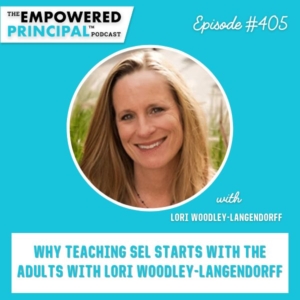
Ep #405: Why Teaching SEL Starts with the Adults with Lori Woodley-Langendorff
When was the last time you thought about your emotional fitness? Just like physical muscles need regular exercise to stay strong, our social-emotional skills require consistent practice to serve us when we need them most. But here’s the thing – many educators are trying to teach SEL without first developing their own emotional literacy.
This week, I’m joined by Lori Woodley-Langendorff, a 32-year veteran school counselor, co-founder of nonprofit All It Takes, and author of SEL Muscle Mastery, for an honest conversation about managing our emotional responses as school leaders and how this social and emotional foundation is the bedrock that makes learning possible.
Join us on this episode to discover how vulnerability and emotional connection unlock learning in ways that control never could. Lori and I explore examine why SEL often fails when treated as compliance rather than literacy, and she shares how teaching SEL skills transforms not just student behavior, but educator wellbeing.
The Empowered Principal® Collaborative is my latest offer for aspiring and current school leaders who want to create exceptional impact and enjoy the school leadership experience. Join us today to become a member of the only certified life and leadership coaching program for school leaders in the country by clicking here.
What You’ll Learn From this Episode:
- Why SEL should be viewed as literacy rather than a compliance checkbox.
- How practicing not taking things personally transforms classroom dynamics.
- The connection between educator dysregulation and student behavior challenges.
- Why storytelling and vulnerability create breakthrough moments with resistant students.
- The difference between authority and authoritarian approaches in education.
- How emotional connection opens learning faster than control or desperation
Listen to the Full Episode:
Featured on the Show:
- If you’re ready to start the work of transforming your mindset and start planning your next school year, the Empowered Principal® Collective is here for you. Click here to schedule a consult to learn more!
- For a free call to review your year, get in touch with me: Facebook | Instagram | LinkedIn
- Participate in The Summer of Fun by joining us in The Empowered Principal® Facebook Group, Emotional Support for School Leaders, today!
- Sign up for The Empowered Principal® Newsletter
- Podcast Quick-start Guide
- Schedule a 15-minute Q&A Call with me
- Lori Woodley-Langendorff: Website | Instagram | LinkedIn
- All It Takes
- SEL Muscle Mastery: Six Tools for Building Resilience and Connection in Schools and Communities by Lori Woodley-Langendorff

Full Episode Transcript:

Hello, empowered principals. Welcome to episode 405.
Welcome to The Empowered Principal® Podcast, a not so typical educational resource that will teach you how to gain control of your career and get emotionally fit to lead your school and your life with joy by refining your most powerful tool, your mind. Here’s your host certified life coach Angela Kelly.
Angela Kelly: Welcome to this very amazing episode. I have just met a new friend in the field of education. We met online. I actually met her through an assistant. You know, I get a lot of people who reach out and want to be on the podcast. And as you know audience, I’m fiercely protective of you. I monitor every interview that comes on to this podcast because I want it to be in service to you, the listener. And Lori and I just met in person on Zoom. And I felt energetically, she’s a match. I love this.
And I have never done this before, you guys. I have never pushed play on a meet and greet ever. And so there’s something special about what Lori has to say, and I am bringing her on. So the audio might not be great. I don’t have my podcast mic because I’m traveling. And sorry about that. But we’re going to just do this. This is a real conversation. This is two women on the planet who want to serve the field of education, the educators, students, families, communities. And I think you’re in for a real treat with this conversation. So Lori, welcome to the podcast.
Lori: Oh, Angela, thank you so much for having me. And I just love that, you know, when you saw synergy happen, you said, “Let’s make this happen.” And that’s how I operate. So thank you for that.
Angela Kelly: Yes, I agree. I could feel. Leaders, I just want to say something right here before Lori and I dive in. A lot of our leadership, there is skill involved. There is knowledge, wisdom, experience involved. There’s also an intuition, a feeling, a gut, whatever you call it. I call it my internal compass. There’s something that’s always guiding you as a leader. So in moments of overwhelm, confusion, indecision, sit in with your body and feel your way through that moment. Feel your way through that decision making process. Feel your way through that connection, that conversation, that whatever you’re doing in terms of taking action, allow yourself to feel the guidance, and you will be amazed at where that takes you.
So that’s a little side note here, but that’s what I was feeling and it was so strong that I just, I literally interrupted Lori and said, “Can we capture this now? The energy’s right, the moment is right.” And she said, “Yeah, my schedule’s actually super busy over the next six weeks.” So this might not have happened for another two or three months. And I’m just glad to capture it today. So little side note there. But Lori, could you tell the listeners a little bit about you, your background and education, and the story of how you created All It Takes and the other programming that you offer to educators?
Lori: Sure, and thank you again. So my background is school counseling. I was a school counselor, still am. Like I still carry my PPS for, I think, 32 years now. And I was a 30 year school counselor, like in schools. Seven years ago, I left to do what I’m doing now running this nonprofit. I left public education but still, everything I do is around education. And like so many of us, my identity is tied in education. For the good or the not good of that, it is, that is who I am and how I’m wired. But yeah, I started at 27 as a school counselor. Most all of my years were in middle school. Some people are like, middle school, and others are like, middle school, really?
Angela Kelly: It’s a love-hate, I think. You’re thinking as a counselor, what a beautiful time of life of development to study the human experience, right? Middle school.
Lori: Absolutely. And so many of my programs right now, like I’ve really, this is a little less about my background, but just really quick, like I believe like our seventh graders are the place that need us the most. So anyways, a lot of my work and a lot of our programming when we’re working directly with students is really pushing for those middle school years. Anyway, so that’s that is a big passion for me. But also being a K-8 counselor the whole time, I really am focused on prevention, right? Like I really saw early on that a couple things. My very first year as a school counselor, I had two amazing opportunities that I said yes to. And we’ll talk about yes in a bit. But I said yes to going to a three-day training on peer programs. And what I found out there is that it’s possible to teach our young people the skills that I didn’t get in formal training until my Master’s program.
And I was like, wait, if I can teach kids to do this, I actually duplicate myself times to however many are in that program. And of course, not the big heaviest stuff, but kids are their own best answers if we can give them the skill set, impart on them, have them embrace it and understand their own personal power, then they become assets to the work I was doing. So I – so lucky, year one. And the other thing I did in year one was attend an overnight experiential training. At the time was titled At-Risk Kids. I don’t love that, but that is what I was assigned to go to back then. It was a hundred kids who really were very affected by many, many different types of trauma. Let’s just leave it at that. And so they had a lot of risk factors. And in that first year, I was fascinated.
By year two, I’m like, “Yeah, I’ll watch the students as a chaperone, but I want to be for participating in the leadership of this.” By year three, I was like, “No, no, I’m not even going to chaperone anymore. I’m just going to be on the team that puts this program together.” And from that year on, I never stopped doing it. I changed locations. That program morphed into other things. But for my entire career, I was very experiential based, because what I realized by saying yes to an opportunity that I knew nothing about, that one of the best assets I had was to get people, get to create change with people feeling their feelings, feeling their why, rather than being told their why. So that was significant. Then in 2010, my daughter and I started All It Takes, originally with a lens on health, environment, and youth leadership. She quickly, my daughter’s pretty popular out there in the world of film, quickly got so busy that she could, she didn’t have time.
No, and she also was like 19 and like, “I got to go do me.” And so she, you know, went and did her life and I, it landed back in my expertise. So we really became a an education focused organization. Jump forward to pandemic when everybody pivots in a way that nobody believed they could or would ever have to, right? We didn’t even dream about what that would look like because how could you even fantasize about that kind of change? And we had an opportunity to make a film. So it’s again, it’s a yes thing. Like I got a text from a local client, an administrator, director of curriculum and instruction.
She said, “Please make a film on trauma. If our teachers have to pay to attend a workshop, they won’t be able to afford it. And we’re going to need this more than ever when this is on the other side.” So over that summer, without any funding or anything, we just made a film. That’s so cool. And I was in the yard. It was COVID, right? So we were in masks outdoors. But Dr. Pedro Noguera, Dr. Linda Darling-Hammond, Dr. Pam Cantor, Dr. Mary Helen Immordino-Yang, who now is like this leading neuroscience and education, just mastermind. Yeah. We were interviewing them.
Angela Kelly: That’s so wild. I want to point out when you are working from an energetic state of belief and of service and contribution and you’re just looking at where is a need that I can support, you know, and I can create solutions for people and I can put my mind power to that, I think that the universe just like collapses time and then it just starts to snowball. And all of a sudden you’re making films and meeting, you know, people who are leading the industry and having these conversations that are so powerful, so impactful. And I really believe you hit on something early on when you said, you know, that students can learn at a younger age what we were maybe exposed to in our master’s programs or college masters or even adulthood, even in our careers, we the awareness of personal power tools, empowerment tools, personal development and growth, SEL, you know, skill sets, these aren’t things that we were maybe taught in our era of school, right?
Lori: Not at all. Absolutely. It was definitely, yeah, not at all.
Angela Kelly: Yes. And I’m curious to ask you this. I want to dive into your book and the, you said that you the SEL muscles, right? So I want to talk about those. But one of the things that was coming up for me when you were speaking was the challenges we’re seeing with bringing SEL, not just, I’m just going to say this like directly. I know we’ve been talking about SEL in education for probably over a decade. Like it started coming in when I was a school leader, but it felt like a little cherry on top of the foundations of like academics first, well, attendance, academics, behavior, and then maybe a little SEL sprinkling fairy dust on the top. Right? And that’s how it felt to me. It was just like this little like, if there was time and it’s kind of fluffy and I’m curious to hear your work in the schools. How are we, how are you approaching this conversation around, let’s talk about feelings and emotions and social emotional development and resiliency and maturity when the adults on campus find it very uncomfortable or uneasy to talk about their own emotional bandwidth?
Lori: I think that you just nailed my journey. So it was always about the kids and we either did direct service, you know, on campuses or we took them off site for field trips and things like that. And that was all fine if we were doing it, right? If we could get a school interested. And a lot of times it was just, you know, social capital because I’ve been in education for so long and as a trusted counselor, “Okay, we’ll give this a try,” right? So that’s how a lot of times we got to work with kids. But in my work, what you’re talking about with the adults who are uncomfortable, I think there’s multiple things. One, I think SEL is so much deeper than what we give it credit for. And also, it’s less scary than we think it is.
So it’s kind of an interesting thing, like we can go so much deeper and make so much more progress with it, and we don’t and it’s not super scary. Where it becomes scary and ineffective, which is what I think a lot of both, we hear students and admin and teachers all say, it’s not working, this is just actually kind of ridiculous, a waste of my time. I hear that so often it’s kind of heartbreaking. The reason that it is that for them is because it’s being seen as a, you know, check the box, word of the week, concept of the month. Like it’s compliance.
Angela Kelly: It’s a compliance thing.
Lori: Right. Yes, thank you. Great. Great word and. And so in compliance, the teachers aren’t really bought in. Right? So you get an elementary teacher or you get a secondary teacher, they pick their topic, right? They pick what they want to teach. Elementary is choosing multi-level and multi-topic, right?
So like all the different curriculums they’re teaching and they’re choosing that. And SEL kind of came in and said, oh, you have to do this without really an individual buy-in for it. And I think that it’s not really bought in because they see it as a compliance thing. They don’t really see it working because overall, my opinion is we’re not looking at we’re looking at it as learning, you get that tool, I check the box, maybe we test on it, but in SEL we really aren’t, and we move on, and we never revisit it again. And I think SEL is the L should be literacy. Like math or reading or like we need to be writing literate, we need to be reading literate, we need to be mathematically literate at least to some degree to have a future that we get to design and that the world doesn’t say you have to be this, but we actually take on who we are and say I want to be this. And so those skills, I think there’s been a miss in the thinking of it as not just cherries and fairy dust, but a integrated part of how we actually move through the world, through the classroom, through the playground, together.
Angela Kelly: Yes. Amen to that. That is so good. And it’s funny because I also call it emotional literacy in my conversations with administrators because they connect to that. Like it’s their language. They understand. We as educators understand and especially teachers, like I want my children literate. Yes, we want them mathematically literate, we want them, you know, reading and writing literate, but we want them socially and emotionally literate. And I will go out on a limb as far as to say, I think it’s the foundation of the academics because – and we’ve seen it. We’ve seen this play out in schools.
When students are emotionally dysregulated, when they feel socially illiterate and isolated, academics aren’t on the radar for them. And teachers will say, yes, if I have a group of dysregulated students or I come in dysregulated, the day is off, the learning is off, the rhythm of the day is off. And people acknowledge that the emotional component is there, and there’s so much pressure on educators. And actually, like, I will say this because this is my personal experience, the way that we’re leading our schools is this level, it’s coming from fear and intimidation. If you don’t perform at this level and get these test scores and get this many kids attending school and get your behavior referrals down, it’s all these, if we don’t get these numbers down and these numbers up, you’re incompetent, therefore you will no longer have a position. And so as much as I think educators want to prioritize social and emotional literacy, they’re afraid to.
Lori: I absolutely, I think they are afraid to, they don’t make the time for it, they don’t have the skill, they’re not trained in it to the same degree as we train a teacher who is in, you know, teaching calculus. You know, they have a lot of training to teach that subject and what we’re not necessarily doing is training educators to understand their own social emotional well-being so that then they have their own why. Oh, wow, if I feel like this when I’m dysregulated and these are my behaviors and attitudes and moods, and if we can start to bring, you know, the educator lens about themselves into the lens of looking outside of themselves at whether it’s their colleagues or the kids that they serve or you know, an admin serving a staff of teachers, like whatever it is and whoever we’re in service to, ultimately it’s always about the kids, but if we’re not doing it well as the adults, I just really, I saw, I knew that kind of intuitively all along, but I never really saw my in until the pandemic.
And that really changed our lens on the supporting of an educator, but not just in what I call death by slideshow. Like again, we used to say PowerPoint and somebody’s like, that’s kind of – that’s actually somebody’s licensed material. So you should say slide show. So you know, like we don’t, like it’s important for us to teach and facilitate growth through experiential lenses, like we know really great teaching happens that way, right? Don’t sit down, I sage on stage, that doesn’t work. It hasn’t worked and especially it isn’t working today. And so I feel the same way about anybody in service to the educators, to the adults in the room, we need to be in playful mode, we need to be in like an open-hearted, open-minded, receptive environment in order for us to really understand how SEL is the magic. It is the fairy dust, but it needs to be the base, right?
Like you said, it needs to be what we start with, building relationships, not, you know, like the whole mentality, “Well, I’ll be nice to them after a few months after they’re afraid of me.” I’m like, well, that’s never worked, but you know, we thought really right after the pandemic, there was a lot of hope. And right now, I think that there’s a lot of discouragement from a lot of educators because it doesn’t necessarily feel like some of the changes we knew needed to happen were are happening and there’s this like kind of almost a fight to go back to 20 years ago mentality of education. And our kids just, we’re not the same, we’re not teaching the same kids. It’s not the same world. And now and then we complain about the behaviors. And so we’re kind of, I don’t know, my heart breaks for what educators are putting up with and dealing with right now, but also, I think education needs to get more courageous about trying new things.
Angela Kelly: I agree. That’s what this space is for and this podcast is for. And I think the work that I do in the world, like empowering site and district leaders and giving them a space to have these conversations because you were talking about, you know, educators in an ideal situation, they’re playful and they experiment and they’re willing to go on a journey and they’re willing to trial and error things to see what works and what doesn’t because we know one size doesn’t fit all and you’re constantly in this journey of exploring like what works this year and what works with this group of students and what works for these teachers.
And I’m in my lens through the world of The Empowered Principal, I’m thinking what prevents the adults on campus from being open, from being playful, from being curious. And I think they again, they lack safety. I think they don’t feel safe to be open and playful because they don’t feel like they have the time to make a mistake or that they have the space to make to trial and error actually.
Lori: Yeah, they permission to.
Angela Kelly: Yes, right. And so there is a rigidity that’s come in with all of these expectations of, you know, students meeting, you know, grade level standards and assessments and all of that. And I will say, I saw a shift because what COVID did and I think it’s actually a beautiful thing, even though it’s a highly uncomfortable thing for educators. COVID opened, it exposed to society that education no longer needs to look the way it’s always looked. Like we kind of as educators held a container. You know, higher education was the holder and power of knowledge and then in order to access that, you had to go through the chains of command which was, you know, preschool, elementary school, middle, high school, graduate, go to college or go to, you know, trade school or go to a community college to access success in the world.
And kids saw, they’re like, wait a minute. During COVID, it was like, I can actually learn how to do math online. I can actually go out into the world to learn science and history and social studies and engage in the world and learn in these more interactive, comprehensive, and actually much faster ways. Like you can just Google YouTube and learn, that’s what parents do. They were Googling YouTube to figure and Khan Academy and all of these things to figure out how to teach their kids the math or just support them in their in their own learning. And so it cracked open and tell me what your thoughts are on this, but I feel like COVID cracked open an awareness in students and an awareness in families that it doesn’t have to be this one traditional box.
Lori: It’s so interesting that you say that we are kindred for sure. Because I like to say often that, you know, we like to say this is the way it is to kids and they’re like, I have this thing, this device you think, you see this thing that you gave me that tells me in real time, even if it’s not, you know, real, right? Because we don’t always know what’s real and not real, but they are seeing that what we’re telling them in so many ways isn’t true. And that there are other ways. And they learned it themselves through the COVID, you know, through the pandemic and the pivoting that had to happen.
And so I do think that there is a big issue between an education system that wants to go back to, dare I say, archaic ways and a world of students and families who are like, wait, it doesn’t have to be that way and my child doesn’t have to be bored and my child should be challenged and should be engaged, right? And then we have educators who are like, well, they just want to be, they just want to be entertained all the time. Well, that is a piece of it. Like our attention spans are shorter. That is the truth. But that’s what our today’s current society is. That’s what our kids are. We have to meet our kids where they are, not where we want them to be. And that’s I think a head space thing that’s a challenge for a lot of educators. Like, I want to do what I know, what I was comfortable in, not change me to help them in their own learning.
Angela Kelly: Right. And that is where we step in and offer that support because in order to, you know, you were saying like kids want to be entertained and I do think yes, for all of us, we are zoomed into these screens and we love to be entertained, which is why people are on social media. Like they’re looking for entertainment, they’re consuming content. And I also think that when I think about a teacher, it’s like they’re bored. They’re bored teaching in the old ways, right? And in order for them to be playful and to be maybe more entertaining, what would make teaching more entertaining? And this is where I invite the leaders and the teachers to come into a reflection space where they’re like, wait a minute, what is the purpose of education again?
What do I value? What do I like about teaching and learning? How do I want it to feel for me as the educator? And I want to feel good coming to work. I want to feel good. I want to feel re And so redefining and actually like exploring once again the purpose, the values, the desires, the goals and shifting them into like what would feel good for us as the educator, I actually think there is some more alignment than we realize. I think what would feel good for teachers will actually feel good for students when we allow that conversation to take place.
Lori: Absolutely. I see it firsthand in the work we do, right? Like I see educators remember how to have fun. I see educators like the light bulb goes off when they’re just like, “Oh, I could use this fun thing to reset my classroom when the whole ship goes sideways,” right? Like because a lot of classrooms with behaviors and stuff. Like I can rephrase ways that I communicate with kids that feel really good to me and have me going home feeling whole and complete and satisfied with my own actions, even if it doesn’t go my way or didn’t fix the problem, I can feel good about the problem. I mean, I can feel good about how I moved through it. And then when we’re feeling good, we have a lens of creativity that we’re able to apply, right? We’re able to lean into like joy or ease and I just, I feel like without those pieces, we’re being asked to make sure our kids have them, but we really just don’t know how.
And you know, there’s a lot of writing, there’s a lot of personal development stuff on, you know, finding joy as an adult. And when did we lose our joy, at what point? You know, but we all kind of, if you look through in the mirror, most of us left behind childhood. And I think we can be playful and grown up at the same time. Somewhere we’ve lost that, especially as behaviors are escalating and traumatized kids are escalating and you know, the ACEs numbers are going up. Like how many ACEs our students are dealing with. And we just think that this, I don’t know, that we’re trying to have control rather than collaboration.
Angela Kelly: Yes. My message to the world is like, education is about human development, developing humans and empowering them, not controlling them, not creating, you know, one size fits all, standardized this, everybody at the at the same age, learning the same thing at the same time in the same way. We were sold that standardization was for the students. And I have found it to be true personally and I’ve seen it in my work over the last decade as a coach and in my 22 years in education that it’s actually a detriment to students which then pressures the teachers to, they’re frustrated and why isn’t the standardization working, right? It’s kind of like saying, I have three personal children and each one of them has a different personality and I parented them all the same way. How did they not turn out the same, right? We’re doing this in our classrooms.
Lori: Yes.
Angela Kelly: And we’re selling teachers on the idea that standardization is the solution when it’s not. So it’s like the insanity equation is in effect.
Lori: Yeah. And I think there’s some reasons we got there, which is a whole different deep dive, right? I do think that, you know, we went from very rigid education and parenting to that didn’t feel good and all the psychology is like, oh, we need to let kids have a an opinion and have kids say what they want. And but then we didn’t really know how to keep that within safe and appropriate boundaries, not rigid boxes, but boundaries. Like, no, you can have a say and tell me you’re disappointed that you don’t have, this is super simple, but a cupcake before dinner, right? A parents are always like, they’re so compelling. I mean, that’s when it got hard for me. Like when my daughter was more compelling and her like all of my intuition’s like, that doesn’t make sense, but you somehow have spun that so like I’m questioning me. Right? The four year old’s got me questioning me, right? Like and that’s common.
And so we wanted to give more freedom, we wanted to give more voice. I think that was right, but we didn’t necessarily have the skill set to say how do we allow voice and feelings and encourage an understanding and awareness of our feelings and how our feelings are driving our behaviors and are we happy about that, right? So we gave them the access to their feelings and their words, but then we didn’t teach them what to do with that within a boundary that helps them understand recovering resilience.
Angela Kelly: Yes.
Lori: So that’s where I feel like there’s some enlightenment in that.
Angela Kelly: Yes. And I’ll just say this and then I want to dive into the context of your book. But I teach this concept called the land of and. So a lot of times our brains will do an all or none thinking, right? And it’s exactly what you explained in parenting. We went one side of the pendulum in education too. And then we swing all the way over to the other. We did it in, you know, it just that’s just how the human mind works. And our goal is to get into that land of and. It’s this and this. This and this. So we get to say yes and yes.
Lori: Yeah I hear it as both and, yes and. I like to say all and. Like it’s all the things and more, right?
Angela Kelly: Like, yeah, yes, yes. Yes, we’re speaking the language here. Okay, let’s dive in. I am so curious to hear about your book. Tell me the title of it again. SEL Muscles?
Lori: SEL Muscle Mastery: Six Tools for Building Connection and Resilience in Schools and Communities.
Angela Kelly: Awesome. Yeah. Just give us an overview. Tell us, I don’t know how far you want to dive into the book. It just came out in 2025, correct?
Lori: Yeah, just a few weeks ago, July 29th. It released July 29th. Yeah.
Angela Kelly: Oh, congratulations. Yay, congratulations. That’s so exciting. It’s so exciting. I’m in the book writing process myself, so I’m like, ooh. Yeah, it’s a thing. That was resilience. Yes, kicking in right now. Okay, so tell me, tell me about the book, tell me about the pillars and the muscles and all of that.
Lori: So first off, SEL Muscle Mastery really is the lens on social emotional literacy development with the thought that those skills, our social emotional skills, resilience, compassion, self-regulation, right? Those are skills that need to be practiced because life is going to always be throwing curveballs, right? Like just living life is living joy and living curveballs and living grief and sadness and it’s a living life is living a lot of different things and there’s no way any of us are avoiding the hard things. It’s just a mixture, right?
And so in order to stay physically healthy, everyone really thinks of muscles, it’s important. It’s important, you know, to keep, you know, strong. And then some of us have a different definition of what strong is, right? But we do know, pretty much everyone knows that if we do nothing and we sit on the couch a hundred percent of the time, we’re going to have some kind of weak and atrophied muscles. And if we’re not practicing our social emotional literacy muscles, if we’re not practicing not taking something personal, which is muscle one, what taking it personal, right? If we’re not consciously, purposely practicing not taking something personal, then when things happen, we instantly often take it personal and then that escalates our defensiveness which then escalates their defensiveness and then we’re just in a spiral of a power struggle.
And so many of the muscles and these muscles were written in the same summer as we were making the film as a co-curriculum for the film and then that was just a short hundred page curriculum and the muscles were just a small part of it. And now we were training on these muscles for four years and they were super popular and helpful to educators. And so then the book and I added one which was curiosity. It wasn’t one of the original five. And so the concept is as adults in the room, we need to look at what we can do to stay in self-regulation, what we can do to not do what I call an adult temper tantrum. Right? And because we have them too, right?
Angela Kelly: We definitely have them.
Lori: We have them. And some of us socially isolate or do the silent treatment and some of us throw fits or get combative and there’s just a lot of different ways that we react because I think many of us adults were not taught those skills either. And so if we can teach these skills, when we teach, not if, I know we can be teaching them, we are teaching them, when we teach these skills and what happens is it’s such an interesting thing. I talk about ouches. Like what is your own behavior when you’re triggered by that kid who, you know, acted out one last time that just basically sent you over the edge. Like what are our ouches that we’re not proud of? And what would happen on the other side with these tools and that’s what we explore experientially, how would we feel?
And you know, my premise is we go home now, a lot of educators and we’re so exhausted that the people we love the most get the worst part of us. And when we flip it and we practice flexing for, you know, flexing our muscles, then even if it didn’t go well, we know we tried hard. There’s this internal intuitive pride of who we are as a person. And so no matter what’s happening out there, we know the way we’re managing it feels like we feel at ease and at peace and more rested and able to bring a new lens of creativity the next day.
Angela Kelly: Yes. This is it. So tell me about your work, like tell me some success stories or some like what’s a really good story you’ve had in working with clients or working with a school district where you’ve seen this work integrated and creating new results.
Lori: Okay. So from a teacher’s lens, one story that I really love is I was doing a morning training, two trainings in a day and she was in the morning one. just in complete meltdown. She was so frustrated and the talk of like the SEL talk, right? Some teachers are like, “It’s just soft, it doesn’t make kids do things.” And that there’s that lens of it doesn’t work and it’s basically diminishing my power and authority rather than improving it because I think we are more powerful and more in authority, not authoritarian. They’re very different. But that, you know, we are the adult in the room and there’s an authority there, right? But she just felt like she’d given it all up and there was no support.
She had this student who refused to write and she just was taking it so personal. Literally every day this student, he hadn’t written, it was like four months into the school year and he hadn’t written a word. So whether they were doing something in actual writing or any other subject, no writing. And so we talked about it. We heard her out and then I was like, what if you apply a different lens? This is a storytelling muscle from the book. And I said, what if you applied this? What was one of your hardest subjects when you were a student? And she was like, “Well, math.” And I said, “And what was your experience of math?” “Well, I never felt successful. I always felt actually, frankly, stupid. I cried at homework. I didn’t do it. I got bad grades. My parents were…” It was just ugly all the way around.
I said, okay. So maybe if you approach this student with your story of what was hard for you, rather than your fear, because you’re so attached to this student writing for their future, like it’s coming from care. It’s coming from you feeling so attached to this kid’s future that if they don’t know how to write, they can’t have a positive future and you’re spinning this whole thing about this student’s life in your heard.
Angela Kelly: And you’re in panic mode. You’re panicked for them.
Lori: You’re in panic. So the more you panic, the more you try to grab and control. And the more you grab and control, the more he shuts down. Like it’s just this whole vicious circle. So anyway, so we talked about it, training ends, do the afternoon training. I’m packing up my car in the parking lot at the end of the day, and she comes running out and she has tears in her eyes. Literally same day.
And she said, “I went to him during writing, which is in the afternoon, and I said, ‘I wonder, I was thinking about how you must feel when you write or when you don’t write. And why? And I was thinking about what stopped me from trying when I was a kid. And I remember how hard math was for me. Mmm. You do really good in math, but for me, math was miserable and I never felt smart. Everybody else was done and I was I felt like I was looking at a foreign language. And I wonder if what I was feeling about math is what you’re experiencing when you try when I ask you to write.’” And she then started crying and said, “He wrote more for her that afternoon than he’d written in four months.” And all he needed, all he needed from her was to be understood. Not desperately attached to it, right? Like so it went from desperation to curiosity and understanding and in that moment it really transformed the way she approached not just him, but from then on all of the students in her classes.
Angela Kelly: Beautiful testament to the power of stepping back into our emotional maturity and our emotional bandwidth, because what they did was emotionally connect.
Lori: Right. That’s what she created.
Angela Kelly: She created that emotional connection. And I love that you brought up the concept of educators, their intention is to love, to serve, to care, but we care so much. And we’re so afraid of students’ lives and we’re so attached about what we make it mean about ourselves as educators, if that kid doesn’t write. And what’s going to happen to their future? And did we ruin their lives because they we didn’t make them write or get them to write in this the seventh grade, let’s say. And so detaching from their personal journey, life journey, and caring about it, teaching them, but also separating our responsibility and ownership of their life, literally our students’ lives, but finding emotional connection. What a – it’s such a beautiful story and a beautiful example of and how simple it was. And I think this goes full circle back to what you said, like it feels really scary, but it’s actually so much less hard than we think it’s going to be.
Lori: Yes. And I think that we think of storytelling or doing like going on the out on a limb, that wasn’t on a limb in my world, right? Probably not in yours. But for her, in the past before we simplified the vulnerable share, teachers and I hear admin, you know, administrators say all the time like, well, my teachers are really worried about they’ll give up power and they shouldn’t bring all the stories into the classroom, the personal things. And I’m like, look, you can come into a classroom as an eighth grade teacher or high school teacher and be like, wow, not my best morning. I’m feeling really cranky and that’s not on you. But if you could give me a few minutes, I’m going to work really hard to like calm myself down. Has anyone else ever had a morning that just was not a good start of their day? You don’t have to say my kid ran away last night or someone asked me for a divorce or you know, got the medical call that just upended my life. We don’t have to give them. Nor should we.
Angela Kelly: No. It’s the emotional connection. It’s, if we think about adults and what engages us, it’s storytelling. We watch movies, we read books, we go to coffee with our friends and family and converse, and it’s the stories of life that engage us because it’s about emotional connection. And what’s interesting is you mentioned that vulnerability, that willingness to be vulnerable. That teacher, she was vulnerable in the emotional connection piece, but she didn’t have to tell the details. Like it’s not about the details of the nitty gritty of the story, the like the good, bad, the ugly, the dirty stuff, it’s just the how it felt, how it felt, how it felt. And that is where we create connections, which open hearts and minds to conversations, which then allow people to then express themselves and create more awareness as to – that little boy probably had no idea why he was so against writing until someone allowed him to be aware of, oh, I’m so resistant because of the feelings I feel when I try to put pen to paper.
Lori: Yeah, and again, like never even maybe having voice to those feelings at all. But when she gave voice to it, it was like, like our stories, you know, there’s so many adults who are like complaining about their kids on their phones. Well, we gave them the phones. And then they’re trying to say, well, when I was a kid, I didn’t have. Well, they’re not living your life. They can’t relate to that. They have no idea what it was like to not have a phone. And for us to try and guilt them, shame them to feel bad for the gifts that we’ve given them that just the world today in 2025 offers through technology is like a full miss on connecting with our young people. And it’s a miss on connecting with each other in colleague to colleague or you know, relationships. Like there, all of these tools are really great in education and they are written in the book from that lens, educator and parents. But I love it. Really, they’re skills that anyone of us, I think, can benefit from.
Angela Kelly: Yeah, yes. I mean, technology is bringing us together today in connection and I really – you can choose to look at the internet as friend or foe, and I choose to see it as like a beautiful way to connect globally. We can be anywhere in the world and have these conversations and connections. We did so in COVID where we were, you know, we had to pivot and it took some stress and it took some time and it took some effort, but we were able to connect with kids online. And I see it as such a beautiful gift to the world when we choose to look at it through that lens. And again, that’s another level of emotional, you know, literacy is how our relationship with technology and relationship to kids and relationship to education. It’s all intertwined right now. And so building a relationship, a healthy relationship with our students in relation to technology and learning. Like, you know, what is our relationship with learning? What is our identity as a student, as a teacher, as a school leader and bringing in the concepts you’re teaching in your book into the classroom, not as another layer, but as an identity of who we are as students, teachers, leaders.
Lori: Yeah. And to have that awareness, right? To become aware of how we are affected, both in ways that move us to things that feel great and joyful and easy and successful, or the awareness of which things are dragging us down or pulling us into, you know, mind, you know, misery, right? Like there’s choice in it, but we can’t even make a choice to step into something different if we don’t start to recognize that it’s there at all. And I think that’s an important place to start is, you know, kind of shifting our autopilot into intentional and then we can do things differently and I think that personally, I think we first deserve it and then everyone we’re in service to deserves that better part of our selves.
Angela Kelly: I agree. I do believe the work that you and I are putting into the world, this is a concept that my master coach taught me and I apply it into my work, which is it there’s a foundation to this work. It’s for us first, then for them and for the greater good. So for us, for them, for the greater good. And if we do it greater good, them, us, there won’t be – we will have depleted, right? We will have given to the greater good, given to our teachers, staff, community members, students, and then what’s little left for us. We need to fulfill, it has to be, I call it a grand slam where it’s a win for us, a win for teacher, staff, students, a win for community and global, you know, education at large. And we’re looking for those moments of for them, for us, for the greater good. Or for us, for them, for the greater good.
Lori: Yeah, I love I love that. It’s like flipping the pyramid upside down, right? Like it took me a long time to not to get to the flip where I was taking, I was so in service and so passionate about kind of being heartbroken about what I was seeing and like needing to fix it, right? So like to settle down and to really see through the lens of self care and then other care and then global impact is – I love that lens that you have on it.
Angela Kelly: Yeah, that’s great. So any final thoughts, comments, insights, wisdom that you would like to share with our listeners as we say goodbye for today?
Lori: You know, you’re worth it as much as they are. And SEL, social emotional literacy is really not a hard thing. It’s actually such a rewarding thing for you first that it’s worth really diving in to see what’s possible in it for you.
Angela Kelly: It is. I believe that social emotional learning, growth, development, personal power, stepping into this world of empowerment is actually it’s much stronger. It makes you stronger. I think people feel like it’s going to make us weak or look broken or unfixable or disempowered. And I think the opposite is true. I feel most empowered when I’m in management and in regulation emotionally and mentally, socially, physically. And when I learn how to do that when my body is freaking out, when my nervous system has gone offline and is in haywire moment, knowing that there’s something that can ground me and bring me back to center and to remember that I have the capacity, that’s when I feel my most empowered, right?
Lori: Yeah. Absolutely. And so we have it a little backwards, right? Like if we control everything, we’ll be happy. And I think it’s the opposite, right? When we let go of control but stay focused and intentional in our own wisdom and our own intuition and our own dreams and purpose, then that’s when the magic happens.
Angela Kelly: Exactly. Lori, I thank you for this conversation. I thank you for your flexibility and your like spontaneity and jumping on. I do believe we captured the essence of the work you’re doing in the world and the services you are providing. And I love that you actually come from a school counselor background and not, you know, the traditional teacher, you know, leader, that kind of a thing because I do know that so many educators value what school counselors have to offer. They want to work more, they want those services and you know, they get taken away with budget cuts or depending on, you know, the mindset of the organization, but the value is there and your literally bringing that work and expanding it to make it accessible for the teachers in the classroom, the students and the school leaders out there. So thank you so much for having the courage to build this service, this company, these tools and resources for people. I think it’s fabulous.
Lori: Well, thank you for, yeah, thank you for having me. The identification, you know, kindred spirits for sure and grateful always to meet people who are in this work and coming from, you know, that yes, we can do this and let’s go and let’s be creative. Thank you for the work you’re doing.
Angela Kelly: Oh, thank you. I appreciate it. I feel like this podcast brings together a group of allies, a group of collaborators. And, you know, I always, when I have conversations like this, I always put into, you know, into my intentions to our paths crossing again, you know, collaborating in some form or another. And I feel that the future will bring us together once again.
Lori: I look forward to it.
Angela Kelly: Great. Awesome. Thank you so much for being on the podcast, listeners. If you enjoyed this, please share it. Share it on your social media, if you’re on social media. Share it with your friends and colleagues. We want to get the word out. We want to get this book into the hands of all the educators, all the leaders out there. And we want to promote social and emotional literacy in our schools to make it a mainstream practice. So grab the book. Lori, we’ll put down, you can send me all of your contact information.
We’ll get the links and all of the other information that listeners need in the show notes so you guys will have immediate access. But do share this with your friends, your family, your colleagues, because we want to get the word out that there are resources available, there are supports in place, there are services available. We are here to help. We’re here to serve, we’re here to support. So thank you so much. Have an amazing week and we’ll talk to you guys next week. Take care. Bye.
Thanks for listening to this episode of The Empowered Principal® Podcast. If you enjoyed this episode and want to learn more, please visit angelakellycoaching.com where you can sign up for weekly updates and learn more about the tools that will help you become an emotionally fit school leader.
Enjoy The Show?
- Don’t miss an episode, follow on Spotify, Apple Podcasts or RSS.
- Leave us a review in Apple Podcasts.
- Join the conversation by leaving a comment below!



Leave a Reply
Want to join the discussion?Feel free to contribute!