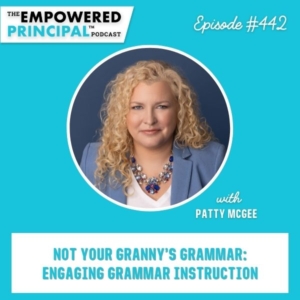
Ep #442: Not Your Granny’s Grammar: Engaging Grammar Instruction with Patty McGee
Understanding how students experience and engage with language is key to creating meaningful literacy learning. Yet so often, grammar instruction is approached in a rigid, punitive, or overly prescriptive way, leaving both students and teachers frustrated.
In this episode, I talk with Patty McGee, author of Not Your Granny’s Grammar, about how she reimagines grammar instruction to make it engaging, experiential, and student-centered. We explore her philosophy for creating learning experiences in which students can experiment with language, reflect on their writing, and develop confidence, while teachers feel empowered to guide without fear of making mistakes. Patty shares practical strategies for classrooms and school leaders to make grammar interactive, joyful, and aligned with developmental learning.
Tune in this week to discover how engaging grammar instruction can transform literacy learning, help students develop confidence and agency, and support teachers in creating a classroom culture that values exploration, creativity, and reflection. You’ll walk away with actionable strategies to make grammar instruction both meaningful and memorable for students of all ages.
The Empowered Principal® Collaborative is my latest offer for aspiring and current school leaders who want to create exceptional impact and enjoy the school leadership experience. Join us today to become a member of the only certified life and leadership coaching program for school leaders in the country by clicking here.
What You’ll Learn From this Episode:
- How to reframe grammar instruction as an engaging and playful experience.
- Why traditional grammar worksheets may hinder deep learning and creativity.
- Techniques for using manipulatives, sentence-building activities, and collaborative learning.
- How to support teachers to feel confident in teaching grammar.
- The role of reflection and curiosity in helping students internalize language concepts.
- Approaches for integrating grammar instruction across grade levels, including elementary and high school.
- How to build a classroom culture that values exploration, experimentation, and student expression.
Listen to the Full Episode:
Featured on the Show:
- If you’re ready to start the work of transforming your mindset and start planning your next school year, the Empowered Principal® Collective is here for you. Click here to schedule a consult to learn more!
- For a free call to review your year, get in touch with me: Facebook
- Participate in The Summer of Fun by joining us in The Empowered Principal® Facebook Group, Emotional Support for School Leaders, today!
- Sign up for The Empowered Principal® Newsletter
- Podcast Quick-start Guide
- Schedule a 15-minute Q&A Call with me
- Patty McGee: Website | LinkedIn | Instagram | Schedule a time to connect
- Save 20% on Patty’s book, Not Your Granny’s Grammar, with code SAVE20
- Patterns of Power
Episodes Related to Engaging Grammar Instruction:
- Ep #389: Why Test Scores Don’t Define You as a School Leader
- Ep #427: Why Dual Language Education Works with Eric Bethel and Dr. Maggie Marcus
- Ep #436: The Science of Handwriting: Why It Still Matters for Student Success with Holly Britton

Full Episode Transcript:

Angela Kelly: Hello, empowered principals. Welcome to episode 442.
Welcome to The Empowered Principal® Podcast, a not so typical educational resource that will teach you how to gain control of your career and get emotionally fit to lead your school and your life with joy by refining your most powerful tool, your mind. Here’s your host, certified life coach Angela Kelly.
Well, hello, my empowered leaders. Happy Tuesday and welcome to this episode of The Empowered Principal® Podcast. If you’re brand new to this podcast, we want to welcome you. If you’re a brand new leader out there, we are so excited for you and we hope that we get to be a part of your journey. So please tag this podcast as one of your favorites, give it five stars, and use us as a resource for you as you embark on your new journey as a school leader. So welcome to all of our new school leaders out there.
I’ve got a very special guest for you today. Her name is Patty McGee. I’m going to let her introduce herself. We just connected online, and I always, as you guys know, I always do a meet and greet because I’m looking for like the right energy, the right click. I want you guys to walk away with so much value. And Patty just, she right away was somebody that I knew you had to meet, you had to hear her story, her passion, her vision, her background, and what she’s bringing into education right now.
And it’s interesting because I do a lot of interviews, right, Patty? And I have been talking about meeting you with my friends since we’ve had our conversation and I’m delighted to introduce you to the Empowered Principal audience. So Patty, welcome to the podcast.
Patty McGee: Oh, thank you. That warms my heart. I’ve been thinking the same thing about looking forward to this conversation with you. So thank you for having me.
Angela Kelly: Good. Very good. Well, tell us about yourself and yourself as an educator and Not Your Granny’s Grammar. We’re going to dive into that later, but I want to really let the audience know who you are personally and who you are as an educator and how you came into the work that you’re doing right now.
Patty McGee: Sure. It’s an unconventional journey. I started teaching in the mid-90s in the school that I went to as a student, and my principal was also my first-grade teacher. And so she taught me how to read and she taught me how to teach. And in that time, I really found really effective ways of employing some literacy instruction that I saw making a big difference. And that difference was just palatable. It was wonderful. I was reading books galore that were professional books.
But what was happening also was I would then teach grammar and it would be the same boring drills and things like that. I knew it was a problem with practice. And it stuck with me then as I became an instructional coach, a school librarian, actually before that, in this region where I live. I became a regional staff developer. I wrote two other books and that still, that problem of practice was still there in the back of my mind. And I would just experiment because I’m in classrooms all the time, demoing as part of the work I do as a consultant. And sometimes I just try something out with grammar.
And then I met my co-author, Tim Donahue, when I was consulting with his district. He was a supervisor at that time, and he all of a sudden taught the whole room, as we were writing grammar curriculum, how to understand grammar in a way that I had never heard before. So he had that and I had all of these ideas about how to teach grammar mulling around in my head. And back then we joked we should write a book together, and lo and behold, we did. And so that’s how we got to this place.
Angela Kelly: That is so wonderful. And just as you were telling the background story and your experience with grammar, I was having all of these images. Now, I loved school. I was that kid who loved school and I played school and I took the extra worksheets and I, you know, I was that kid.
But even then, so I was a kid who loved school, and I was a kid who was, you know, good at school, you would say. Like I knew how to play the game and I was able to like complete my worksheets and do my homework. I just wanted to please the teacher, right? But I remember hating grammar. And then there were programs that would come in. And I’m a kid of the, like I went to elementary in the 70s, you know, upper school and graduated in 1989. So I was in the 70s and 80s, but there was a lot of like drill and kill. And it was just, it was kill, it was just grammar by death. And I really hated that.
And I can only imagine, and it breaks my heart. I was a kindergarten teacher for 15 years. So I loved it because I loved bringing the kids in and helping families. I loved it, but also it was such a primary year for grammar. And I saw the pushdown, right, as No Child Left Behind came in and then it was this crunch of then the standards came in and it was more drill and kill. And they would package it in different ways, but it was still drill and kill.
And I am so eager to share what you’re offering because I want school leaders out there to know. And this is a perfect time. So this is going to drop in mid-June when people are thinking about their goals for the next year and their curriculum and their choices. And this, I really recommend grabbing this book and reading it and thinking about, especially if you’re teaching elementary, but even into middle and high school, and you’re going to talk about how grammar goes across. We discussed this in our meet and greet.
But let’s talk about the innovative way that you approach grammar and so it doesn’t have to be so drab and boring for both teacher and student. And we can actually make it fun, engaging, naturally engaging, and exciting for both, you know, teacher and student to participate in. So tell us a little bit more in detail about what you came across in your studies and findings.
Patty McGee: Absolutely. First, I’d like to give you just a tiny bit of background on how I’ve got here in terms of the thinking in this book, knowing that problem of practice and basically trying out lots of things that weren’t working. They were just like versions of the same thing, but maybe like cuter, like you’re mentioning, like different programs.
Angela Kelly: A little more artwork.
Patty McGee: Yeah, exactly. Exactly. I often find solutions to my problems of practice by looking at how I learn outside of school. And so that’s what I did. And I thought to myself, okay, something I’m learning right now is refinishing furniture with these special paints and waxes. And it’s very artistic. And so the first thing I do is I get curious. Like what paints and waxes might look good on this piece of furniture? And then I go to somebody who’s more expert and I ask them to show me how to do what I’m envisioning and to give me feedback on how to make it better.
And then I go ahead and I practice, but not on the furniture yet. I practice on like cardboard or scrap wood and just to get the techniques practiced. And then I go ahead and I paint the piece. And then I pause and reflect on, what did I learn there? Like what did I learn about painting from that experience? What is it that I want to try next? What might I have done differently? I can always repaint it if I find something that I’d like to revise.
And so all of those experiences were missing from grammar instruction. They’re often found in other subjects, but they’re, I have not seen that in grammar instruction at all. And so instead, we decided to create these sorts of entry points within a grammar study, and in the true word study, the way I study painting.
And so what we’ve created is grammar where kids can get curious, where they can seek out expert feedback and explicit instruction, where they get a chance to play. This might be my favorite part. They get a chance to play with grammatical concepts in partnerships or trios, and they pause and reflect on what is it that I’ve learned? What am I still curious about? Anything that is in our minds right now, how we might use this in the future.
So having a series of experiences within a unit on, I usually start with sentences, there’s so much research behind sentence-level construction, specifically for grades two and up. Yes, some of first, but really looking at sentence combining, sentence construction, and sentence expansion. And so starting a unit on sentences where we get to get curious, like what’s the difference between or the relationship between simple and compound sentences? And we talk about that. And it’s not lessons that we’re teaching. They’re experiences.
And the reason I like to use the word experiences is because when we think of a lesson, we often think of a lesson plan format. And these are just quick 10-minute experiences where students in partnerships, having conversation, that oral language support, and talking and working through and co-building grammar know-how.
And so that’s the background on kind of how we got to the point where we thought of grammar in units, learning in three phases, which is surface learning, deep learning, and transfer, which in our work we call immersion, deep learning, and transfer. And so that there’s an extended amount of time for students to wrap their heads around and likely not yet master, but start to wrap our heads around grammatical concepts.
I think of grammar as the writer’s paintbrush. And I think that that’s a big shift in thinking and one that if we make it, we start to see grammar differently rather than a rigid set of rules that one must follow. Instead, it is how we make meaning on the page for clarity and connection. And when we think of it that way, we can see greater possibilities.
Angela Kelly: Yes. Oh, so beautifully said. What really resonated with me was that you’re taking something that used to be like an intangible experience, something that was separate from us and it didn’t have meaning and purpose in its own entity because I believe that learning sticks, like you said, when we experience things through all of our senses. So much of education is through, you know, the hearing and the sight, those two senses. We don’t, we rarely use, we might use touch a little bit kinesthetically in the earliest stages.
But, you know, getting our mind, our body, our soul, or just our heart into something that’s so intangible, you have created experiences where kids are anchoring in the learning through multiple senses and through connection, through communication. And that already just feels better and it feels more inviting because if you think about any memory that you have or anything you’ve learned, like you discussed the painting and the, and I also love the artistry.
It takes grammar from being like a skill, a hard skill that you must learn in this fashion and rules 1, 2, 3, 4, 5, into an art form. And if you think about the most majestic of written pieces, whether it’s spoken or written, they break the rules intentionally. Why? To connect, to ignite your senses, to ignite an emotion inside of you. And what you’re offering is grammar as a full-body experience, an anchoring experience that kids can actually connect to, see its purpose, see its intention, play with it like a media, an art medium, a form of painting, dancing, expression of the human experience.
I have goosebumps saying this out loud right now. Like I’m tearing up, but it really, when I think about my kinders, wow, this, this is why I was so excited to share Patty with you guys today. But when I think about grammar being painful and hard and frustrating into this lightheartedness, this fun, this dance, this playfulness, and it brings joy, it brings curiosity and exploration where there really is no one destination, there is no one right answer. There’s simply the form of expression down to the individual student level. Is that what I’m hearing from you?
Patty McGee: Yes. Yes, 100%. And wow. And I want to say that the feelings of emotion around re-envisioning what grammar can be is because many reasons, but I’d really like to point out the amount of shame that’s included in the whole concept of grammar, learning, knowledge, and instruction. It’s like the haves and have-nots. It’s saying, you speak this way, so that means that you’re not as, quote unquote, educated, or it means that if you don’t remember grammar, this is a lot with teachers on all levels of educators. They may not remember grammar very well because the methodology that was used to teach it wasn’t effective.
Angela Kelly: And off-putting. Like you, it’s almost like resistant to it. Yes.
Patty McGee: Oh, 100%. So there’s a level of like shame for those of us who are adults who don’t feel like we know grammar very well. And so there’s a great avoidance to teaching it. And we’re also surrounded still, even as adults, I mean, we have people wearing t-shirts that say, “I’m silently correcting your grammar,” or carrying mugs that say, “grammar police.” Does there need to be such a punitive type of tone around something that is art?
Angela Kelly: Yes. I guess it would be like holding a mug that says, you know, I’m judging your artwork. I’m judging your physical capacity or like something where grammar is a developmental form of expression and cultural form of expression. And I mean, that takes us down another whole other path, but the truth is that there is no one right way. There is, there are ways that we have learned culturally within our society here in the United States, but other cultures have different grammar globally. There is endless grammar. It’s a form of language. It’s a form of expression.
And we are teaching some foundational skills for kids. I feel like more in the sense of like being able to recognize patterns, just like you would in art class, recognizing patterns, recognizing techniques, recognizing, you know, different types of expression and art forms. And you know, we do that when we get into the upper grades, might study poetry or, you know, why somebody wrote the book in the grammatical way that they did, you know, based on, you know, the historical background or the content, the messaging, the intention behind the story and the book.
So this just opens up grammar. It, I feel like it just, it’s a new paradigm of, it’s a new lens, as I call it, a new lens through which we look at grammar as more of an art form, as more of an expression. But I agree with you, Patty, it feels like people take pride in correcting. It’s funny because when you think about it in terms of the context of this conversation, what’s the point of being the grammar police or correcting it other than to make somebody feel inferior?
Patty McGee: Or the person correcting feeling superior.
Angela Kelly: Correct. Yeah. Yes.
Patty McGee: If we could take a second just to talk about the different buckets of grammar.
Angela Kelly: Yes, let’s do it.
Patty McGee: You were going in that direction a little bit. So I like to think of grammar in three buckets. I know there’s more, but just generally speaking, there’s spoken grammar, and that is the grammar we use dependent upon our community, our family, our culture, whatever that grammar is. And then there’s book grammar. That’s the second bucket. And book grammar is where an author is using or, like you were saying, intentionally misusing standard grammar. And standard grammar is that third bucket.
And so what we do when we are expressing ourselves on the page is we think of our reader, we think of our audience, and we think, would my writing connect us with clarity if I used more spoken grammar? If I used a mix of spoken and standard grammar? Or is it most important to use standard grammar? And so it’s almost like code-switching.
Angela Kelly: Yes. I was just thinking that as you were describing it, I was like, this is a form of code-switching.
Patty McGee: Yeah. Yeah.
Angela Kelly: And when I was writing my dissertation, I had to use whatever standard book of, it was very painful, but I had to write because it was a dissertation, it was a thesis, I was expected to write in that very professional, collegiate form of writing, which I was actually pretty good at, but you had to follow like every dot, every punctuation, every space. I can’t even remember all of the terms, but like the resources and the guides that you use, like referencing people.
And so that part of the writing for me felt so constrictive, but I also respected it because it was a form of writing based on the type of writing I was doing that to give my book the grit that it required, I needed to learn and perform that level of grammar.
Patty McGee: Yes, because that was your audience. Your audience are academics and those who will approve your work, your dissertation. Where if you were writing the same thing but for a different audience, let’s say it’s for new teachers, you’d probably find a blend of some of that more formalized standard grammar and ways to communicate with a new generation of teachers.
Angela Kelly: Yes, definitely. So let’s talk about what this program invites teachers and students to do, how they engage with the work of grammar learning.
Patty McGee: Sure, absolutely. So before I start that, I just want to say that I have a beautiful endorsement that I would love to share. I was in a 7th-grade classroom demoing a series of experiences, and I’ll describe them to you. And we started off by saying, I’m going to teach you some grammar today, but it’s a little bit different than the old way. And when we were done and I was leaving, a 7th-grade boy stood up and said, “That was so much better than the old way.” And I was, so ringing endorsement from a 7th-grade boy and I was like, “We’re onto something here.”
Angela Kelly: Yes. And to hear that from a middle schooler, that’s pretty profound.
Patty McGee: Absolutely. Absolutely. So the way that I propose that we experience grammar instruction and grammar learning is first by taking away the expectation that when we do something with grammar, we will be able to immediately use it. That was one of the expectations with the worksheets. Like, oh, you just did a worksheet on nouns, so now you should be able to use that proficiently in your writing now and forever. Yes. And that’s just not a realistic expectation for any type of learning.
And so instead, one, say, cycle in deep learning might look like instead of studying simple sentences on their own, we might study simple and compound sentences and look at the two and in conversation hypothesize, what do I notice is the same? What do I notice is different about these two types of sentences? And they’re already identified. So identification is not the first step. I often hear, and I’ve probably said myself that, well, if they can’t identify a verb, how can they use them? They’re using verbs before they can even write words. So identification has acted as a gatekeeper to grammar learning.
So instead, I go ahead and I identify, here’s a list of simple sentences, here’s a list of compound sentences. Talk to your partners and theorize what you think the relationship is. That’s one experience, 10 minutes or less. The next experience is when I like to explicitly teach and say, “Here are a couple of theories that I overheard you talking about, and here’s a little more clarification on it.”
And then I might teach how to take two simple sentences and turn them into a compound sentence. And I do so with a very friendly chart. For those of you listening who haven’t heard of FANBOYS, that’s just an acronym, which we have too many acronyms, but I like this one.
It’s an acronym for the coordinating conjunctions for, and, nor, but, or, yet, so. And then I teach it step by step. You’ve got two simple sentences and you want to combine them into a compound sentence. First, you choose one of the fanboys. Then you go to your first simple sentence, change the period to a comma, put in your fanboys, and then add your second simple sentence. So it’s crystal clear. It’s not like, take a guess, what do you think I should do here? It’s a step-by-step. This is how you do it. Now, just give it a little whirl. I’ll give you two simple sentences. Try it out with your partner. And that’s it.
And then the next experience is one of play. So this one I call, well, I love grammar manipulatives, the way we use them in math to use them in grammar has been really effective. So I call this one “Presto Chango,” where we would have some sentence strips of all simple sentences. Then we would have, and they would be, you know, cut out. Then we would have the FANBOYS all cut out and a comma cut out. And in partnerships, they would create compound sentences.
And what happens there is many things. One, they start to touch and talk about, I’d rather use this word or that word. What inevitably comes up is I’d prefer to use the word because. And I’m like, we’re going to get to that, but it wouldn’t be a compound sentence. It would be a complex sentence. Right now, we’re creating compound sentences. And so kids start to get curious instantly about that.
Sometimes they start to look at, well, I structured it correctly, but it doesn’t really make sense. It just feels awkward. And so they’re having the chance to create and compose sentences out loud without having to think about down to like the handwriting of, you know, how am I going to shape this letter? How do I spell this word? What am I even going to write down as a simple sentence? It’s a beautiful scaffold between those places. And that kind of play sometimes I will do for two different experiences on two different days just so we get some extra play.
We then reflect, but before I go there, I just would like to say that there’s a difference between play and games. I tried the grammar games and I think it only deepened the shame because it was more public that everyone was watching, and of course, the one who knows standard grammar better is the winner. And the one who doesn’t know standard grammar as well is the loser. So I’m only building more shame on top of what already has a lot of shame around it. But with play, we don’t have a predictable outcome. There isn’t a winner or loser. We’re creating together. And what we’re creating, yes, has some guidelines, but it also has some freedom and can look different than the partnership next to me.
Angela Kelly: Yes. That is a really important distinction because we do confuse playing a game with our students versus just open exploration.
Patty McGee: Yes. Absolutely.
Angela Kelly: That’s a really, I’m glad that you said that.
Patty McGee: And then the next experience is reflection. And inevitably, I hear when they talk about their curiosities, can I put three simple sentences together? Or can I put three independent clauses together? Or when should I use these? Or even can I try these in my writing right now? So when we write down, chart out, you know, as the teacher listening into partnerships chat about what they feel they know for sure about grammar, what they’re curious about, and maybe how to use it. But the first two, what do you wonder? What do you know? Charting that out and keeping that as a little staple that we add to throughout the unit.
So the next round that looks very similar in the pattern might be on simple and complex sentences. And we would do the same thing, but I might change up the manipulatives. I might create word cards that are similar to if you’ve ever seen like magnet poetry, we had that and we’d leave each other notes in college on the fridge or on the door.
Angela Kelly: With the magnet words, yes.
Patty McGee: Yes, yes, exactly. And so having a collection of words and using every part of speech, all punctuation, multiple “the” because that’s the most commonly used word in the English language, having endings, all of that. And putting them into a baggy, making one baggy per partnership or trio, those word cards then can be used to manipulate and create complex sentences.
And there’s two different ways to do that. So kids get a chance to play and explore. There’s a lot of words in there, so we may want to whittle them down a little bit, or we may want to just give them a day to play. And once they get familiar with the words that are in there, they’ll know them very well by the time we get through different grammar units, but it’s a great long-lasting tool.
And one little tip, before you cut out all those words and punctuation and endings, color the back of the paper so it has its own unique color. Because when, not if, one of the words falls on the floor, you can match the color on the back…
Angela Kelly: To the set. Yeah. Yep. That’s a teacher tip. That’s a pro tip right there. Yeah. I love this. It’s actually taking me back to how we were teaching just the kinesthetic of it, you know, being able to manipulate and use manipulatives. And I love that you’re actually doing it in the, I call them the upper grades, but I mean like upper elementary, middle school. Now, does this program have aspects for like the high school?
Patty McGee: Yeah.
Angela Kelly: Okay.
Patty McGee: Yes.
Angela Kelly: For high school kids.
Patty McGee: Absolutely. So I have found in my work with high schools that they’re really preparing kids to take a test, like the SAT, and not necessarily preparing kids for usage of grammar. And I would say that this approach does both because if you know how to use grammar, you can see what’s going on when they’re testing you. Still, we want to look at a test, see what it’s going to ask, practice that, but that not be the only thing.
But if we take this approach, I mean, I have two kids. One is almost 21 and one just turned 26. And I can tell you that they do not know grammar as well as, you know, you would think after being a graduate of college and now a senior in college. And that’s because grammar was taught for a test, not taught for usage. And so definitely having this type of approach in high school, I think is, I know time is limited, but that’s why this is such a good approach.
And I like to say maybe have these grammar experiences 10 minutes, three to five times a week, and keep it simple. They’re all very low-tech or no-tech. They are, they don’t require screens. They require face-to-face conversations. They require cutting things out sometimes. It’s, or projecting something. It’s very low-prep, very high engagement. And so, yes. And in fact, seventh grade is usually the grade where the student standards are the compound-complex sentence. And most teachers I’ve met don’t know how to make those. And that means that most kids don’t know how to make them either. And so that is really important for high school as well.
Angela Kelly: This brings up a really important topic. So if we, like our generation and the generations that are teaching right now, were taught in the more traditional or more strict way of, you know, the grammar police kind of generation or era, is there a component for teachers? Because there is a lot of embarrassment and shame in the adults in the room. Like, you’re a teacher, you’re supposed to know grammar, you’re supposed to teach, especially the professional kind of, like you said, standardized grammar. You’re supposed to know that.
And if you don’t, a lot of people will mask that and they’ll, and it’s subconscious. I remember subconsciously maybe avoiding topics I didn’t feel as competent in, or I would just do the surface level, or I would go exactly as the curriculum said because I was afraid to like expose myself or to teach it wrong, right? The worst thing you could do is teach it wrong. And so is there a component for teachers to learn this along the way with their students in a way that’s like…?
Patty McGee: Yes. Yes, 100%. So first, I want to say that in my own anecdotal research about grammar instruction, grammar learning, I talk to about 100 different teachers from all different grade levels. And the number one reason that grammar was not being taught was because the teacher didn’t feel comfortable with it. And so we are not alone. I do not want anyone to feel any sense of discomfort around not remembering grammar that was taught to us in a way that we couldn’t learn it. There are small percentage of people that did, but there’s a greater percentage of people that did not.
And so what we have in our book, in the very back, is called Your Grammar Refresher. And Tim wrote that whole part. So Tim’s understanding of grammar and the way he teaches it makes so much sense. And so if we’re not sure about certain grammatical concepts, I’m referring to that all the time. And I wrote this book with him. So you don’t have to remember everything. You don’t have to, you know, put it all in your mind.
And there’s also to go with it, he recorded videos of him teaching particular concepts. So it’s not only written out for us, but it’s also videotaped. He got a dry erase board in his basement and his boys recorded him on their cell phones. Like it’s just, you know, simple and he just explains things so beautifully. Also to go along with that, we have provided many different resources that a teacher can use.
So in chapter three, that’s a full unit from soup to nuts on sentences, and we have the resources for each of those things. So a teacher doesn’t have to feel confident in the grammatical concept. And in fact, I would say a beginner’s mindset is actually really helpful in this approach because we often want to tell kids what they’re doing wrong because that’s what always happened with us.
And so there’s things like charts that we can use and print out or project from our companion site. There are different types of manipulatives that we have created. We have mentor texts and ways that we could use them. There’s just so much in there. There’s also a process for transfer and how we really get it into student writing. And really, we are not expecting perfect mastery of the entire knowledge of grammar or know-how of grammar. What we’re looking at is growth. We’re looking for is growth.
Angela Kelly: Yes, absolutely. Oh, that is wonderful to hear that there’s that component so that teachers can kind of lower that defensive shield that comes up when we feel that we’re, you know, because teachers really are under the pressure of, “You’re the educator, you should know everything, you should know exactly what you’re teaching, and you should understand it at a mastery level.” And we’re humans. And that pressure can be intense.
So kind of lessening that affective filter and being able to lighten things up for the teachers so that it feels safe to explore that and to not know everything and I think just to say to your kids, right? Like, this is something we’re exploring even into adulthood because grammar is an art form and it can be expressed in so many different ways. So we’re all learning here together and there’s no need to feel like you have to know everything and being a little vulnerable and sharing that with your students and letting them know like, this is, you know, I had to learn it in this way and this is why I want to teach it to you in this way.
Patty McGee: Yeah, absolutely. And I was having a conversation with Whitney LaRocca and Travis Leech, who are part of the Patterns of Power group, which I think is a really sound grammatical set of resources. And we talked about this concept of being a contemporary grammarian and a contemporary grammarian is somebody who is curious about grammar, who knows that we’ll never know everything that there is to know about grammar because every style guide, no matter which one it is, revises every few years. So it’s impossible.
Angela Kelly: Because it evolves. Grammar evolves and it has evolved over the centuries.
Patty McGee: Exactly.
Angela Kelly: Because it’s a form of communication, right?
Patty McGee: Exactly. So if we think of ourselves, and maybe instead of saying we don’t know things, we can say we’re contemporary grammarians because we’re curious about grammar.
Angela Kelly: Yes. And what it, how it exists right now. In this era, in this time, you know, timeframe of our existence. Yeah it’s, it also just gives perspective, like just almost universal perspective of the evolution of grammar. And it means like we’re just studying as it exists in this little piece of time right now. You know? That makes it kind of fun.
Patty McGee: Funny that you should say that because in chapter one of our book, we’re really trying to help us shift our minds from the way we think about grammar. And I have a chart in there where it has, here’s grammar from the 16th century. Here’s grammar from the 17th century. And just quick quotes of just by centuries of how very different grammar is now than 100 years ago. So it shows that evolution. I know it’s at a glacial pace, so we don’t really see it clearly, but it really has evolved to the point where it’s hard to read the older stuff.
Angela Kelly: Right. And it’s only in the context of the English language. Yeah. As we know it here in our own country, right? Because again, it is different. So I just am thinking about what listeners want to know. Okay, one thing I was thinking when you were speaking earlier was, for the listener out there who always wants to know this, I’m just going to ask the question for you. Let’s talk about the results, the outcomes, the impact that you have witnessed in your work with schools and districts because people want to know like, “Yeah, this sounds great, but we still need to get those test scores and we still need to, you know, we have benchmark assessments that we need to be monitoring.” So what’s the impact of this approach to grammar that you have observed?
Patty McGee: Yes. Well, obviously it’s observation, it’s anecdotal, but there’s also some studies behind components of this approach. I’ve seen in the pilot classrooms, those that I was just an email away, but I wasn’t doing all the teaching, they have reported that their test scores jumped or were significantly higher than others on the grade level. There’s one classroom in particular, it was a 4th-grade in-class support class, and the special ed teacher was like, “Sure, we’ll pilot this. It’s not going to do a thing for my kids.” But the opposite happened.
And it’s really interesting too because when we study grammar and how sentences work and how to expand them, combine them, the pieces of them and create them ourselves, we are better then at comprehending because we can unpack the syntax of a sentence when things get tricky if we’ve been studying how to build sentences. So there’s direct research in that as well. So I think that the reason we saw these results, especially from the classrooms that really did the whole pilot unit, was because it has an effect on all things literacy.
Angela Kelly: Yes. Wonderful. That’s so inspiring and encouraging for people. And what I love most about this, and I guess we’ll close out with this, and then I’m going to have you share how people can find you and connect with you and the work that you’re doing, is this really is about making grammar feel good. And in my programs, the Empowered Principal programs, we talk about feel-good goals and we talk about goals that actually feel good to achieve.
And there’s an intention and a purpose and we’re connected to the reason, we’re connected to the interaction with that goal. And there’s something more than just putting something down onto paper because it’s a compliance, you know, action that we’re taking and a task that we have to do because we were told to do it.
This just feels so much more like we’re making grammar feel good for students and for the teachers. It feels a little more approachable when we know that it’s so expansive that there is no need to know it all, get it right, do it this one way. And like the red ink, I think about when I was a kid, like the red ink coming out and circling where you forgot this and marking that and, oh, you would just like be allergic to the red ink.
But this approach, like there’s no winner-loser, there’s no right-wrong, there’s no destination almost. It’s just a journey and a grammatical journey and an exploration, which just feels so much lighter and more delightful to engage with it as fun, as play, as a form of expression and artistry and connection. And I love it. I love it. I love it. I love it.
So Patty, if listeners want more, if they want to grab a copy of the book, if they want to connect with you directly, or if they want to get the, it sounds like you have resources and manipulatives that people can order for their schools to explore, where can they go for more?
Patty McGee: Yes. I just want to tell you before I say that, you use the word “delightful.” And when I share my bio, I say that I’m an advocate for delightful literacy practices.
Angela Kelly: Oh.
Patty McGee: So that was just very kismet.
Angela Kelly: Yes, good, good.
Patty McGee: So I have a website. It’s pattymcgee.org. Be sure to spell Patty with a Y because you will not find the right Patty. You’ll get Patti McGee, a famous skateboarder from the 60s.
Angela Kelly: Oh, nice.
Patty McGee: And there are free downloadables, some of them manipulatives. There are lots of different posts and resources that are on my website, and there’s also ways to contact me through there. You can voice record a message to me. You can just click contact and it will go right to my email. So I would say the best place for resources and connection is pattymcgee.org.
Angela Kelly: Great. And we’ll put that in the show notes. So the link will be available for you. Now, is the book, it’s called Not Your Granny’s Grammar. Is it on, can people just go onto Amazon or whatever their favorite bookstore is and purchase?
Patty McGee: Okay, great. Yes. So it’s Not Your Granny’s Grammar: An Innovative Approach to Meaningful and Engaging Grammar Instruction. If you go to the Corwin website, which is my publisher, and you use the code SAVE20, you’ll get 20% off and free shipping.
Angela Kelly: Excellent. Okay, so we’ll put that link in the show notes because I want people to go directly to the publisher and get that. And it’s called SAVE20?
Patty McGee: Yes.
Angela Kelly: Okay, you guys heard it right here directly from Patty herself, the author of the book, Not Your Granny’s Grammar. Thank you so much for your time. Thank you for reaching out and being on the podcast. This is why I do this work. This is why the podcast is here. It’s to connect people with alternatives to what we would consider traditional learning, teaching, and leading. And I’m just so delighted to have met you. It’s been a pleasure. And I do hope we keep in touch. Like when I meet people on the podcast, I just want to become friends with everybody and…
Patty McGee: Yes.
Angela Kelly: And I hope you guys feel that too, listeners out there. So for more, we’ll put all the links to Patty’s work in the show notes. Again, thank you for your time. To all the principals out there, congratulations. You guys are wrapping up the end of the school year. If you’re not finished yet, you’re near the finish line. Congratulations on a beautiful school year. Have a wonderful summer and we will see you next week on the podcast. Take great care, everybody. Goodbye.
Thanks for listening to this episode of The Empowered Principal® Podcast. If you enjoyed this episode and want to learn more, please visit AngelaKellyCoaching.com where you can sign up for weekly updates and learn more about the tools that will help you become an emotionally fit school leader.
Enjoy The Show?
- Don’t miss an episode, follow on Spotify, Apple Podcasts or RSS.
- Leave us a review in Apple Podcasts.
- Join the conversation by leaving a comment below!



Leave a Reply
Want to join the discussion?Feel free to contribute!