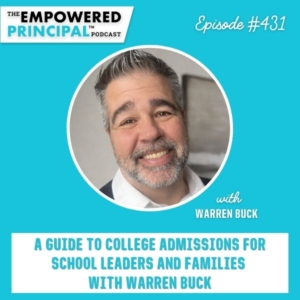
Ep #431: A Guide to College Admissions for School Leaders and Families with Warren Buck
What if preparing students for life after high school felt less overwhelming for both families and school leaders?
In this episode, I sit down with Warren Buck, founder of Future Finders, to explore how we can better support students and families through the college admissions process. Warren brings a unique perspective as a former teacher and principal who now works directly with families to help students navigate their options after high school.
Join us this week as we explore how the college admissions landscape has changed, why it can feel so complex and overwhelming, and how students benefit from having a guide who can help them explore possibilities, clarify their goals, and take ownership of their future. You’ll learn what families and educators should prioritize early in the college planning process, the importance of focusing on school fit rather than rankings, and how to help students tell their authentic story through their application materials.
The Empowered Principal® Collaborative is my latest offer for aspiring and current school leaders who want to create exceptional impact and enjoy the school leadership experience. Join us today to become a member of the only certified life and leadership coaching program for school leaders in the country by clicking here.
What You’ll Learn From this Episode:
- Why the college admissions process feels overwhelming for many families and students.
- The importance of helping students take ownership of their future planning.
- Why “fit” matters more than rankings when choosing a college.
- How to support families in setting a realistic college budget early in the process.
- The role of authentic storytelling in college application essays.
- How AI is impacting student writing and why human voice still matters.
- Ways school leaders can leverage external resources to better support students and families.
Listen to the Full Episode:
Featured on the Show:
- If you’re ready to start the work of transforming your mindset and start planning your next school year, the Empowered Principal® Collective is here for you. Click here to schedule a consult to learn more!
- For a free call to review your year, get in touch with me: Facebook
- Participate in The Summer of Fun by joining us in The Empowered Principal® Facebook Group, Emotional Support for School Leaders, today!
- Sign up for The Empowered Principal® Newsletter
- Podcast Quick-start Guide
- Schedule a 15-minute Q&A Call with me
- Warren Buck: LinkedIn
- Future Finders: Website | Facebook Group
- College Admissions for Overwhelmed Parents by Warren Buck
- Becca Silver: LinkedIn
- The Whole Educator
Episodes Related to A Guide to College Admissions:
- Ep #374: A Teen’s Guide to Self-Love and Authenticity with Kristi Simons
- Ep #389: Why Test Scores Don’t Define You as a School Leader
- Ep #403: An Unconventional Path to School Leadership with Deepali Deshmukh

Full Episode Transcript:

Hello, empowered principals. Welcome to episode 431.
Welcome to The Empowered Principal® Podcast, a not so typical educational resource that will teach you how to gain control of your career and get emotionally fit to lead your school and your life with joy by refining your most powerful tool, your mind. Here’s your host certified life coach Angela Kelly.
We have an exciting interview. This particular interview is near and dear to my heart. Warren Buck is a friend of one of my most dear friends, Becca Silver, who is a content expert in resistance. She is an instructional coach coach, so she coaches instructional coaches across the nation. And she is personally a friend of Warren’s. I met him through Becca.
This interview is fantastic. It revolves around college entrance and prep and all of the things that families need to do to prepare themselves to apply for and land the school of the students’ choice. Warren is an expert in this. I think you’re going to love this interview. Please share it with any family members that you know personally or if you are a school administrator in the high school levels, please share this with your colleagues. Warren’s work is phenomenal. He’s got a book that he has published on the topic, and he individually supports families through the college application process. Enjoy this episode.
—
Angela Kelly: Let me give you a little background before I introduce our guest for the podcast today. My friend, Becca, is a coach for instructional coaches. So Becca and I met at a workshop, a presentation. We were both presenting in Maryland, I believe, at the National Center Convention. It was this huge school leadership summit and we were both presenting. And we, I think we just ran into each other over dinner. And we met, “Can I join you for dinner, glass of wine?” and we started talking and we hit it off. And so she and I are kindred souls. We have been entrepreneur buddies. We have been friends ever since that one meeting. And she and I talk on a regular basis about life and business.
And she introduced me to her friend, Warren Buck. And Warren is our guest on the podcast today. And he offers something so special and so unique that is very relevant to school leadership and to your students, particularly those who are in the high school leadership arena. And I’m going to pass it over to Warren, let him introduce himself, tell you a little bit more about who he is and what he does, and we’re going to have a conversation about the services that he provides to students and families. So Warren, welcome to the podcast.
Warren Buck: Thank you so much, Angela. I think this is going to be a lot of fun and it was really cool to hear your story about how you and Becca got connected. So I’m the owner of a company called Future Finders. I work with families to help them plan for life after high school, navigating all the choices that are out there because it’s a lot different than back in my day when you just kind of followed the path that you’d always been on. And now kids just have so many choices and they all sound amazing. So my company works really closely with families to navigate that landscape, explore the options that are out there and provide them with the tools and resources to end up with a really bright future.
So in my Becca story is, we met actually 16 years ago when we were both new teachers at KIPP, The Knowledge is Power Program in Atlanta. We just kind of hit it off in a social studies cohort meeting one day and became friends. And I transitioned into being a principal for KIPP eventually here in Jacksonville, Florida. But Becca and I have stayed in touch and when I moved into the nonprofit sector, that coaching that she does of coaches was really valuable. So she was the first person I called to help us out with a cohort at the Jacksonville Public Education Fund. And she just brought that energy and brought that expertise that she has and just wowed everybody that we were working with. So that’s my little Becca story.
Angela Kelly: Yeah, Becca is amazing. And I actually am kind of saving her, her services story because she’s coming on the podcast. We’re going to do a separate interview. She and I literally could not remember if we, I have been on her podcast, but we couldn’t remember if she’d been on mine because we have so many conversations. We’re like, it feels like we’ve had a podcast conversation, but it might have just been like friends talking on the phone. So yes, Becca is incredible. She is the founder of The Whole Educator. You can find her on Instagram. Yeah, she’s on Instagram, but you can really find her on LinkedIn. I think that’s where she does the primary. And I noticed connected with Warren on LinkedIn as well.
So if for all of you all who are following on LinkedIn, you can find us all over there doing fabulous work. So Warren, I’m curious to know like you’ve been a teacher and I didn’t know you were a principal. So that’s really cool. So that makes this even more relevant. And now you are supporting families and connecting them to, you know, higher level education. So how did you transition from your role in school leadership into this role?
Warren Buck: Well, really it was that role in school leadership that helped me develop a passion for this. Just if you want to get kids engaged, start talking about their future and start talking about it in realistic terms and really, you know, kind of push them to think about what they want to do in a meaningful way, not just naming the first two or three careers that every kid says when they when they start thinking about those things. So just seeing the process of kids getting really invested in their future and the pathway towards that future, when you lay it out and have a really mature discussion with them, just kind of set my educator brain on fire and it was something that, you know, coming to the college admissions world from the school building like I have, I’m just in this for the kids.
And, you know, as educators, we all know we want to see when the kids light up and get energized about something. So that’s really what I’ve tried to bring into this process. And you know, really helping the kids to learn some soft skills along the way because that teacher hat is always on and getting them ready to be successful on whatever next step they choose and frankly, just not being their parents because I think we all know that about the time those kids hit 9th, 10th grade, parents stop knowing anything as far as they’re concerned. So sometimes I can just be that third party in the room that really brings some energy and brings some excitement, brings some resources and connections and I’m not mom and dad.
Angela Kelly: Yes, yes, which is a win-win for the kids. What I love about the work you’re doing is that genuine connection to something that they find passion about that isn’t just another curriculum to learn, another test to take, like performative learning, especially at the level of high school kids where they like they get it at this point, right? They know the difference between like performative learning and just like learning for the pleasure and the joy of being alive on the planet and learning for life’s purposes learning and that passion. So you get to connect with them at that genuine level which they probably appreciate. It must be so refreshing for kids to have someone to talk to and of course like there’s not that barrier of like, I’m the parent and I say so.
And like the parents have an interesting interest in their children’s lives. It’s like, they want their kids to have all the opportunities and all the passions, but they kind of have their own way of in the way that they want that for their kids versus you just get to say, hey, I’m all here for you. What do you want to do and what connections can I help you develop to get you where you want to go?
Warren Buck: Well, and that’s one thing I do very intentionally in the first meeting with my students is I tell them like, you’re going to have to get used to this. You’re about to be bossing around a 50 year old guy that’s going to be working. You have to put yourself in the driver’s seat of this process because I don’t know you well enough to steer your future, but I’m really good at research. I’m really connected to lots of people and I just I have some gray hair that I’ve earned along the way of figuring these things out for families. So automatically putting the students in the driver’s seat, I think really kind of shifts their perspective and gives them a lot of power in the in the dynamic, which they take and run with.
And then, you know, on the back end, I’m doing really cool presentations for the families to make sure that the communication is there, everybody’s on the same page. So really the kid and the family don’t need to do anything but discuss all the cool options that are out there and all the different things that Warren has found in his research. So it really becomes a very collaborative experience for everybody where I like to think that I’m kind of the engine driving it with the process and the timelines and the deadlines and all that. But the students definitely in charge of that steering wheel and the parents know everything that’s going on and get to steer me as well because they know and love their kids so much.
Angela Kelly: Of course, of course. Yeah, it’s such like a, you’ve developed like a grand slam home run. It’s like a win, win, win for everybody involved. So I’m wondering how you connect. Do you go through the schools and connect with the schools, the kids, or do you work with parents directly? Like, how do you reach out and how do you connect with families and students?
Warren Buck: Well, really the main way is A, I spend an embarrassing amount of time on Facebook. Facebook groups are phenomenal for making those initial connections and getting people warmed up. I’ve also created a whole bunch of digital products that I’ve made available to families for free on my website. So that families can go on there and kind of get a sampling of what I do and start to get more familiar with the process. Then when they get to that point where they feel like they need some additional help, they contact me and we set up a free consultation and kind of talk about what we need as far as, you know, which of the packages they’d like to select.
And honestly, at this point, it’s great because we’re doing mostly word of mouth with our business. Our clients have been super happy. And this is the best time of the year, by the way. We’re recording this in December and a lot of my early action clients are getting those acceptances from their schools. And getting all the celebratory emails and texts from everybody. So like one of my clients just got into one of her reach schools, Texas A&M today. So she’s ecstatic and it’s really just becomes like a self-perpetuating thing. Kids just get really happy with the results. The kids coming behind them are like, “Oh, how’d you do that?” And that’s when they mentioned future fighters.
Angela Kelly: Yes. I love this because I mean, I can remember one being way back when I was, I’m the first person to go to college in a four year university in my family. So this really matters to me that you’re connecting kids, especially if kids haven’t had the pathway led for them or like if they don’t have that guidance to connect them from what do I do after high school other than like getting a job and getting married and kind of this, you know, role playing out just one option. I love that you are out there connecting with kids who might not have that guidance otherwise.
And then I was thinking about my own experience as a single mom when my son was in, you know, junior year, senior year looking into colleges. That was overwhelming. And I was a principal and I thought to myself, one, I’m a single mom, like, how am I going to run my school and go on all these, you know, visits or whatever. And then two, you know, if I’m this overwhelmed, and I’m in the field. What is it like for families, families of second languages, families who aren’t native to the system, families who just aren’t familiar with education or they don’t have anybody directly related in the field to guide them? Like, it’s a really daunting process for students and families.
Warren Buck: It absolutely is. And I mean, yeah, you’re a former principal and navigating this was super hard for you while you were in a school building. So that just lets you know that this is a very complicated process. We can all hem and haw about whether or not it should be, but the fact of the matter is that it is. So having somebody that can get in there and really get to know your student and your situation is totally invaluable. And that’s I love working with first generation college students, also one myself here.
And I just I know that this is a core belief that we all have is that parents want their kids to do amazing things. Sometimes they just don’t have the skills necessary and that’s when a third party like me can come in and work with a family. And I also want to say like a lot of so much get put on the plate of principals and schools these days. It seems like every time that there’s a societal issue, people want the schools to fix it. So we’re in a situation where so many educators and especially poor school counselors in high schools have these tremendous student to counselor ratios and there’s this expectation that parents can go to school counselors for college admissions advice. And I know all the counselors want to do their absolute best with that, but the numbers are just daunting. So, you know, really just having third parties like me, free resources like Future Finders puts out. You know, I know there’s a lot of us out here that are trying to flood the zone with as much information and help as possible because it really does take a village not only to raise a kid, but to get them to college these days.
Angela Kelly: Yes. Yes, agreed. Agreed. And that’s just the starting point, right? Then that’s a whole another journey on, you know, once you get in, then you’ve got to go through the process of like getting yourself physically to and from school and getting in and settled and then on you go to that next adventure. So, okay, so what are you had mentioned there are different packages or levels? I’m just genuinely curious like, so what are the services that you provide and what are those different levels? You don’t have to go into detail, but just in general, like so that principals can maybe, you know, understand like what are the services that a student might need or what’s what are families looking for so that they could point them in your direction.
Warren Buck: Well, there’s two things that I really prioritize with every single client and every single communication that I put out there anytime I talk about this topic. First, parents need to have a very realistic budget for what they can spend for college as early as possible. I have a tool that’s on my website that’s for free that leads families through planning their own personal finances, looking down the road at what they can expect from the FAFSA process, and then other potential financial aid sources through net price calculators that schools have available. So that process needs to be as realistic as possible as early as possible because there’s nothing as heartbreaking as a student that’s worked four years to get into a dream school.
And then the parent has no idea how they’re going to pay for it. They just assumed that it was always going to work out or that federal financial aid would take care of it or the mythical full ride scholarship would come through. So I always start with that. Just please have a budget when you start this process. And then the next thing that I really would tell anybody that’s working with this age is please, US World News Report does fantastic work at a lot of things, but their rankings are not what you should be basing college choices off of. Really take the time to diligently look at what your student wants from a college experience, and then use tools that are available, like on my website, to do that process of finding schools that are actually a really good fit for your student.
We know how teenagers are. I mean, they watch SEC football every Saturday or they get, you know, they go on a campus tour that’s all rah and looks like a lot of fun. And a school can seem like the absolute best destination from the marketing that goes on, but if the fit isn’t there behind it, it can really lead to some wasted time and effort down the road. So those are the first two things.
And then, you know, as a former language arts teacher, getting those personal essays to be as good as possible in the Common App, hugely important because they’re one of the few true differentiating factors. There’s a lot of kids with high stats these days. I look at some of the SAT scores that students are cranking out these days and I won’t tell them what I got back in the day because it’s just a little embarrassing, but there’s just so much talent out there and you really need to have some personal statements and other materials that stand out from the crowd. So that’s where you can really kind of focus some of your energy to make sure those little differentiating factors make this process happy from the beginning. Realism with a budget, finding a really good fit, even if it’s not a highly ranked university, and then making sure those little differentiating points are spot on and really thoughtfully done.
Angela Kelly: This is brilliant. Just what you’ve shared right here for both educators and for families. One, like I mean, those were points that I hadn’t considered. One, I wish we had been more realistic in our budget. Fortunately, we only had one child, so we were we’re able to make that work for him. His dream come true. But he didn’t pick a school on ranking, although it was highly ranked, but I do remember that conversation with kids like being very concerned about the image of the school and the rankings.
And even with our, you know, and I coach school leaders day in and day out, we get caught up in these rankings and these listings and you know, we need to look at what we’re making them mean and the truth of that, those could change at any moment. Anybody could come up with a list of ranks or different, it depends on the criteria and it changes from year to year. So it’s really a matter and at the end of the day, 10 years from now after you’re out of college, nobody cares what your school was ranked, right?
Warren Buck: Yeah, absolutely. I’m thinking of one student in particular that I worked with in this past cycle. He was such a cool, chill young man. He’s a surfer, so that kind of gives you a hint about his personality. But he has amazing stats. He has all the extracurriculars. His essay was brilliant. And there was so much pressure in his school for someone like him to go to the University of Florida or go to Georgia Tech. And all along for him, he was so level-headed and smart about this and the approach that he took with his mother is he wanted to maximize the merit aid that he could get.
Get into a good program that would lead to being a physical therapist like he wants to be down the road. And then he was like, “I’ll I’ll apply to those other schools, but I really want to make sure that my mom’s not having to stress out about paying for college for me.” So we got him connected over at University of Alabama, Birmingham, which has some tremendous pre-medical programs. And sure enough, they saw his application and his scores and they just started throwing money at that kid. And he is thrilled with the whole process because now he’s got his undergrad paid for the next four years. He’s got a 3+1 program that they have at UAB that’s going to lead to him getting a master’s within that four year award that he’s got. So because he took that time to like just tell everybody in his high school, “That’s fine. You go to UF, you go to Georgia Tech, you go to Duke. I’m going to go over here for free and we’ll see each other in four years and see.”
Angela Kelly: Exactly. I love that. That is such a great story and really, it does, and he can put his heart and soul into that program and become the best physical therapist out there. It doesn’t matter the rank, it matters what you do with where you land, right?
Warren Buck: Amen. Amen.
Angela Kelly: And the third thing you said was about the essays. And that’s interesting because I think about it, I coach aspiring school leaders to land their first job. And there are people who are just like, “Oh, they just kind of like do a cover letter and whatever.” And or they get over obsessed with it. And it’s interesting because I think some of the kids out there might think like, “What difference does the essay? Is it really going to make the difference?” But hearing you say that really solidifies like that part of the process and the value that work that you invest into that essay provides.
Warren Buck: Well, you know, one of the most interesting things about this is there’s so many misconceptions about what makes a great essay for this process. There’s so many kids and parents that psych themselves out thinking that if you haven’t overcome some great big obstacle or challenge in your career, that your personal statement’s not going to be any good. And I’ll tell you the best essay I read this past cycle was about erasers. The student that started collecting those little erasers all throughout her childhood and how they marked time for her and they marked major milestones in her career and with within her family.
And she just wrote it so beautifully and it was no giant, you know, revelation. She didn’t cure cancer or anything, but she told a really authentic story about who she was and how she’s going to contribute to this campus that she wants to go to. And it legit brought tears to my eyes. I was just so blown away by this writing. And I want students and families to understand, there’s no formula for a great essay except being yourself. I love AI for tons of things, but not this process. Like AI will never be able to tell your story like you can. And that’s what those professionals in the admissions office are looking for, is genuine, wonderful kids that are great citizens and are going to be great citizens on their campus.
Angela Kelly: And I really think that because of AI, that the authenticity in your writing and the genuine story from your heart, I think that communicates energetically, that just communicates so much more honesty and transparency and openness and willingness as a human, from a human to human connection, which is what you’re trying to create in these essays, that matters more than the perfect articulation or, you know, the which word choice or you know, all of the getting everything correct grammatically. It matters more than perfection, right?
Warren Buck: Well, and these admissions officers, they know what they’re doing. These are highly educated people that have been doing this for a long time and they know what a 16 or 17 year old sounds like in an essay. And there’s a certain realism that needs to be there and a certain affectation to the writing and the storytelling that’s just not going to be reproduced by AI. And you know, honestly, one of the most fun things about this is I’ve seen so many students that do this personal statement process with us and this is really the first time they love writing because we don’t tell them how to start.
We just tell them, “Tell us about yourself.” One of my tricks and I’ll give this one away for free, I always tell students, “Get out your phone, open up your voice app, put it on record, and just start talking about the topics that you’re thinking about. If you can talk for five minutes about a topic, you have probably got a good topic there. Click it off, copy and paste that transcript into a Google Doc, and you’ve got a rough draft. If you think you had a great topic, but you can only talk for a minute or two about it and you’re I don’t, it’s not going to be a good topic. So move on.” So a lot of the time it’s kids really starting to think about themselves and their story very legitimately for the first time. And I think it’s another one of those light bulb moments that I’ve really come to enjoy. And I also enjoy not having to give feedback on 120 essays at a time. That’s definitely another perk about this process.
Angela Kelly: Yes, yes. There’s a check for the teacher right there. That stack of papers coming home with you on a Friday. Oh boy. Oh, ouch. I know. I remember the days. It was painful. Yes, and so this just really, I guess, and for educators out there, it really does kind of highlight the value of having kids maybe sooner than junior or senior year, start to write stories about themselves in a way that’s authentic and where it’s not about, you know, I get it. There’s standards that have to be met and grammar this and that and whatnot. But having them get this free writing opportunity where maybe it’s a little less structured and a little less graded and just more exposure to storytelling, authentic storytelling in a way that’s connecting human to human, and getting them to really think deeply about who they’re becoming as young adults.
Warren Buck: Yeah, I think we could probably go off on a completely different tangent for a couple of hours just talking about how AI is changing the game for teachers. And I think that’s I hear so much frustration from teachers and rightly so because a lot of what they’ve done doesn’t really fit into this AI paradigm anymore because students can get the answers from ChatGPT or they can write the technical writing or the expository writing in ChatGPT and you know, they wash their hands of it. So I think, you know, my initial thought is, let’s get a little more analog and just get some paper and pencil out and really challenge the kids with prompts that can’t be answered by AI, things that come from themselves.
Get them comparing and contrasting and cause and affecting, just based on their own experience in the world that’s around them because I think that’s where kids are going to have a chance to excel is those kids that are more generalist in their approach to their education. They’re able to take from their math class and combine it with their science class or there’s a beautiful generation of kids that are really engineering focused because they’ve had a lot of STEM education, but they’re super talented artists and they see connections that aren’t there to these old folks. So I think we’ve got to we’ve got to lean into the creativity of kids and show them a world outside of AI and how fulfilling that can be for them to really be on that journey of personal discovery without any kind of device next to them.
Angela Kelly: Yes. I really believe this. Becca and I have had these conversations too where at the end of the day, I don’t believe that AI can replace human energy, like the human story, the human experience. It can try to emulate it or it can try to encapsulate it, but it isn’t it. And there’s a difference between like a story about it and then it, the actual experience. And so I love that. I do agree. I think like just bringing it down and I’m not anti-artificial intelligence at all. It’s just there’s a time and a place for it. But when it comes to the human expression and the forms of human expression that we that we invite kids to participate in and to engage in, I agree with you. I think like and their story, like their story deserves to be told because it’s a unique story. There’s no other person on the planet that has or ever will have your exact experience through the lens of your life and who you are. So.
Warren Buck: That is just so true and it’s I talk to my clients about this all the time because I tell them up front, I use AI in my practice. It’s something that does more research in a blink of an eye than I could do in hours on Google. The difference is that I’m 50 some years old. I have a master’s degree. I have taught for a long time. I’ve had multiple careers, and it’s that blend of expertise that I have and the speed and research of AI that makes it an effective tool. If you just go to AI, it’s going to miss so much of the nuance that makes these kinds of things important. There’s just reading body language. There is understanding what’s left unsaid in a conversation that can be a key to the whole process working or not working. So it really has to be that balance of human experience, human expertise, human knowledge with the cool research that AI can do. But if the balance goes too far in one direction or the other, you’re just going to miss out on some tremendous potential.
Angela Kelly: Exactly. So shifting gears a little bit, I understand that you have recently written a book.
Warren Buck: I have.
Angela Kelly: Can you tell us about it?
Warren Buck: It is College Admissions for Overwhelmed Parents. And it is a relatively short and breezy 150 page ebook that really takes families all the way through the college admissions process. It’s probably like a lot of other products that are out there in that regard, but there’s a couple of things that I think really make this unique and it’s something that I’m very excited to get into the hands of parents and to educators. First, there is a family in the story, Samantha and her parents, you follow along with them as they go through the college admissions process, which kind of gives you characters that are relatable that you can latch on to throughout reading the book and cuts through some of the more technical aspects of the book because this has got to be a book that you start in junior year and you’re not finished with until spring of senior year.
So you want to make sure that it’s engaging. But then I know there’s a lot of books that tell parents how to do this process. My book shows them how to do this. So on the first page of the book after the table of contents, they can download a workbook that they do alongside with the reading of the text. And then there are AI prompts in there that show them very specifically how to do some of the key steps along the way. So a family can spend seven dollars and ninety-nine cents on the ebook. They get basically a concierge that leads them through the entire process. And then with that intelligent infusion of the workbook and the AI, they can really get expert level results.
It’s probably not the best business decision I’ve ever made to put this all in one place and to give this all away. But I think it’s so essential that families have more tools that can kind of level the playing field for them. I think it’s really helpful for educators and those heroic counselors that are in our high schools doing all the work that they’re doing. So putting a few of these on the shelf and, you know, we’re in some workshops with them, it can be really powerful that families have a common text that they can go to, a common language, and then this workbook that leads them through the entire process step by step.
Angela Kelly: Yes, because for some families, seven dollars and ninety-nine cents is what is accessible. And that just like you said, it does level the playing field in a way that probably no other service has yet to offer, which is outstanding. Like I had no idea that Becca mentioned you wrote a book. That’s what the message I got. I’m like, hey, let’s have him on the podcast. I had no idea like the depth of the book and the intention behind the book and the services that are included in this incredible, like almost no-brainer offer for families to have access to the process because boy, if that book would have been out when I was going through it with my son back in 2017, I would have purchased a copy for me and everybody I know.
Warren Buck: Well, and at the end of the book, they get an invitation to join our Facebook group. You know, that embarrassing amount of time I spend on Facebook, going to double down on that and invite them into my Facebook group where they’ll have access to me and my team answering questions that they have. So not only do they get the book, but they get the ongoing support in case something’s not clear or they have something that pops up along the way. They can, you know, keep accessing the community, keep accessing our experts to really guide them along the way because if we’ve learned anything in the last few years, chances are we’ve got some curve balls ahead of us and the more that we can lean on each other as a community to navigate those, the better it is for everybody.
Angela Kelly: That’s wonderful. The question that just popped in my mind, I’m wondering, do you have connections with the colleges at all or is it strictly through the student and parent? How does all of that work?
Warren Buck: Well, fortunately, I’ve had the opportunity to work for City Year and Jacksonville Public Education Fund and some other organizations. I did a fellowship at Harvard for a year. So in my work with those organizations, I developed quite a few relationships in higher education across the country. And then I’m that guy that as soon as I start working with my clients and they start narrowing down the schools that they want to go to, I call up an admissions officer and have a conversation and introduce myself. So I don’t have a lot of experience working on the higher ed side, but I have lots of friends and I’m not shy about making more.
Angela Kelly: And the reason I asked that question is I was curious about the college, the admissions perspective of this work. They must really appreciate you helping families through the process because it one, it helps on their end, but two, you’re helping a greater number of students apply to their school, which is it’s just another win for colleges and universities given, you know, all that’s going on in the world of education right now, right? There’s a lot of uncertainty and I think that having those connections and looking through the lens of all the different perspectives of all the players on board really helps provide students with like a holistic experience and understanding of that process from, from you start thinking about school and what you want to be when you grow up and all of that into like the technical aspects of it and the hoops you got to go through and deadlines to meet and requirements and all of that technicality into like landing that position and then also having to interface with admissions on the other side.
Warren Buck: Well, and that’s where so much of it comes back to that concept of fit. And, you know, we have kind of perfected it to a mathematical formula at Future Finders. And we give every school a fit score for each of our students. You know, we dive into the common data set and learn as much as we can from the information that’s put out there. And really, we want students not just applying to schools that are a good fit, but we want them showing up on campus prepared on day one to be successful because that’s ultimately, we all know that you can fall into a pretty big student debt hole pretty quickly. You can waste lots of money dropping classes because you’re not prepared for certain things. So we really, you know, based on my own personal experience, I graduated high school in 1991 and graduated college in 2006. So I’ll let your audience do some math there about who was unprepared to go to college. And I’m really just very passionate about making sure that our students are going to schools that are a good fit and that they’re going to be academically successful from day one. That’s a hugely important thing to me.
Angela Kelly: I love that. I love that. So where can educators, parents, where can they find this book online and where can they find your services? You are on LinkedIn, but where else can they find you?
Warren Buck: So it’s college, college for overwhelmed parents, college admissions for overwhelmed parents. I should probably have that pitch down a little bit better. College admissions for overwhelmed parents, it’s available on Amazon, but it’s also available on my website, which is pretty simply FutureFindersLLC.com. You can go on there. Right now, I’m running a little special where you can download a first chapter for free, just to make sure that it’s something that you think is going to be a valuable investment. So you can get that first chapter for free and then hopefully download the rest of the book right there or purchase it the paperback copy through Amazon.
Angela Kelly: Oh, wonderful. That’s great. Is there any other wisdom before we go? I just want to make sure that you’ve been able to share your words of wisdom and connections with educators because this is primarily school, site and district leaders who listen to this, aspiring leaders, but many parents, I also have, you know, teachers out there who are listening to this. So.
Warren Buck: Well, and just as a former principal, I think naturally wanting to talk to the principals out there and just saying that I know your plates are full. I know how difficult that seat is and how much there is that you’re balancing every day. So hopefully finding resources like the ones that I’m putting out there and other companies are putting out there, it’s such a great area to delegate and to bring on some contractors to work with you so that you can really stay at that high level, focusing on the relationships with your kids and your family and knowing that they’re working with people that also care about them and are going to make sure that they get fantastic results. So I know sometimes it’s hard to look outside the building for help for your kiddos, but this is one area where there’s a bunch of us trying to do our best to help out and we’d love it. And anything we can do to make a principal’s job easier, trust me, I’m there for it.
Angela Kelly: Absolutely. Amen to that. And that’s what we’re here for. And I think I remember being a school leader and being overwhelmed by I knew there was, you know, support out there, but it felt like hard to know what this is why I do the podcast because you get to know somebody, you get to and we’ll put all of the links to his content, all of Warren’s content, information, the book. We’ll put all the links in the show notes so that you guys have immediate access. But this is a place where you I curate the people who come on to this podcast, people who are in it with the right intentions for the right reasons, in service of students, families, education, school leaders.
And this is just one layer of research that will hopefully help you out there listening to this, know that this is a service in the best interest of your students and your families. And if it’s something that can be taken off your plate, amen to that. And this is what I do. Like I offer support to school leaders to help you, even though I’m on the outside, and Warren’s coming in from the outside, we are at heart educators here to help, here to serve, and here to provide a service that makes life and your work easier for you and helps students learning and connection to higher learning easier for them. So we are here to help and support.
Warren, thank you for your time today. I know we did this kind of last minute, but I really value the work that you do. I’m really impressed by it and honored to have you on today and I look forward to future connections and really seeing like where this takes kids because I’d love to hear like you mentioned some stories about kids coming back, getting their dream, you know, connection with their school, having it be a match. And imagine just the trajectory of the contribution that these kids are going to provide to the world in the upcoming years.
Warren Buck: It’s exciting stuff and I really appreciate the opportunity to talk about it today, Angela. And anytime we can talk about amazing kids and the cool things that they’re doing with their futures, I’m happy to hop on and talk some more.
Angela Kelly: Yeah, we’ll do it. We’ll have to come back and have a whole another conversation about that. So that’s it, folks. Warren Buck, it is again, just tell them the name of the I just want to make sure we got it right.
Warren Buck: College admissions for overwhelmed parents.
Angela Kelly: Yes. And the website is?
Warren Buck: FutureFindersLLC.com.
Angela Kelly: Okay, write it down, look it up, leverage these resources. Have a beautiful week and we’ll talk to you guys all next week. Take good care. Thanks so much. Bye.
Thanks for listening to this episode of The Empowered Principal® Podcast. If you enjoyed this episode and want to learn more, please visit AngelaKellyCoaching.com where you can sign up for weekly updates and learn more about the tools that will help you become an emotionally fit school leader.
Enjoy The Show?
- Don’t miss an episode, follow on Spotify, Apple Podcasts or RSS.
- Leave us a review in Apple Podcasts.
- Join the conversation by leaving a comment below!



Leave a Reply
Want to join the discussion?Feel free to contribute!