Ep #386: Flow and Focus Hacks to Transform Your Principal Productivity with Steven Puri
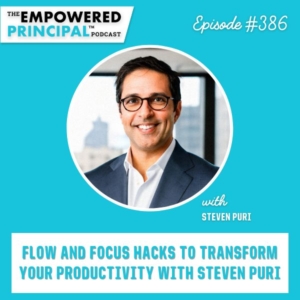
As principals, it can feel like there’s never enough time because you’re responding to one crisis after another without making meaningful progress on important projects. You need tools and concepts to overcome the overwhelm, helping you become more efficient and focused. That’s exactly what my guest today specializes in.
In this episode, I sit down with Steven Puri, a fascinating guest who had an extremely successful career in Hollywood, but has traded that in to help remote workers master flow, productivity, and efficiency. Though not my typical education-focused guest, Steven brings fresh perspectives on productivity, focus, and creative problem-solving that directly apply to school leadership.
Tune in this week as Steven Puri shares powerful insights about flow states, mono-tasking, and creating dedicated spaces for deep work. Through Steven’s stories from film production and tech entrepreneurship, we explore how to break unproductive cycles and find more fulfillment in our work.
The Empowered Principal® Collaborative is my latest offer for aspiring and current school leaders who want to create exceptional impact and enjoy the school leadership experience. Join us today to become a member of the only certified life and leadership coaching program for school leaders in the country by clicking here.
What You’ll Learn From this Episode:
- How to overcome the cold start problem that prevents you from tackling important tasks.
- Why limiting yourself to fewer tasks actually increases your productivity and success rate.
- How to create dedicated spaces that trigger your brain to enter productive flow states.
- The counterintuitive approach to creativity that explains why your best ideas come when you’re focused on something else.
- How mono-tasking can transform your productivity compared to the “whack-a-mole” approach to leadership.
- Why your physical environment significantly impacts your ability to focus and make decisions, especially when working at home.
- The neuroscience behind flow states and how to harness them for more effective leadership.
Listen to the Full Episode:
Featured on the Show:
- If you’re ready to start the work of transforming your mindset and start planning your next school year, the Empowered Principal® Collective is here for you. Click here to schedule a consult to learn more!
- For a free call to review your year, get in touch with me: Facebook | Instagram | LinkedIn
- Participate in The Summer of Fun by joining us in The Empowered Principal® Facebook Group, Emotional Support for School Leaders, today!
- Sign up for The Empowered Principal® Newsletter
- Podcast Quick-start Guide
- Schedule a 15-minute Q&A Call with me
- Steven Puri: X | LinkedIn | Email
- The Sukha Company: Website | Instagram | LinkedIn
- Flow by Mihaly Csikszentmihalyi
- The Net and the Butterfly: The Art and Practice of Breakthrough Thinking by Olivia Fox Cabane and Judah Pollack
- Cal Newport

Full Episode Transcript:

Hello Empowered Principals. Welcome to episode 386.
Welcome to The Empowered Principal® Podcast, a not so typical educational resource that will teach you how to gain control of your career and get emotionally fit to lead your school and your life with joy by refining your most powerful tool, your mind. Here’s your host certified life coach Angela Kelly.
Angela: Well, hello my empowered principals and happy Tuesday. Welcome to the podcast. And hey, if you’re new, a shout out to you and if you are a first-year principal, if you’ve just got hired and you’re binging on the podcast and you’re trying to learn all of the things, welcome to the world of the Empowered Principal. We are so happy you are here.
Just remember, I have all of the essential leadership things lined up for you. So be sure to reach out. Just a shameless plug here, but I want to make sure that you feel supported as you’re entering into the new position. So, I know it’s the middle of May, you’re winding down your current position into your new position. And I just want to let you know there is support available. There are resources for you. You don’t have to go into that first year all alone. So just be sure to check that out.
Now, I have an amazing guest. We have just met, and I’ll tell you guys, when I have people on this podcast, I do a pretty thorough screening. I send a list of criteria and I am very adamant about protecting this podcast. I do not want it to be a stream of solicitations of other people’s products or services. I want them to come on with the intention of serving the community and to provide you with something that you can walk away with. So, I’m pretty stringent about it.
And for every person who’s on my podcast, if I do not know them personally, I do a meet and greet beforehand. I meet them personally. I get to know who they are, what they’re like, their energy, their vibe to see if they’re a match for the content of this podcast. And I have to tell you, Steven Puri, who is our guest on today’s show, is not my typical podcast interview. But when I saw his email, there was something about the email that caught my attention, and that was a personal connection.
So, Steven and I both lived in the Mountain View, California area. I served in the Mountain View area as a teacher, principal, district administrator. Steven worked in the industry. I have actually been to the company that he worked at for so many years. I used to take my kinders on tours there because I had parents who worked at the company. And now we connected and he has so much insight to share with you guys. I couldn’t resist having him on the podcast. So, that was a long introduction, Steven. All of that to say, welcome, welcome to the Empowered Principal podcast.
Steven: Angela, I really appreciate you having me on. I hope as you said in a recent episode, I can be an A-plus guest. And for everyone listening, I hope that some of the things I have to share from my journey are helpful in terms of feeling your own empowerment, mastering your time, finding your focus. This is where I’ve spent a lot of my time.
And to give you a little context, I spent about twenty years as a senior executive at several studios. As Angela mentioned, as a senior executive vice president, DreamWorks for Kurtzman Orci, as a vice president at 20th Century Fox. Saw a lot of movies there, and then when I moved back into tech, I saw that there was a lot of overlays about the kind of management techniques, both for managing yourself as managing others, that were really helpful. And that’s what I’ve been talking a lot about the past five, ten years. So I’m really happy to be here and I hope this is both engaging and maybe has some cool prescriptive advice.
Angela: Yes. One of the things I love about Steven is his engagement strategies, talking about education, but just human-to-human contact, his engagement strategies. And our conversation at our meet and greet flowed so beautifully. I felt that connection and those are the kind of people I bring on because it’s really about the energy and the intention behind the words that we’re sharing with you today. And so, we’re probably going to dive into a couple of different topics here and there, but really the context of this is it starts out with storytelling and connection and your ability to work and flow with people. That’s kind of where our conversation led. So, Steven, I’m going to just turn the mic over to you and I’m going to let you tell the stories that you shared with me on the meet and greet and we will put them in the context of our school leaders out there who are wrapping up the year. I know we talked a little bit about the energy behind the end of the school year and managing all of that stress, trying to do many big things at one time, managing the time, managing your energy. So let’s just dive into your story and tell the listeners a little bit more about who you are and the context of why you’re here today.
Steven: That is so generous of you. Okay. I will give you some of my story, and by you I mean everyone listening, so that you have a spine on which you can hang the lessons we’re going to talk about. So you’re like, “Oh, I understand the context of why Steven learned that and how it’s applicable.”
So, my story is, if it were made into a movie, it would probably be something of a dramatic comedy in that I think a lot of things have fallen in my lap and I’ve been very lucky, and then I’ve worked really hard to make something of the things that fell in my lap. I cannot tell you that my grand design at fifteen was to be on Angela Kelly’s podcast years later talking about remote work, but it’s led here. And I’m going to tell you how.
So my mom was a high school science teacher in the Bronx. Hard area, this was a long time ago, and she definitely had that vibe of like, you need to learn, you need to respect education, you need to do this from a very underfunded point of view. My parents both grew up extremely poor and my mom worked while she was a high school science teacher on the side. I guess what you’d call it now is like a side hustle. But she built up an engineering education where she eventually became a software programmer at IBM, which is where she met my dad, who was a hardware engineer. So my mom was programming System/360 computers. My dad was designing chips for them.
So when I was little, of course, mom taught me how to code. I mean she’s a teacher. She loves passing along knowledge, right? Which is what I’m very excited about. As you know, I’m having a son this year. Super excited to probably teach him more stuff than he cares to learn, but you know what, you’re trapped, right? So let’s talk about stuff.
So, so that was my early years was doing software, learning about this, becoming a little code monkey, a little hacker. I got a scholarship to go to USC. USC was very generous and I was also a Thomas J. Watson scholar from IBM. So, they essentially paid me to come to Los Angeles, which I grew up in Northern Virginia, very different world from that. This fell in my lap where USC came when I was still a junior in high school and said, “Do you want to come to college early? You know, we think you’d do well here.”
I went there and this is another one of those lucky coincidences. So while I’m there, of course, a lot of USC has a fantastic cinema TV school. A lot of people in my dorm and in my life were aspiring filmmakers, you know, writer directors, you know, wanting to be the next Lucas or Spielberg because they had gone to school there, right?
And this was the moment when film went digital. And I happened to be at the intersection of that Venn diagram of I could speak to an engineer and I could also speak to a filmmaker. And by sitting right there at that intersection, my career took off when I was like a junior, senior in college. Suddenly I started working in film. It was an amazing period of time. And you know, everyone aspires to make great movies and work on great projects. I got very lucky is that I produced the digital effects for Independence Day and we won the Academy Award for the visual effects on that movie.
And a rising tide lifts all boats as we know. Yes. We set up a company with the director and producer of Independence Day because we got along really well. We were like, “Oh, we’re going to keep making big movies like this.” Sold that company four years later to a German conglomerate called Das Werk, after doing a bunch of movies through there. So I got to work with Woody Allen and Jim Jarmusch, who are not typically known as effects filmmakers, as well as worked with Cameron and Fincher and Spielberg and a bunch of the big name, you know, a bunch of guys.
So, I did that for a few years through my twenties, sold this and foolishly thought, “Oh, this is easy, like building companies is so easy.” Yeah, later in life we learn not so easy, right? So, this next turn was I had, in doing this, met a lot of people who were in film, not doing computer generated film, but actually producing films and working at the studio. I thought, “That seems really cool.” So that was kind of my thirties was I want to go be a studio executive, which is how I ended up as you know, senior executive at a couple studios. Again, kind of fell in my lap, but I worked really hard with those opportunities that came.
And I think there’s probably from my both my parents who worked very hard and earned their degrees, there was a celebration of learning. It was like one of the greatest things you can do with your life is just have a beginner’s mind. Just continually ask why and how and why and how, you know? And I can’t wait, you know, for my child and hopefully my children have that same sense of curiosity about the world.
So, I did this, worked on a bunch of movies, Transformers, Star Trek, you know, Die Hard, Wolverine, and I have to admit, there’s a moment on Die Hard where I was like, “This is a terrible script. I’m the senior executive running this franchise.” And I know that the momentum behind this project because Bruce wanted, he had a spring slot to shoot. And when you’re working with stars, they have very rigid schedules. It’s like, “I have April and May to do this and then I have to be in Romania to shoot the sequel to, you know, whatever it is.”
So, he had a slot and it was like my boss, the chairman of Fox Film Entertainment was very clear, “We’re going to shoot this in the spring.” Like, I don’t care if it’s written in crayon on, you know, on like napkins. You will shoot this because we know how much money we’ll make. We can do the projections, we’ll release at Christmas, it’ll make some amount of money, right?
I’m thinking, “I’m going to wake up, be like forty, fifty years old, be like, I’m cranking out Die Hard movies.” You know, like, and what will my children think of me? Hey, Daddy’s got to go to work today making Die Hard 9 in the retirement home because it pays your college, right?
I decided to get out of film, which a lot of my friends were like, “You’re insane.” There are maybe thirty executives in the world that had my job, that senior executive at a studio because it’s a very rare job to have. And I got back into tech. And that was when, as I mentioned before, I had this moment of, “Wow, there is a lot about how work works in film that is not translated to other industries and I can mind some of those lessons and share them in these other industries.” And that became very much a point of my career the past five, ten years of just saying like, “Okay, here are things that I’ve learned.” And the fun thing is when you can illustrate them with like, “Here’s a great anecdote about how Transformers got made or how Star Trek got made or how this,” you know, it’s more memorable for people. So, maybe it just it sits differently and people remember this like, “Oh, that’s a great productivity technique that the writers on so and so used. Oh, I should try that,” right? So, that’s kind of the spine of my story.
Angela: Nice. Oh, well, first of all, I think everyone can relate to film because most of us in the world watch movies. Second of all, I’m personally attached because for those of you who don’t know, my son is a screenwriter. He went to Chapman University. He studied screenwriting, but he really loves working on set. He is an assistant camera. He’s worked in LA, he’s worked on many shoots, he’s traveled for his work and now he’s in Nashville and he’s getting into the network out here. And he loves the art of film.
And so, Steven’s story connected with me personally as a mother, but also I started thinking about how leadership is leadership and it crosses over in every industry. And sometimes in education, we feel like it’s very different in the field of education than in other industries. And then when I hear stories and I speak to other leaders who have actually been in the shoes of leadership in other industries, there really are so many similarities and things that we can learn from one another in different industries. And I think it’s wonderful to consider and be curious, like you said, to bring in perspectives outside of education because we want to expand and evolve our capacity to lead within our field without being stuck in the bubble of how we’ve always done things.
Steven: Angela, I so appreciate you saying that. And to anyone who is listening who is like, “What is this Hollywood tech guy have that’s applicable to teaching and you know, being an administrator in education?” I would love to acknowledge that there’s a bit of that when you and I were talking, I was like, “I’d like to figure out if this is applicable, if this is something that would actually help your audience.” And you and I got to a place of like, “Oh, this is going to be a great episode. Let’s do that.” I hope this is a great episode.
And I’ll mention that there are some things that I have seen either through my mother’s life or friends who are who are teachers, mainly in LAUSD, that I have listened to their problems and said, “Oh, it’s so interesting how you don’t see this as similar, but I see it as an outsider, outside the bubble as being very similar to other problems in other industries,” which really mimics my journey, which is a lot of the solutions that I offer are ones because they represent solutions to problems I have. And I’m not unique.
And I just want to say, there’s that great new mode about, you know, if I’ve seen further it’s because I’ve stood on the shoulders of giants. A lot of what I’m going to share is from reading the books by all the smart people who have been like, “I’ve thought on this deeply for my entire life and here’s what it is.” And if you do read like those top twelve books on focus, on meditation, if you read Flow by Mihaly Csikszentmihalyi, if you read Clear and Cal Newport and, you know, I’ve actually got to meet Cal, like you start to see, you know what, there are maybe five to seven common themes here. They all have their own lexicon. They do need to sell you their book for $24.95, so it has to be different than everyone else’s book, right? With their own McKinsey studies, you know, and like this case study of this weird, you know, serial company in Oklahoma and how they did things. So they all have those specifics. But in general, there’s some very common things. I’d love to share some of those. So maybe this is an opportunity for us to dive in.
Angela: Yeah, let’s go.
Steven: Okay. So, let me begin with this, which is I know that when you are an administrator or you are an actual teacher, like frontline, that there’s a lot of your energy, your brain energy, your spirit, your time that goes into other people. You are there to nurture a next generation of people, whether you are there administrating them or they are actually talking directly to the students.
And there is also a bunch of time where you need to do things that move your life forward, whether that is, “I need to go offline now. I’m not interacting one on one or one on thirty with other people, but I need to do the deep work that moves things forward here.” And let’s talk about some of the ways in which that can be either easier or I think you mentioned another episode like how to find the joy in some of that.
And there is number one, a problem that I hear from a lot of people, which is a cold start problem. I have it. I did a bunch of reading on solving it. And I, as you know, run a community of thousands of focused, you know, productive people. And when I talk to them, because I love learning, this is the number one thing they bring up in their own language. They always say it’s this thing about like sometimes just the inertia of getting going. Either I’ve had a day already and I’m going to guess that, you know, there’s the, “I need to grade papers or I need to review work or it’s I need to do administrative work.”
I’ve already had a day. I’m exhausted. How am I going to do this? And by the way, this could sprawl until dinner time. And no one wants to have that feeling of like, “Oh, I’m tired. I’ll just get up early tomorrow and try and like finish the stuff I just couldn’t get through today,” right? You want to have the feeling of, “Oh, I’m done. Feel great. Let me go do something.”
When you really dig down the cold start problem and you do the why and the why, very often what you come to is the problem is about overwhelm. And it’s overwhelm because there are too many things that you think you’re going to do and it’s not possible. And your brain then shuts down and you do fewer. There is research that if you say, “I’m going to do three things,” you may do three things. If you say, “I’m going to do seven things,” you may actually do two. Because it just seems insurmountable, right? I can climb that hill but that mountain, I’m never going to make it and you don’t go as far, right?
Yes. So, there is that issue. Part of the solution to that is limit yourself to what you’re going to do so that you have successes. So if it’s like, “I’m going to make this up, I’m going to grade four thousand essays tonight.” No, you’re actually not, you know? But if you say, “I’m going to grade thirty or something,” right? That is achievable and you can get there. And then suddenly you listen to an investor, right? So that’s one thing.
The other kind of overwhelm, and this maybe applies sometimes to people’s like side hustles. I don’t know if part of your community is also working on another thing. Yes, they are. It is that when you have a task that seems so large, you don’t know how to approach it. That stops you from doing anything. It’s almost like a paralysis. And for example, we have a lot of writers and engineers who work in our platform. And it is interesting how some of them will make a task that’s like, “Write my book.” You know, and you’re like, “You’re never going to achieve that in the next two or three hours,” right? Right.
So, I mean this is why we built a smart assistant that helps you break down tasks. So it might say, “You know what, instead of write your book, which seems big, what if we were to say outline chapter one?” And could we do that in thirty minutes? And then suddenly you’re like, “You know what, when I was driving yesterday, I did have that idea for chapter. You know what, I could jot that down in thirty minutes.” Great. You’re going to have a win today, right? And in doing that, in chipping away at it, you start to have little successes.
I’ll mention this, there is a vice principal at a high school in Missouri that has been using our platform for two years, named Roy King. Super nice dude. And every night and weekend, I’ve seen him in our platform because we have like a virtual co-working space where he’s been working on the side on his engineering PhD. Wow. He defended his dissertation last Monday. It’s so great. In our group chat was like, “Hey guys, you know, guess what? Tomorrow is the big.” And people all over the world were like, “Congratulations, Roy. We’ve been excited for this day for you. You know, good luck. You got this one,” right?
People who don’t know him. And that feeling of support and seeing that he could chip away at this and complete his side hustle. The next day when he said, “Hey, you can now call me Dr. King,” is a pretty great moment to see you can do those things. But he was very methodical about, “Tonight, I’m only going to get through these three things and I’m not going to look at a list of seventeen where I just feel paralysis of like, I’m never going to do that.” And then you procrastinate. When you feel you can’t do something, that’s when you put the laundry in, that’s when you clean the dishes, that’s when you scroll. So that’s one of the things. Like false productivity. Exactly right. So let us begin there.
Angela: Yes. Exactly. And so for the listeners, this to me resonates with the concept that I teach called the overwhelm cycle and the forever long to-do list that just basically transfers from day to day. So you write the list of all the things you have to do and it just stares at you and you kind of pick the easy things or the things that are super fast and then the non-urgent important things sit there on the list from day to day and then you have to cram, right? So, it sounds like we’re talking a little bit about there’s always too much to do in educational leadership and there never feels like enough time. So we have to knowing that, if that’s just a fact of the work, then we have to come up with some strategies and that’s what Steven’s here to share with us today is are some strategies for you to really break down the work in this field, which is there is too much to do and not enough time. So how do you break it down so that your brain drops its resistance to getting started and then to complete a bigger task, right?
Steven: Yes. And can we move on to another principle of monotasking? And this is something that there has been in the course of our lifetime, a lot of talk around multitasking and like, “Oh, I’m so good at juggling.” And the most recent research really shows that we don’t multitask. The thing that we call multitasking is monotasking with context switching in between. Yeah. And it’s almost like if you think in computer terms, it’s like I’m running this program. Oh, I want to switch to that program. Let me take what I’m doing, store it in RAM, find the other context, bring that back from RAM so I can work on it and then work on the new thing. And that process of storing and retrieving, that context switching actually burns brain energy.
So what they’ve found is that you can pretend that you multitask, but in reality, you’re context switching and using energy that could be used to get something done if you monotasked on simply switching tasks. So, I’ll make this one super short, but that is one of the things that I’ve personally seen with a lot of writers is that and we’ll talk about sort of the balance of creativity. I’ve seen works. I’ve been lucky to work with a lot of the top writers in Hollywood. But with monotasking, there is that moment where a writer says, “Okay, this is the thing I need to do and needs to block everything out.” And that’s when you do get the, “Hey, I came out of my cave and here is the script.” And then Brad Pitt wants to be in it because it has that kind of focus to it.
Angela: Yes, I agree with you. And so again, when you have the to-do list and there’s teacher observations and there’s discipline situations that you need to deal with and you need to investigate, and then you’ve got to make these phone calls and you’ve got to check these emails. When you are doing a little bit of this and a little bit of that and a little bit of this and a little bit of that, your brain thinks it’s being productive, but at the end of the day, that’s the day you look back and say, “What did I get done today? What just happened with this day?” And it’s because you’re a little playing, I call it whack-a-mole. You’re playing whack-a-mole all day long versus blocks of time. I call it batching blocks of time.
So, principals out there, particularly new principals, I know you’re listening because you’re you’ve just got hired or you’re getting hired and you’re transitioning over. You do have the skill sets as a teacher, but it’ll feel like you don’t have them when you go into the administrative role because the expansion of the role and the expansion of responsibilities and demands on you. So you’re going to be in the overwhelm cycle. So, taking these tasks, breaking them down into small segments as Steven was saying, and then also batching them or you said monofocusing. Is that the way you were Monotasking. Monotasking. Yes, I love that word. That’d be a new vocabulary word for me. Monotasking where you are focusing on just one thing and allowing your brain. And would you say, Steven, and you can help me with this. Would you say that when you monotask, your brain can actually go deeper into that task?
Steven: This is a fantastic segue into flow states.
Angela: Okay, perfect.
Steven: Let’s do that. Some of you out there are nodding your head, “Flow state, got it.” And other people are like, “I maybe I’ve heard that. What exactly is that?” So, let me do thirty seconds on what it is and then we’ll talk about some of the conditions precedent, some of the techniques that help you get that. Great. Flow state, to be very succinct, is that concentrated state when you look up, hour or two hours have gone by, you’re like, “Wow, I got everything done. I didn’t fidget. I didn’t check my email. I didn’t go to the bathroom. I didn’t go get water and you know, go check the fridge.” And you just were incredibly productive and focused and maybe did your best work.
If you’re a sports fan, you’ve heard that famous quote of Michael Jordan about, “When I’m in the zone, it’s me and the ball.” He’s like, “Everything else falls away. I don’t see the scoreboard. I don’t see the defenders. I don’t see the stands. It’s just me and the ball.” Picasso had that great quote about, “I was up all night. I didn’t go to the bathroom and I forgot to eat, but here’s Guernica. Do you like it?” you know.
So Mihaly Csikszentmihalyi wrote a book and he named this book Flow because he said, “I’ve studied these people who get into this state where it’s just they’re hyper productive, they’re high performers, and I wanted to distill the knowledge about that into a form where people could use it.” And he said, “They often describe it in a way where it almost feels like you get into a state where you’re not just moving forward, but you’re moving forward like a river is carrying you.” And he said, “We’re going to call it flow,” right? And that’s what we call it flow state.
So, I personally first had that on an airplane where the Wi-Fi was broken. There was no incoming Slack message, text, WhatsApp, you know, email to check. And I had to like do some designs and I looked up. I was like, “We’re landing? We just took off. Like what? How are we in, you know, San Francisco now?” right? And it was magical. I was like, “Oh wow. How my career would move forward if I could find a way to do this?” Which of course, necessity is the mother of invention. We all look for the things that help us.
So I offer this thought about flow states, which is now that there’s a ton of research on how to get into these states. And by the way, Cal Newport, fantastic writing around this, you know, the deep work movement. There are some things that seem to help. Number one, you have to believe what you’re doing is meaningful. Like if you think you’re just raking the lawn, it’s not that thing, right? So you have to believe there’s some meaning in what you do. You also have to have skills that apply. So if it were Picasso playing basketball, not going to get into a flow state. You know, Michael Jordan painting, not going to, unless I know something I don’t know, right? But not going to get him into flow state, right? And it has to be at a challenging level where you’re not outmatched, but it is something where you have to pay attention, you get into it and you start to feel good about, “Oh, I’m good at this. This is real,” right?
Music, there’s a lot of research now that music often helps. And for example, I know a lot of film composers and they have a lot of time on their hands right now. So we have like a thousand hours of original music in my platform that is all designed around the scientific best practices, which seem to be about sixty to ninety beats per minute, certain key signatures, non-vocal, you know, screaming lyrics at you, you know, rhythmic, and some people really dig binaural beats, you know, which is when there is a delta in the frequency between your left and right channels. So you need headphones for that. We offer binaural beats too if you’re into that sort of thing.
And with this, and there are some wonderful YouTube channels. There’s Brain FM, there’s Endel, there are a lot of people who are… There are a lot of apps, you know, that provide fantastic music if you like that. So there are a number of these things that provide the conditions precedent to make flow states more available to you. And then once you drop in, it’s like a muscle, you start to develop that. I’m going to use this as a segue into a question, which is I believe that probably a lot of the audience listening, when they’re working on things that are not classroom oriented, they may be doing that at home. Am I correct about that?
Angela: Yes, they’re working at home about as much as they’re working at work.
Steven: Right. So let’s talk about that for a moment because there are some really bad practices about working at home that can be corrected and you’ll start to see the benefits. I say this because I not only studied it, but I observed it in myself and made this correction in my behavior, which is when I first started running tech companies from home, right? We were entirely remote and I was like, “Oh my god, this is so great. I can hire talent globally. I don’t have to just hire people who live twenty miles from the office. Oh, you know, we don’t have commute times. Everyone can work and you know, do…”
All these things are true. But I made a huge mistake, which is in my home environment, I started working from the sofa. I was like, “Oh, you know what, this afternoon I’ll be here. It’s great. Oh, you know, I made breakfast. I’ll just sit here at the kitchen table, work a little bit.” And one of the things I saw, and I’m going to illustrate this actually with a Hollywood story, which is that the brain does associate spaces and light with certain kinds of work.
Now, I’m going to give you two quick examples. One is when Roland and Dean, whom I mentioned we did Independence Day and Godzilla and Stargate and, right? When they wrote, they would always rent this villa down in Puerto Vallarta, this beautiful villa. And they said like, “The light in the morning, the way it comes in across the pool and you know, they.” Don Devlin, Dean’s father was like Jack Nicholson’s producer. So Dean was accustomed to like a certain kind of lifestyle. And Roland Emmerich, his family is basically the John Deere of Germany, like a huge industrial family, right? So they rented this beautiful villa down and this is where they wrote their screenplays as their career was going up and up from little movies like Moon 44 and Universal Soldier to Stargate to, right?
So on a Friday, Roland told his assistant, “Okay, go rent the villa for us. We need to go write the next script. Like we have a deal lined up at Fox.” She came back and she’s like, “It’s rented already.” Oh no. And it was like a hue and cry around the office. It was like, “What are we going to do?” So Roland, being Roland, spoke to his attorney, John Diemer, who’s a fantastic entertainment attorney and was like, “John, you must buy the house.” By Monday, John had purchased the villa. I don’t know where the current renters went. God bless. I’m sure they found another place. But Monday, Roland and Dean were there because they had associated so much the space and the light with creativity. And that is where they went and wrote Independence Day and Godzilla and a bunch of stuff, right? Wow.
Now I’ll tell you this, it doesn’t have to be, “Oh, we need a villain Puerto Vallarta.” When I was working with Alex Kurtzman and Bob Orci, who are amazing, wonderful guys. Bob sadly just recently died about three weeks ago. Sorry to hear that. But while I was working with them, their meeting was really like that college, we’re in dorm rooms, we’re scrappy, young, right, we’re going to be somebody someday. This is before they did Alias and Mission Impossible 3 and like Zorro, like all the things that launched them to be, you know, the Transformers guys.
So when they had to write, and I mean when they were getting $1.5 million per screenplay. This is established top twelve writers in Hollywood. They would still have their assistant book them a room at the Universal Hilton, which I whisper to say is not the Beverly Hills Hotel. This is not the Ritz Carlton, this is not the Four Seasons. This is the Beverly Hilton. And it was super, let us say, austere to be diplomatic, okay? Yes. But it evoked in them that creativity of we’re young guys in college and we’re scrappy, we’re going to. We’re hungry, yes. Exactly.
And that is where they wrote these multi-million-dollar screenplays in that little room at the Universal Hilton. I’m not talking a suite. I’m talking a room, all right? Yeah. So that is something that I offer like a mental hack is if you start to say, “You know what, this is the space in my home for doing this thing,” your brain, as soon as you enter it, starts to be trained to say, “Oh, I’m here right now to grade papers or work on my side hustle or whatever it is.” And don’t let that blur throughout your home. Don’t take your laptop into your bedroom and then say, “Well, this is where I’m also going to do the other thing.” You’re missing out on a really good hack.
Angela: That was a beautiful story because I coach, my business took off during COVID because we were pivoting and we were going remote and nobody knew what we were doing. We were all coaching together on this and it was trial by error, learn by doing, just in the, you know, walking through the fire together. And what’s interesting is post pandemic, we still rely on remote days. We didn’t used to. I mean, most schools that I know of didn’t have remote days prior to COVID. It was you were in school or you were not in school. And now we can have hybrid days where or we can have remote days. Like if there’s inclement weather, we can still hold school remotely.
They have these kinds of options now and the people that I am working with will say like it feels like those days are kind of a wasted day or less productive. But based on what you’re saying, if we can get set up as such, at least for the teachers and the administrators to define some space, create the type of lighting that works for you, whether that’s a little, you know, a little dark and a little focused or it’s like bright and sunny and cheery, whatever works for you, but maintaining consistent space and a consistent kind of environment to keep you focused.
One of the things I learned, we had so many people in our house during COVID that you had to kind of use a bedroom, but sitting in bed working, like when you first got up, it felt good in the morning like, “Oh, I’m just going to lay here and work away.” And then I realized, “No, that’s not good.” Or like working. Now, principals, I know what you do. You come home, you eat dinner, you play with your kids, you put them to bed, and then you get on your laptops. And you might be getting on your laptop on the couch or you’re getting on your laptop in your bed. Anybody guilty as charged?
Steven: Can I raise both hands?
Angela: Yeah. It’s so hard to go to sleep when your bed is your office and it’s supposed to be your place of serenity and peace and quiet and shutting down the brain when you’re firing it up right before the time you’re asking it to shut down and turn off, right?
Steven: Can I say something a little bit woo, a little bit like out there? I’m just going to tell you. So with my own company, the Sukha company that I run, which is this focus community, one of the things I noticed is when I was doing the thing of spreading out through the house and be like, “Oh, I made breakfast, I’m going to work at the kitchen table,” which was a thing, right? Yeah. “Oh, it’s late in the afternoon. Well, I’ve worked on the sofa before, I’ll work on the sofa now. It looks so comfy,” right? My company was doing okay, not great, to be super honest.
And when I was talking to Laura, my wife, who’s pregnant right now, and I said, “You know what, I’m going to actually make a dedicated effort to set up my workstation upstairs in one of the empty bedrooms and that’s going to be a place to work. So when I’m downstairs, I’m totally available to you. I’m never going to be like, ‘Oh, I’m on a Zoom.’ If you see me outside of that room, I am in non-work mode. But if you see me in my office, I’m going to be really focused on that.” Can I tell you, since I made that decision in January, my company has turned around. Like it is growing. And I’m not going to say it’s because I’m brilliant. I think there’s something about just the energy does it kind of gets concentrated and you start to exude and attract things to you by saying like, “No, this is my space for killing it.” And I want to work X number of hours but get this amount done.
I’ll tell you one story. When in the early days of my company, I was looking for a name. And let me be honest, I had every bad name in my head. I was like, “We should call it Focus app or productivity mate or something terrible.” And I was just like, “I hate all these. I hate them all,” right? It was around the time Laura and I were getting married, right? So, we go off on our honeymoon, very grateful. We got to go to Bali. Like yoga, you know, Laura and I met in yoga. Okay, beautiful. We have a daily yoga practice for ten years, right? So it’s a big part of our life. It’s very like meditative but physical thing. Yes.
So, we go off to Bali. And running a small business that I have and being part of, you know, any sort of organization, you’re continually badgered with questions. Some are big, some are like, “Can we order the staplers?” you know. But all day long, it’s like this barrage of things. And I knew for the next ten days, no one would bug me. Yes. It’d be really quiet, right? So I’m like, “This is the perfect time to let my unconscious mind bubble up.” And we’ll pick up on that moment about sometimes you do need to be creative. It’s not just grading papers. Sometimes there are, you know, let me create the next thing. I’m going to talk about that in a moment.
Angela: Designing content, right?
Steven: Exactly. So, I told Laura as we’re flying over there, I was like, “Listen, I know we’re going to, you know, do some yoga and eat some food and sit by the pool.” I’m like, “Do you mind if I sort of feed the back of my mind on the first day so that maybe over the course of the next ten days, something bubbles up and it becomes interesting,” right? And I said, “I kind of want to reach out to a couple of our power members in these early days and ask them like, ‘What do you like about what we do? Maybe you can give me an outside the bubble perspective that I can’t see because I’m inside the bubble.'”
Laura, being Laura, was just like, “Absolutely, I’m going to the pool. Like enjoy. Talk to a couple of people. I’ll see you down at the pool when you’re done,” right? So I had a couple of conversations that day. And the third one, I was talking to a guy. And I promised everyone, “It’s just ten minutes. Would you just talk to me for ten minutes? I just want to hear your thoughts,” right? So about eight minutes in, I had asked all the dumb questions and I was like in the wrap up. I’m like, “You know, Angela, thank you so much for chatting with me. I really appreciate you taking the time.” And he stopped me. He said, “Steven, you didn’t ask me the right question.” And I was like, “Oh, okay.” You got my attention. Right. “What was the right question?” He said, “You should ask me why do I pay you?”
And we only charge $10 a month. It’s like thirty cents a day or something. So it’s like, it didn’t seem like a big deal. But I was like, “Okay, I probably wouldn’t have said something so bold, but I’m super curious. Like, why do you pay me?” He said, “At 3:00, I can be playing with my kids or at 6:00, I can say where did the day go?” He said, “The difference is, did I open Sukha in the morning and have a focused experience?” He’s like, “That’s why I pay you. My kids are two and four and I want to see them grow up.”
And I was like, “That is more articulate and insightful than any stupid thought I’d had over the past couple of months. Thank you.” Told this to Laura. I was like, “Oh my god, I talked to this guy. It was so cool. He said this thing. What do you think?” She loved it. So we’re brushing our teeth that night going to bed and Laura says to me, “You know what that is? What that guy told you is you actually are trying to help people live a happy life. And the tools that you built, you know, the music we talked about, the timers, the smart assistant, these are just the path. This is just productivity is the path to that.” And that is why she said, “You know, Sukha, it’s that word we hear in yoga a lot about happiness, self-fulfilled happiness when you’re doing the thing you’re meant to do and you’re good at it.” And she’s like, “I think that’s kind of what you’re doing.” And that’s why I called it the Happiness Company, the Sukha company.
As this relates to creativity, which I know we bookmarked in the middle of that. So something I learned along the way about creativity was this. And this is when I was like twenty years old, wet behind the ears, and I was working at an ad agency that did trailers for movies, mainly for Warner Brothers and Buena Vista, which is basically Disney. So, two guys own the company. Awesome guys. Still good friends with one of them. One of one of them has died at this point sadly. But Jeff, who is one of the two owners, came into my office and my job at this point was to get the movies in and assign them to writer producers. “Hey Angela, we got in this movie from Warner Brothers. It’s a rom-com. Right, you know, watch this and write a trailer for it,” right?
So, he comes to my office, he goes, “Hey, do you know Bart?” And I was like, “Bart, the guy in the vault who delivers the tapes around Hollywood?” He goes, “Yeah. Have you ever given him a movie to write a trailer?” I was like, “Bart, the guy who drives his around Hollywood.” I actually, Jeff, I actually haven’t. And he always called me Stevie. He’s like, “Stevie, I think you should give him a movie.” And I was like, “Okay, you’re the boss and you’ve been doing this for twenty years and you have this huge reputation. I’m totally going to trust your instincts. You got it. Done. Do this.”
Two days later, Jeff comes to my office, “How’s Bart doing?” I’m like, “Jeff, I gave him the movie two days ago. He’s never written a trailer before. I’m not going to stress him out and ask him every day, ‘How you doing? How you doing?'” He’s like, “What else did you give him?” “Jeff, he’s never written a movie before. I gave him one movie. I gave him some Warner Brothers B title that had like a month deadline. So if he bombs out, we can give it to one of the pros and they’ll bang it out in a week.”
He’s like, “Stevie, let me teach you something about creativity.” He said, “It’s always about the other thing. If you give Bart one thing to work on creatively, he’s going to stare at that with little beads of sweat coming down his temples and he’s going to come up with the worst ideas you’ve ever heard.” He said, “You have to give him another thing because the part of your brain that comes up with the, ‘Oh, chocolate and peanut butter,’ is not the part that you’re staring at. You have to stare at something so the back of your brain that does that creative thing can play freely.” He’s like, “Have you ever noticed you have great ideas when you’re driving, when you’re showering, when you’re doing the dishes?” He’s like, “Because it’s the part of your mind has the other thing to look at.” And the other part that’s important goes, “Ah, chocolate and peanut butter.”
And this may apply because I know there’s a lot of creation involved in, you know, in education is always think about how you’re balancing your brain so that you have that part of your brain free while another part of your brain is occupied with the other thing, as Jeff would call it. And I’m going to tell you this, in twenty years of film, I saw that proven over and over and over with the best writers, the best directors. They’re always juggling two or more things and when they’re on this one thing and something they go, “Oh, I just had an idea on the F1 project today.” Happens all the time, every day.
Angela: That’s so cool. And the beautiful thing about school leadership is that there’s always multiple things to be thinking about. So when you have a big project or you’re trying to creatively solve a problem, this is what happens a lot of times. Like, I have to make a decision or I need to solve a problem and I can’t figure it out. So what I think I hear you saying is go chew on something else. You know, go focus on something else even if you’re just getting up out of your office and going into the lunchroom or going out onto the recess or going into classrooms or even taking a walk on campus and just saying hello to people or doing another like maybe lesser intense project to open up, like you said, the mind to be creative because it’s still thinking about the problem or the solution or the decision, right? It’s still processing.
Steven: Anyone who wants to dig deeper into the neuroscience of this, there is a great book by Olivia Fox Cabane that’s called The Net and the Butterfly, like catching those ideas. Nice. And it talks about when we’re little, we have this like default mode network that’s the one that’s just like, “Huh, you know, interesting, piece of paper. What does it taste like?” right? And it’s like doing that weird stuff. Yeah. And then as you mature, you have that executive mode network of like, “I must get my homework done by 6 because I want to do the thing and I have to go to practice.”
As you become older, the executive mode network runs the house. Yes. And it’s only when the executive mode network is busy with something. “I have to go drive, I have to go shower, I have to do.” The default mode network goes back into that like, “Oh, let’s, you know, like the parents aren’t watching. Let’s try crazy ideas.” And it’s a fantastic book that digs deeper than we’re going to go in this podcast. So if someone’s interested in that, pick up that book. It’s fantastic.
Angela: You know what? We, can you say the name of that book again, please?
Steven: Oh, sure, it’s good. The Net and the Butterfly.
Angela: Okay. We will put that link in the show notes just for somebody interested and you want to know the title, we’ll put it in the show notes so that you can resource. And actually, we’ve talked about a lot of books. I’ll try and capture the titles of those books so that you can check them out if you so desire to do that on whatever platform tickles your fancy. So, Steven, this has been, first of all, so energizing. It’s so fun. So much fun. And if we had to like, you know, wrap things up and hit a home run here, if there’s one last precious gem that you would like to drop with our listeners, what might that be?
Steven: I will say this, which is if there is anyone that is intrigued about something I said or wants to pick up on it or has a question, my email address is really public. I try to reply to every email same day. It’s steven@theSukha.co, the Sukha company. I’m happy for someone to be like, “Hey, could you mention the name of that book again? Or what’s that Cal Newport blog you talked about?” Email me. I probably won’t send you a long lengthy email like it’s writing to my mom about college. I will answer your question and try to help because people helped me on the way up and now is my opportunity to give back.
Angela: Yeah, great, great. So good, so good. All right, my listeners, I hope you have found this delightful and helpful. Steven, it’s such a pleasure to have met you. I’m really honored that you reached out and I’m glad that you chose The Empowered Principal Podcast® because we’re out here. We are really in the business of people.
Education is the business of developing humans, young and adult. And we’re out here to make a difference, but really to have some fun and to expand our capacity for joy, delight, fulfillment along the way. So we get a little up in here at the Empowered Principal program too, but it’s really about, you know, that balance of the external work that we do and the internal work that we do. So thank you for being a part of our experience and our world over here and I just wish you many blessings in your life. Congratulations on the new baby.
Steven: Angela, thank you so much for having me. This was awesome.
Angela: All right, you guys, have a great week. Thanks for being here and we’ll see you all next week. Take good care. Bye.
Thanks for listening to this episode of The Empowered Principal® Podcast. If you enjoyed this episode and want to learn more, please visit angelakellycoaching.com where you can sign up for weekly updates and learn more about the tools that will help you become an emotionally fit school leader.
Enjoy The Show?
- Don’t miss an episode, follow on Spotify, Apple Podcasts or RSS.
- Leave us a review in Apple Podcasts.
- Join the conversation by leaving a comment below!



Leave a Reply
Want to join the discussion?Feel free to contribute!